
Notizen
OCR Biology B2a-h

Inhalt der Notizen (9)
Seite 1
B2a - Classification
There are two ways to classify organisms:
Artificial (based on observable characteristics)
Natural (based on similarities in DNA)
The seven levels of classification:
Kingdoms - Animals, Plants, Fungi, Bacteria, Proctoctists
Phyla/Phylum - Each Kingdom is sub-divided into Phyla. Animals = vertebrates (Arthropods, Cnidarians, Annelids, Molluscs)
Class/Classes - Each Phylum is divided into classes (e.g. Arthropods)
Orders - Each class is divided into orders (the class of mammals contains the orders 'Primates' and 'Carnivores'
Families - Orders are divided into families (the order of carnivores contains 'Felidae' and primates contains ' Homindae')
Genera - Families are divided into Genera (the family felidae contains the genus 'Panthera' and homindae contains 'Homo'
Species - Genera are divided into species, just one type of organism is included (the genus pathera contains 'Leo' and 'Tigns'
CNIDARIANS : SOFT-BODIED ORGANISMS MADE OF ONLY 2 LAYERS OF CELLS
MOLLUSCS : SOFT, UNSEGMENTED BODIES (SHELL)
ANNELIDS : RING-LIKE SEGMENTS
ARACHNIDS : 4 PAIRS OF JOINTED LEGS
INSECTS : 3 PAIRS OF JOINTED LEGS, 2 WINGS
MYRIAPODS : JOINTED LEGS ON EACH BODY SEGMENT
CRUSTACEANS : MORE THAN 4 PAIRS OF JOINTED LEGS
SPECIES = A group of similar organisms that are capable of inter-breeding to produce fertile offspring
Organisms are sometimes difficult to classify because:
Many organisms do not fit into one group
Hybrids
Asexual organisms (e.g. bacteria)
Evolution
Organisms that are not closely related yet look similar probably look the same because of:
Evolution
Common ancestors
Organisms that are closely related yet look very different probably look different because of:
Evolution
Different breeds
Seite 2
B2b - Energy Flow
Food chains = show the transfer of energy from organism to organism
Sun - Grass (producer) - Grasshopper (Primary consumer) - Shrew (Secondary Consumer - Owl (Tertiary Consumer)
Plants = Photoautotroph - automatically creates own food in response to light (using sun's energy)
Pyramid of numbers = show the number of organisms at each trophic level
Pyramid of biomass = show biomass of total number of organisms at each trophic level. Always a true pyramid shape as energy is lost at each level
Efficiency of energy transfer = energy transferred to next level x100
energy in previous level
Seite 3
B2c - Recycling
Carbon enters living organisms by photosynthesis
Carbon is released from living organisms by respiration and combustion
The key role of microbes in the carbon cycle is decomposing dead organisms and their waste
Humans are leading to an imbalance in the carbon cycle because of deforestation and combustion
The carbon cycle in a marine ecosystem:
Carbon dioxide dissolved in water
Photosynthesis leads to marine organisms producing carbon-compounds
Feeding and digestions leads to marine animals using carbon to produce calcium carbonate shells
Sedimentation leads to layers of shells at the bottom of the ocean forming sedimentary rocks (e.g. limestone)
Volcanic eruptions and weathering starts the process again
The nitrogen cycle:
Seite 4
B2c - Recycling
Carbon enters living organisms by photosynthesis
Carbon is released from living organisms by respiration and combustion
The key role of microbes in the carbon cycle is decomposing dead organisms and their waste
Humans are leading to an imbalance in in the carbon cycle because of deforestation and combustion
The carbon cycle in a marine environment:
Carbon dioxide dissolved in water
Photosynthesis causes marine organisms to produce carbon compounds
Feeding and digestion leads to marine animals using carbon to produce calcium carbonate shells
Sedimentation leads to layers of shells at the bottom of the ocean forming sedimentary rock (e.g. limestone)
Volcanic eruptions and weathering starting the process again
The nitrogen cycle:
Seite 5
B2d - Interdependence
Interdependence = the relationships between organisms that live together
Competition:
In habitats where organisms live together, there is often competition for resources such as:
Food
A mate
Nesting materials
Territory
Water
2 types of competition:
IntERspecific = competition between different species
IntRAspecific = competition within a species
Intraspecific is often more significant as members of the same species occupy the same ecological niche (way of life/role within ecosystem)
Parasitic relationships : In a parasitic relationship, the parasite benefits whereas the host is harmed.
Endoparasites = live inside the body e.g. tapeworm
Ectoparasites = live outside the body e.g. tick, flea
Mutualism = also called symbiosis; both species benefit.
e.g. legume and nitrogen-fixing bacteria
Benefits to legume:
Supplied with nitrate that can be combined with glucose to make amino acids, these join together to make proteins
Enables the plant to grow in soil lacking nitrate to reduce competition with other plants
Benefits to nitrogen-fixing bacteria:
Supplied with food in the form of glucose from the plant's photosynthesis
The nodules protects them from oxygen which would denature their enzymes
Seite 6
B2e - Adaptations
Adaptations are characteristics that make an organism better able to compete and survive within an environment
Surface area to volume ratio:
SA : VOL (determined by size and shape)
If you increase the size of the animal the SA : VOL decreases
Organisms that have a large SA : VOL are either:
Small
Thin
or Flat
Organisms that have a small SA : VOL are either:
Large
Fat
or Round
COUNTER CURRENT HEAT EXCHANGE SYSTEM
(OPPOSITE) (THE FLOW OF BLOOD) (TRANSFER OF HEAT FROM ONE PLACE TO ANOTHER) (PHYSIOLOGICAL ADAPTATION)
Heat from the blood travelling through the artery is transferred into the colder blood flowing through the vein. This means that heat is retained close to the body's core, so enzymes are maintained at their optimum temperature.
Biochemical adaptations (e.g. thermostable enzymes)
Thermostable = thermo (heat) & stable (doesn't change)
Enzyme = protein (doesn't change when exposed to heat)
Denatured = active site has changed shape, reactions are not catalysed, reactions happen too slowly to maintain life e.g. respiration
Seite 7
B2f - Natural Selection
Darwin's theory of natural selection:
Factors that may constitute 'struggle' for survival:
Harsh environment
Lack of food and water
Natural competition
Predators
Mates & Breeding
Lamarck's theory of natural selection:
A characteristic that is used more and more by an organism becomes bigger and stronger, and one that is not used eventually disappears
Any feature of an organism that is improved is passed onto its offspring
Speciation = the development of a new species from an existing one, it is usually the result of:
Geographical isolation
Reproductive isolation
Seite 8
B2g - Population and pollution
Pollutant Effect Negative consequence(s)
Carbon dioxide and methane Global warming and greenhouse effect Ecosystem damaged
Sulphur dioxide Acid Rain Acidification of lakes
CFC's Depletion of the O-Zone layer Skin cancer & eye damage
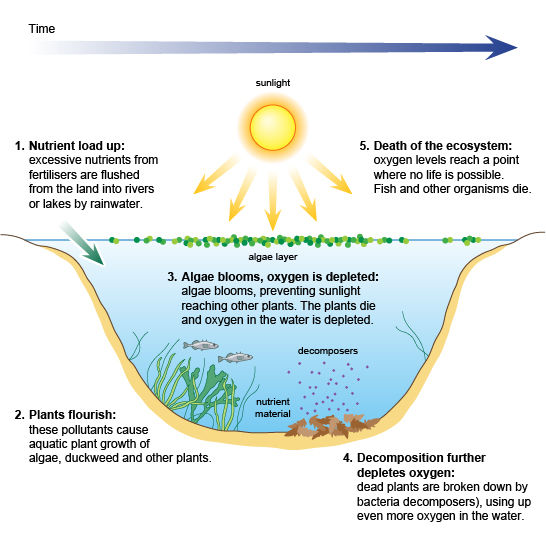
Fertilisers Eutrophication Stagnant water system
Seite 9
B2h - Sustainability
Endangered species = number of individuals of that species is very low and the species therefore is at risk of extinction
Sustainable development = development which meets the needs of the present without compromising the ability of future generations to meet their own needs
Fishing (increase mesh size, fishing quotas, limit of days at sea)
Woodland (Leaving stumps of trees, replanting)
Developed countries:
Produce more waste
Eat more food
Use more energy