
Notizen
Oligopoly
Inhalt der Notizen (8)
Seite 1
Oligopoly
A market dominated by a few large firms
A few firms between them share a large proportion of thte output or sales
Increased market concentration ratios
Many markets tend to be oligopolies in the long run
Characteristics of an Oligopoly
High level of market concentration
Branded / differentiated good or service
Entry barriers
Long-run abnormal profits
Non-price competition
Occasional price wars
Examples of Oligopoly Markets
Petrol retailers
Food retailers
Hotels
Banks
Low cost airlines
Package holidays
DIY stores
Seite 2
Non-Price Competition
When firms compete on other things other than price
Examples of Non-Price Competition
Marketing techniques
Loyalty cards
Banking and other financial services
In store chemists / post offices
Home delivery systems
Discounted petrol
Extension of opening hours
Seite 3
Collusion
Where oligopolists agree formally or informally to limit competition between themselves.
They may set output quotas, fix prices or limit product promotion/development or even agree not to poach each others' target markets
Types of Collusion
Overt collusion - No attempts to hide their collusive acts from the authorities
Covert collusion - Making attempts to hide the results from their collusion, usually to avoid detection by regulators such as when fixing prices
Tacit collusion - When firms act together, but when there is no formal or even informal agreement between them e.g it may be accepted that one firm is the price leader and other firms just simply follow their lead, all firms understand this but no agreement or record exists to prove it
Cartels
Hardcore cartel - an agreement between competitors to fix prices, share markets, rig bids or limit output at the expense of the interests of customers and without any countervailing customer benefits. Usually secret arrangements under which competitor businesses agree to coordinate their activity
Seite 4
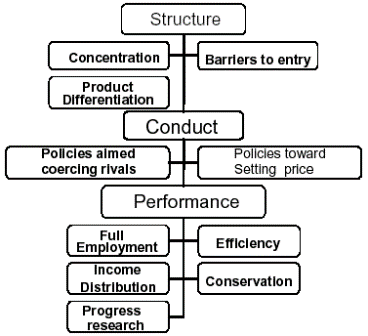
The Structure / Conduct / Performance Model
Analytical framework that makes relations between market structure, market conduct and market performance
Structure
What the market consists of in terms of:
Concentration
Barriers to entry
Product differentiation
Number of competing firms
Ownership - public or private sector
Amount of technology available
Conduct
How the business behaves, which is usually affected by the market structure
How does the market structure affect:
Pricing
Output
Any anti-competitive behaviour - collusion or control over supply chain
Non-price competition
Interdepence
Market Conduct Affects Structure
Decision about research and development and marketing
Performance
How well the business performs compared with competitors in terms of:
Profits
Spending on R&D
Labour productivity
Environmental issues
Efficiency - allocative, productive, dynamic, social
Performance Can Affect Market Structure
Top performing firms will gain market share at the expense of their rivals
This gives them more market power
There is a fine line between market dominance and economic efficiency
Seite 5
Pricing in an Oligopoly
Oligopolies use a variety of pricing techniques
In practice, the pricing strategies in an oligopoly will probably change over time
Pricing Strategies
1. Collusion to charge a high monopoly price
2. Predatory pricing to force rivals out of the market
3. Limit pricing to deter entrants
Collusion for Pricing
Oligopolies may collude with rivals and raise their prices together
Advantages of this Pricing Technique
High prices means higher average revenue
Disadvantages of this Pricing Technique
If the colluding firms are caught by the authorities, it could result in a hefty fine
High prices attracts new entrants
Lower consumer welfare (CSR)
Predatory Pricing
Keeping the prices artificially low, and often below the full cost of production, to force rivals out of the market
Advantages of this Pricing Technique
Forces rivals out of the market so increased market share
Good for consumer as they benefit from low prices - higher consumer welfare (CSR)
Disadvantages of this Pricing Technique
Extremely low / or sometimes no profit margins
Anti-competitive behaviour
Limit Pricing
Reducing price to push competitors to make only normal profits
The oligopoly sarcifises their profit maximisation to push competitors to make only normal profits.
Deters new entrants as there are no abnormal profits in the market
Advantages of this Pricing Technique
Pushes competitors to make only normal profits
No new entrants have the incentive to enter as there are no abnormal profits to be made
Disadvantages of this Pricing Technique
Short term profits are sacrificed
Seite 6
Pricing in an Oligopoly
Price leadership
Price agreements
Price wars
Price Leadership
Where one firm is considered the most dominant (market leader) and has the ability to set a market price
Other firms then follow their lead
Tacit collusion
Price Agreements
An agreement between two competing firms (cartels) regarding pricing of their good or service
Overt collusion
Price Wars
When rival firms continually lower their prices to undercut their competitors
Seite 7
The Kinked Demand Curve (Paul Sweezy)
A model which makes describes the pricing and output in an oligopolistic market
Shows the reaction of rivals to a price change, depending on whether the price is raised or lowered
The elasticity of demand, and hence the gradient of the demand curve, will also be different. The demand curve is kinked at the stable/current price
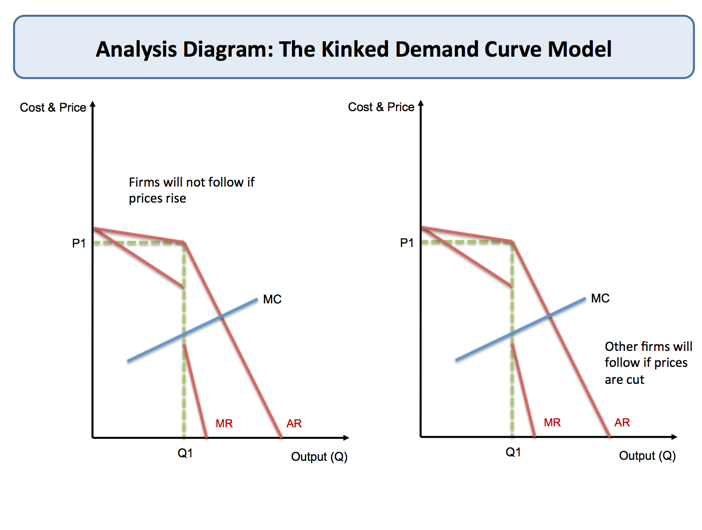
It has created a price and output where it is in equilibrium (P1/Q1)and any change in the equilibrium will not benefit the firm
If you put your price up, competitors will remain at the same price which allows them to take your market share from the loss of your customers as a result of your higher price
If you put your price down, competitors will also put theirs down so your revenue will not change much as all the competitors would have followed
The firm is unable to change their price without having an effect on their profit maximisation
The model shows how the firm is in a time of price stability, which is shown by the vertical discontinuity in the MR curve
Inelastic demand at lower prices, elastic demand at higher prices
Advantages of the Kinked Demand Curve as a Model
It is one possible model of how firms in an oligopoly might behave if they have to consider the responses of their rivals
Gives a theory
Disadvantages of the Kinked Demand Curve as a Model
There is limited real-world evidence for the kinked demand curve model
The theory can be criticised for not explaining why firms start out at the equilibrium price and quantity
Lays emphasis on price rigidity, but does not explain price itself
Ignores non-price competition/price leadership/cartels among organisations
Seite 8
Reaction Curves (Antoine Cournot)
Shows the reaction of firms in response to the action of a competing firms
Shows how both firms adapt their price
Stable Equilibrium Reaction Curve
If firm B sets a price of B1, firm A will respond by setting a price of A1.
However, A1 price is lower than B1 so firm B responds by setting a price of B2 and so on.
The price will carry on falling until they meet the stable equilibrium of A*B* as if they lower the price anymore they will make a loss
Unstable Equilibrium Reaction Curve
If firm B sets a price of B1, firm A will respond by setting a price of A1.
However, A1 price is lower than B1 so firm B responds by setting a price of B2 and so on.
The price will carry on falling until someone leaves the market and this is the creation of a price war as there is no equilibrium to be stable at
This is price instability
Informationen
- Beschreibung
- A level Economics (Micro Revision) Notiz am Oligopoly, erstellt von Zoe WATKINS am 02/06/2017.
- Erstellt von
- Zoe WATKINS
- Aufrufe
- 0
- Bewertung