
Notizen
Chromosomes
Inhalt der Notizen (6)
Seite 1
Prokaryotic genetics
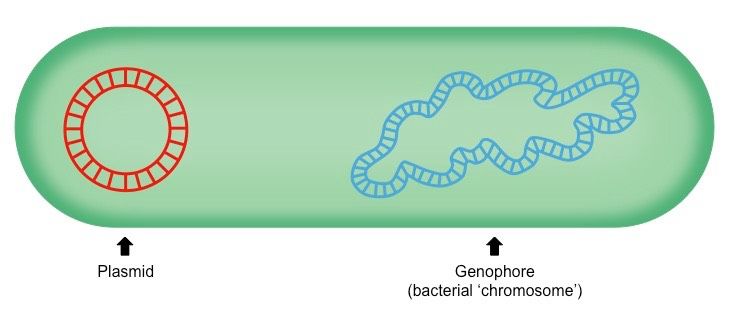
Prokaryotes do not possess a nucleus – instead genetic material is found free in the cytoplasm in a region called the nucleoid
The genetic material of a prokaryote consists of a single chromosome consisting of a circular DNA molecule (genophore)
The DNA of prokaryotic cells is naked – meaning it is not associated with proteins for additional packaging
In addition to the genophore, prokaryotic cells may possess additional circular DNA molecules called plasmids
Plasmids are small, circular DNA molecules that contain only a few genes and are capable of self-replication
Plasmids are present in some prokaryotic cells, but are not naturally present in eukaryotic cells
Bacterial cells may exchange plasmids via their sex pili, in a process known as bacterial conjugation
This exchange of genetic material allows bacteria to evolve new features within a generation (horizontal gene transfer)
As plasmids can self-replicate and autonomously synthesise proteins, they are ideal vectors for gene manipulation in labs
Seite 2
Eukaryote Genetics
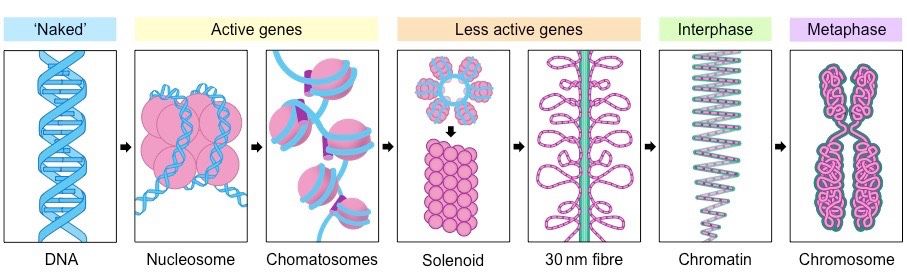
The genetic material of eukaryotic cells consist of multiple linear molecules of DNA that are associated with histone proteins
The packaging of DNA with histone proteins results in a greatly compacted structure, allowing for more efficient storage
Organisation of eukaryotic chromosomes can be summarised as follows:
DNA is complexed with eight histone proteins (an octamer) to form a complex called a nucleosome
Nucleosomes are linked by an additional histone protein (H1 histone) to form a string of chromatosomes
These then coil to form a solenoid structure (~6 chromatosomes per turn) which is condensed to form a 30 nm fibre
These fibres then form loops, which are compressed and folded around a protein scaffold to form chromatin
Chromatin will then supercoil during cell division to form chromosomes that are visible (when stained) under microscope
Seite 3
Diploid versus Haploid
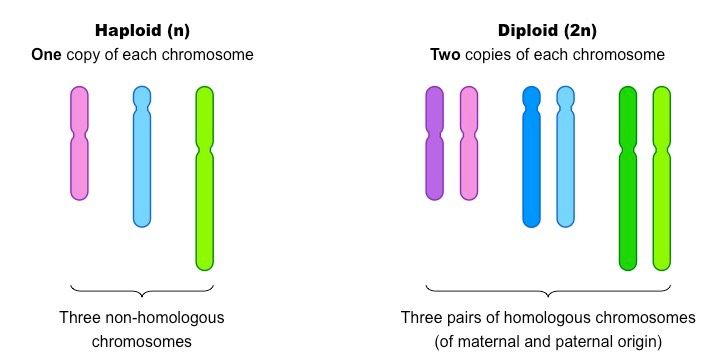
As sexually reproducing organisms receive genetic material from both parents, they have two sets of chromosomes (diploid)
To reproduce in turn, these organisms must create sex cells (gametes) with half the number of chromosomes (haploid)
When two haploid gametes fuse, the resulting diploid cell (zygote) can grow and develop into a new organism
Diploid
Nuclei possessing pairs of homologous chromosomes are diploid (symbolised by 2n)
These nuclei will possess two gene copies (alleles) for each trait
All somatic (body) cells in the organism will be diploid, with new diploid cells created via mitosis
Diploid cells are present in most animals and many plants
Haploid
Nuclei possessing only one set of chromosomes are haploid (symbolised by n)
These nuclei will possess a single gene copy (allele) for each trait
All sex cells (gametes) in the organism will be haploid, and are derived from diploid cells via meiosis
Haploid cells are also present in bacteria (asexual) and fungi (except when reproducing)
Seite 4
Homologous Pairs
Sexually reproducing organisms inherit their genetic sequence from both parents
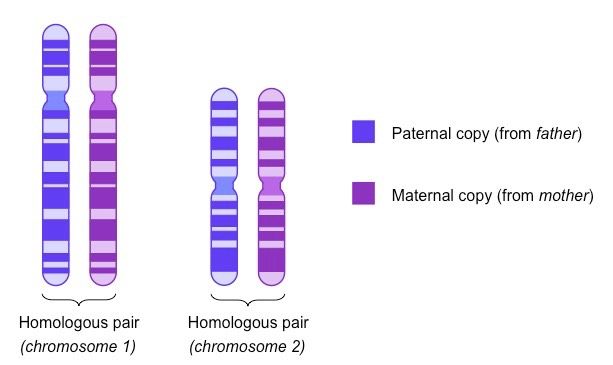
This means organisms will have two copies each chromosome (one maternal and one paternal)
These maternal and paternal chromosome pairs are called homologous chromosomes
Homologous chromosomes are chromosomes that share:
The same structural features (e.g. same size, same banding patterns, same centromere positions)
The same genes at the same loci positions (while the genes are the same, alleles may be different)
Homologous chromosomes must be separated in gametes (via meiosis) prior to reproduction, in order to prevent chromosome numbers continually doubling with each generation
Seite 5
Autosome versus Heterosome
In humans, sex is determined by a pair of chromosomes called the sex chromosomes (or heterosomes)
Females possess two copies of a large X chromosome (XX)
Males possess one copy of an X chromosome and one copy of a much shorter Y chromosome (XY)
The Y chromosome contains the genes for developing male sex characteristics (specifically the SRY gene)
In its absence of a Y chromosome, female sex organs will develop
The sex chromosomes are homologous in females (XX) but are nothomologous in males (XY)
Hence the father is always responsible for determining the sex of offspring:
If the male sperm contains an X chromosome, the growing embryo will develop into a girl
If the male sperm contains a Y chromosome, the growing embryo will develop into a boy
In all cases the female egg will contain an X chromosome (as the mother is XX)
The remaining chromosomes in the organism are called autosomes(they do not determine sex)
Seite 6
Informationen
- Beschreibung
- GCSE Biology (Reproduction and cell division) Notiz am Chromosomes, erstellt von Arianna Weaving am 21/07/2017.
- Erstellt von
- Arianna Weaving
- Aufrufe
- 0
- Bewertung