
Notizen
Meiosis - Cell Divison
Inhalt der Notizen (1)
Seite 1
Introduction to Meiosis
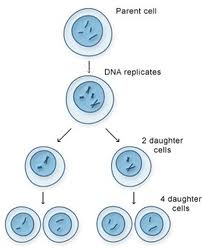
Meiosis is a form of nuclear division in which the daughter nuclei contain half the chromosomes number as the parent nucleus. Immediately after Meiosis, the daughter nuclei are enclosed by cells. When meiosis takes place in a diploid cell (2n) , the daughter cells will be haploid (n). If these cells are capable of joining with another haploid cell from the opposite sex, they are called sex cells or gametes. Most human cells have 46 chromosomes (diploid cell). Meiosis occurs in the ovaries and testes to produce gametes called eggs and sperm, respectively. As a result of meiosis, there are 23 chromosomes in each egg or sperm.
Functions of Meiosis
Meiosis has two basic functions in multicellular organisms -
1. It allows for sexual reproduction without increasing the number of chromosomes in the offspring.
2. It allows for new combinations of genes to be formed - which will give rise to variations amoungst organisms.
Meiosis allows for sexual reproduction
In axesual reproduction, a single parent splits to form two or more offspring. The new cells are formed by mitosis and so the offspring are identical.
In sexual reproduction, two cells join to form a zygote. These cells are called gametes or sex cells.
In animals, the gametes are the sperm and the egg. In flowering plants, the gametes are the male gamete nuclei and the egg and polar nuclei. The zygote will contain the normal number of chromosomes.
Meiosis is essential for sexual repreduction ebcause it halves the chromosome number. This means that the normal chromosome number is restored at fertilisation. For example, In humans the normal chromosome number is 46. Meiosis halves this number to 23 in the gametes. Fertilisation restores the chromosome number back to 46 (Two gametes join, each with 23 chromosomes - 23+23=46.)
Meiosis allows for variation
The cells resulting from meiosis are not identical. Their genes vary due to the exchange of genetic material which takes place during meiosis. The variation in the genes (genetic variation) produced in meiosis results in variations in different organisms resulting from sexual reproduction. This is why brothers (or sisters), while they may resemble each other, they are rarely identical.
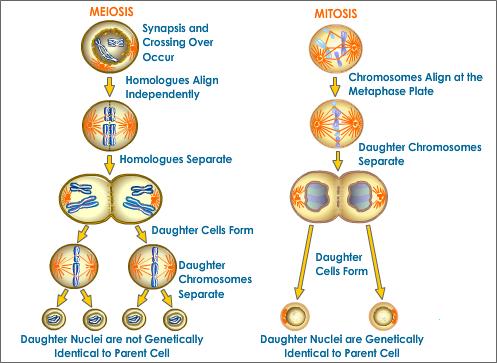
Differences between Mitosis and Meiosis
Mitosis - the number of chromosomes in each resulting cell is the SAME as the number of chromosomes in the parent cell.
Meiosis - the number of chromosomes in each resulting cell is HALF the number of chromosomes in the parent cell.
Mitosis - the genes present on the chromosomes of the resulting cells are IDENTICAL.
Meiosis - the genes present n the chromosomes in the resulting cells are DIFFERENT.
Meiosis
Informationen
- Beschreibung
- Meiosis is a form of nuclear division in which the daughter nuclei contain half the chromosome number as the parent nucleus. This note outlines the processes in Meiosis. It would appeal to anyone studying intermediate level biology.
- Erstellt von
- daniel.praecox
- Aufrufe
- 288
- Tags
- Verlauf
-
- Erstellt von jill.examtime · 22 Jan 2014
- Kopiert von daniel.praecox · 22 Jan 2014
- Bewertung