
Karteikarten
Applied Year 10 - Unit 2 - Topic 2.3.1 Factors affecting human health

Karten in diesem Stapel (42)
- 1What is a chromosome?Chromosome contain DNA molecules which determine inherited characteristics and are found in pairs
- 2What is a gene?Sections of DNA molecules that determine inherited characteristics
- 3What is an allele?Different forms of a particular gene e.g. eye colour - blue, brown
- 4Describe the structure of DNADNA contain four bases - A, T, C and G. These bases pair up (A-T, C-G) to bases on another strand with hydrogen bonds to form a double helix.
- 5In genetics, what is meant by the term dominant?An allele that shows the phenotype whenever it is present (shown by a capital letter)
- 6In genetics, what is meant by the term recessive?An allele that is hidden when a dominant allele is present (shown by a lower case letter)
- 7In genetics, what is meant by the term homozygous?Contains two identical alleles for the gene concerned (e.g. BB, bb)
- 8In genetics, what is meant by the term heterozygous?Contains two different alleles for the gene concerned (e.g. Bb)
- 9In genetics, what is meant by the term genotype?The genetic makeup of an individual
- 10In genetics, what is meant by the term phenotype?The description of the way the genotype ‘shows itself’ (e.g. blue eyes, red flowers)
- 11If a tall plant (TT) is crossed with a short plant (tt), what is the percentage chance of a tall plant being produced?100% chance of plant being tall

- 12If a person with blue eyes (bb) has child with a person with brown eyes (Bb), what is the percentage chance of having a child with brown eyes?50% chance of having a child with brown eyes

- 13Tall allele is dominant, short allele is recessive. If a homozygous recessive plant is crossed with a heterozygous plant, what is the ratio of tall plants to short plants produced?1:1 (2:2)

- 14How many pairs of chromosomes do humans have?23 pairs
- 15How is cystic fibrosis and Huntington's inherited?The child must inherit a recessive allele from each of the parents as cystic fibrosis is a recessive disease
- 16How are new genes produced?Mutations (changes in genes)
- 17Do mutations always have an effect?Not always - some mutations can be harmful, beneficial or have no effect at all
- 18How can you increase the chance of mutation?Mutation rates can be increased by ionising radiation
- 19Why do some people have Down's syndrome?There can be chromosome abnormalities in humans.
Down's syndrome is the result of an extra chromosome (47 rather than 46) - 20What are the short term effects of alcohol?Slows down reactions as it is a depressant
- 21What are the long term effects of alcohol?Can become addicted or dependent on alcohol
Physical damage: liver disease, circulatory, heart diseases - 22Why is smoking bad for your health?Carcinogens can lead to lung cancer.
Nicotine is addictive.
Cigarette smoke destroys lung tissue which leads to emphysema. - 23What is meant by the term carcinogen?A cancer causing substance
- 24Name a carcinogen in cigarettesTar
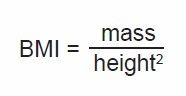
- 25What do doctors use to assess if someone is overweight?BMI (body mass index)
- 26What is the equation for BMI?
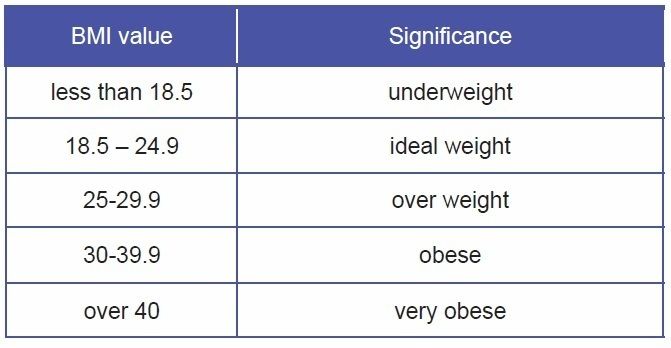
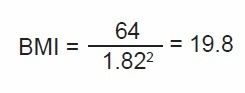
- 27Using the table, calculate the BMI for a person who has a mass of 64 kg and a height of 1.82 m.The person has an ideal weight for their height
- 28What are the limitations of BMI?• athletes – BMI does not distinguish between fat and muscle, which tends to be heavier and can tip more toned individuals such as athletes into overweight status, even if their fat levels are low.
• children - children are growing and may show significant variations in height, muscle tone etc. at different ages. BMI charts designed for adults should not be used for children. - 29What is the reference intake (RI)?The reference intake is the amount regarded as suitable to maintain a
healthy body. - 30What is guideline daily amount (GDA)?An older term you may see is guideline daily amounts (GDAs). It means the same thing as RI.
The new reference intake values (RIs) are values which have been set out in European law. - 31Why is salt needed by our body?Salt is a necessary nutrient
for correct functioning of our bodies. - 32What happens if there is too little salt in your diet?• muscle cramps
• dizziness
• electrolyte disturbance - 33What happens if there is too much salt in your diet?• high blood pressure leading to an increased risk of heart disease and strokes
- 34What is homeostasis?Homeostasis control mechanisms in the body work by negative feedback. Conditions, such as temperature and the level of glucose in the blood, need to be controlled so that a constant internal environment in the body can be maintained.
- 35How does the body control the blood glucose levels?The body controls this by the hormones insulin and glucagon. These hormones control the release and storage of glucose.
- 36Where are insulin and glucagon released from?Pancreas
- 37How does insulin work?If blood glucose levels are too high, insulin acts on the liver, causing it to convert excess glucose into glycogen for storage.
- 38How does glucagon work?If blood glucose levels are too low, glucagon acts on the liver, causing it to convert glycogen back to glucose.
- 39What is the difference between Type 1 and Type 2 diabetes?Type 1 diabetes – The body does not produce sufficient insulin
Type 2 diabetes – Body cells do not correctly respond to the insulin that is produced - 40What is the treatment for Type 1 diabetes?This can be treated by controlling the amount of sugar and carbohydrate in the diet and regular insulin injections. A pancreas transplant will also provide a new source of insulin.
- 41What is the treatment for Type 2 diabetes?This is treated by controlling the amount of sugar and carbohydrate in the diet and
taking medication which makes the liver respond to the insulin. - 42How do we test for diabetes?A common symptom of diabetes is the presence of glucose in urine. We can test the urine for blood glucose
using Benedict’s solution.
Informationen
- Beschreibung
- GCSE Biology Karteikarten am Applied Year 10 - Unit 2 - Topic 2.3.1 Factors affecting human health, erstellt von Mrs Z Rourke am 19/04/2018.
- Erstellt von
- Mrs Z Rourke · Apr 2018
- Aktualisiert
- 19 Apr 2018
- Aufrufe
- 633
- Bewertung