
Ohne Titel
Folien in diesem Satz (5)
-
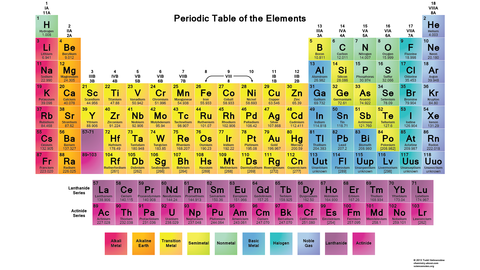
- Bildunterschrift: Periods go across (rows = tell you the number of shells that the element has, collums are groups = tell you how many electrons in the outer shell
-
- Element
- Lithium - burns crimson
- sodium - burns yellow
- potassium - burns lilac
- rubidium - burns red
- cesium - burns blue/violet
- Reaction with water (all react with water, intensity increases as you go down): They are called alkaline metals because they react with water to form alkaline solutions E.G: lithium+water=lithium hydroxide + hydrogen
- Reaction to oxygen: They burn in the air to form basic oxides Eg: lithium+oxygen=lithium oxide
- burn with a characteristic flame color . They dissolve in water to form an alkali solution.
- Physical properties:
- low melting, boiling and densities compared to other metals
- soft'n'shiny easily cut with a knife
- tarnish easily, melting and boiling points decrease as you go down the group (reactivity increases) stored in oil to prevent them from reacting with air
- good conductor of electricity
- Chemical properties:
- They have similar properties beacuse when they react they lose one electron to form a positive ion with a stable electronic structure. This is an example of oxidization (oxidization is the loss of electrons). They become more reactive because ass the group goes down it is easier for the atom to lose its out most electron (further from the nucleus- attraction gets smaller)
-
- element colour state (25C) Use
- Florine yel/green Gas toothpaste
- chlorine green Gas sterilizing water
- bromine Orange Liquid pesticides/plastic
- iodine Grey Solid sterilizing wounds
- Physical properties
- low melting and boiling points (which increase as you go down the group)
- poor conductors of electricity
- All are diotomic
- soluble + react with water
- soluble in organic solvents to form solutions with colours (Cl-colourless, Br- organge, I- purple)
- Chemical properties
- when reacting an atom gains an electron making it negitive (less easy/less reactive as group goes down- closer to nucleus)
- they are reactive non-metals
- Reaction with water:
- When added to water an acid is formed, containing oxygen which works as a bleaching agent. To test for chlorine gas it turns litmus blue and then bleaches the litmus.
- Reactions with Metals
- The word halogen means salt producer, they react well with metals and from salt (halides)
- A more reactive halogen will displace a less reactive one in on of its compounds
- Test for halogens
- 1. A material that contains ionic halogens will burn with a green flame is heated on a copper wire
- 2. Few drops of nitric acid then add a few drops of silver nitrate (Should for a coloured precipitate)
-
- Metals properties
- Shiny
- ductile
- good conductors of heat and electricity
- high melting points (mercuary is low)
- Metal oxides form basic oxides which 1. do not disolve in water and 2. react with acids to form salts (MgO + HCl = H2O + MgCl).
- metal oxides which do dissolve in water form alkalies
- Non-metals properties
- poor conductors of both heat and electicity
- brittle
- dull
- low melting point
- Non metal oxides dissolve in water to typically formacids or acidic oxides
Informationen
- Beschreibung
- IGCSE edexel Chemestry Folienset am Ohne Titel, erstellt von khtsmith09 am 04/11/2015.
- Erstellt von
- khtsmith09 · Nov 2015
- Aktualisiert
- 6 Apr 2018
- Aufrufe
- 2
- Bewertung