
Notizen
Restless Earth - created from Mind Map
Inhalt der Notizen (1)
Seite 1
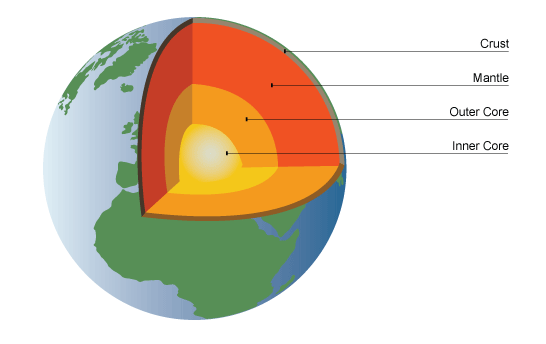
Two types of crust
Continental crust - makes up most of the land area of the Earth. Dominated by rocks below the surface such as granite.
Oceanic crust - much thinner, made up of rocks such as basalt.
Between 25 and 80km thick
Between 6 and 8km thick
How the earth's tectonic plates move
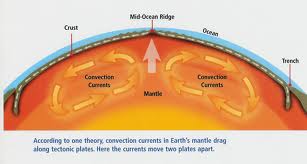
Convection Currents - High temps in the core caused by gradual radioactive decay create rising limbs of material in the mantle
Cool and spread out before sinking again like a lava lamp. Some move in sheets, creating movements in the crust above, which is pulled apart to form a new crust.
Other places it rises as columns, creating hotspots.
Plate boundaries
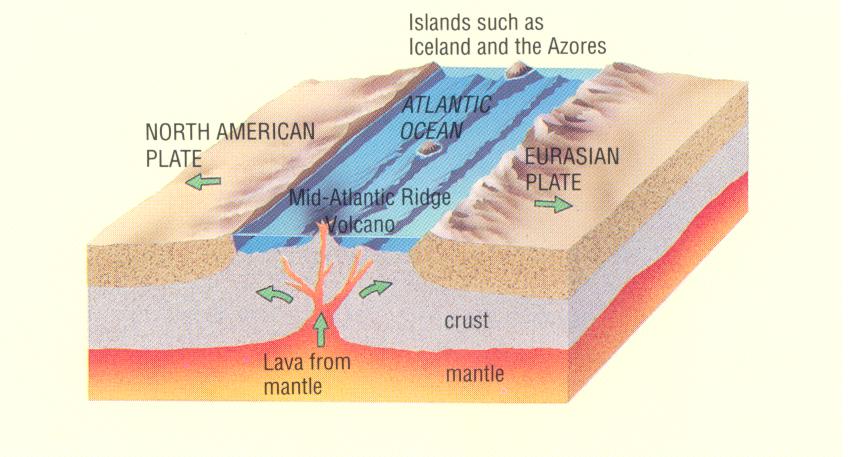
Constructive margins
Destructive margins
Conservative margins
Formed by magma splitting up continental crust and forming new oceans.
E.g. The Eurasian plate and North American plate.
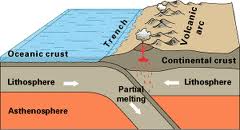
Oceanic plates collide with Continental plates
When this occurs, the denser basaltic oceanic plate sinks beneath the continental plate
This process is known as subduction and creates a very deep ocean trench near the line of contact between the oceanic and continental plates
Increase pressure and temperature
Lightweight materials melt and rise to the surface to form volcanoes
As a result- long chains of volcanoes, known as volcanic arcs are located above subducted plates
Collision of the plates also lifts and buckles the continental plate, creating fold mountains; for example the Andes.
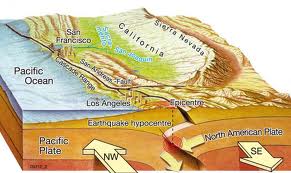
Where plates slide past each other or move in the same direction but at different speeds
No crust is formed or destroyed, no volcanoes form
Strain builds up along the junction, with sudden lurches along the fault
Earthquakes are frequent and often large
Different hazards and their causes
Volcanic eruptions generate earthquakes, but earthquakes also occur on conservative margins.
Two main types of Volcanoes
Earthquakes are more dangerous because you can't predict them
Both can cause a Tsunami as a Secondary Hazard. Travel across oceans at speeds up to 900 km/h and be 20-30m high
Composite/strato
Shield
Steep sided, small area. Alternate layers of lava and ash
Magma/lava type- viscous/sticky and flows slowly.
Infrequent and sometimes unpredictable. Happens due to pressure building up over time
Examples - Mt. Pinatubo (Philippines) and Mt. Sakurajima (Japan)
Gentle Slopes, Almost all lava
Fluid- flows very very quickly
Very frequent and generally gentle erruptions
Mauna Loa (Hawaii, USA) and Mt. Nyiragongo (DRC)
Impact of Earthquakes
Factors that control severity; -Magnitude -The depth -Distance from epicentre -Time of day -Level of preparedness -Quality of emergency services
Primary impacts- Immediate effect (Deaths, shaking and property destruction)
Secondary impacts- Property and people of an event after it's finished (Fires, lack of shelter)
Port-au-Prince, Haiti
Epicenter- point on the earths surface vertically above the focus of an earthquake
Magnitude 7.0 , Depth 13km , 316,000 deaths and 30,000 injuried, £8.5 billion lost (Primary) 7000 people killed, 1 million people homeless(Secondary)
Living with Volcanoes
Active, dormant or extinct.
Dormant - A volcano which hasn't erupted in a long time but is till capable of doing it.
Prediction, warning and evacuation
Can normally be predicted (aswell as tsunamis) if the right equipment is in place
Mitigation - Action of reducing the severity of something
Developed wold- making new buildings better. - Foundations deep but allow movement, shock absorbers built, cross bracing to prevent floors collapsing
Gas emissions - Earth tremors and 'bulging' of a volcano's flanks can be measured and used to predict eruptions
Tsunami sirens
Developing world- Reduce weight of roofs, lightweight hollow bricks used, strengthen wall corners with wire mesh and cement
Response and relief in Haiti
Event
Response
Strongest earthquake in Haiti since 1770, 7.0 magnitude, epicentre was 10 miles west of Port-au-Prince and its 2 million people living there. Aftershocks ranging in magnitude from 4.2 to 5.9
3 million people in need of emergency aid and the red cross dispatched a relief team. World vision provided food to .2 million people, emergency shelters for 41,000 families with 16 millions litres of clean water, installed 300 showers and 240 toilets. Inter-American Development bank gave $200,000 grant for emergency aid and Obama promised $100,000 million in aid to Haiti
Restless Earth
Informationen
- Beschreibung
- Geography (Restless Earth) Notiz am Restless Earth - created from Mind Map, erstellt von georgia.somerville am 03/12/2013.
- Erstellt von
- georgia.somerville · Dez 2013
- Aktualisiert
- 28 Nov 2016
- Aufrufe
- 442
- Tags
- Verlauf
-
- Erstellt von georgia.somerville · 3 Dez 2013
- Zu Notiz kopiert von georgia.somerville · 3 Dez 2013
- Bewertung