
Notizen
Formation of Peptide Bonds
Inhalt der Notizen (5)
Seite 1
Formation of Peptide Bonds
Peptide bonds are formed with the assistance of Adenine TriPhosphate (ATP) via an endothermic (energy-absorbing) reaction.
Seite 2
****DISCLAIMER: NONE OF THE IMAGES IN THE FOLLOWING DOCUMENT BELONG TO ME, NOR DO I CLAIM THEM TO BE SO. I AM NOT MAKING ANY PROFIT FROM THIS RESOURCE. NO COPYRIGHT INFRINGEMENT INTENDED.****
FORMATION OF PEPTIDE BONDS
Peptide bonds make up the backbone of proteins. They are the bond between the nitrogen (N) of one amino acid and the carbonyl carbon (C) of the next amino acid. The reaction gives off water as a side product: the H comes from the nitrogen, and the OH comes from the carboxylic acid.
Peptide bonds are formed via an exothermic reaction with the assistance of ATP.
Seite 3
Seite 4
Adenine Triphosphate (ATP)
Adenine TriPhosphate (ATP) is the energy molecule found in all living systems. It consists of a ribose sugar attached to a triphosphate group and an adenine base.
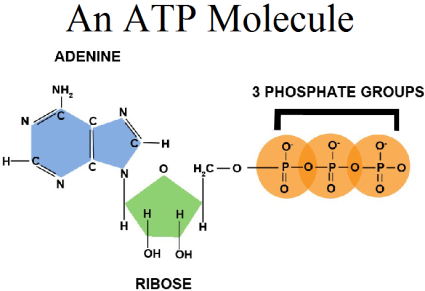
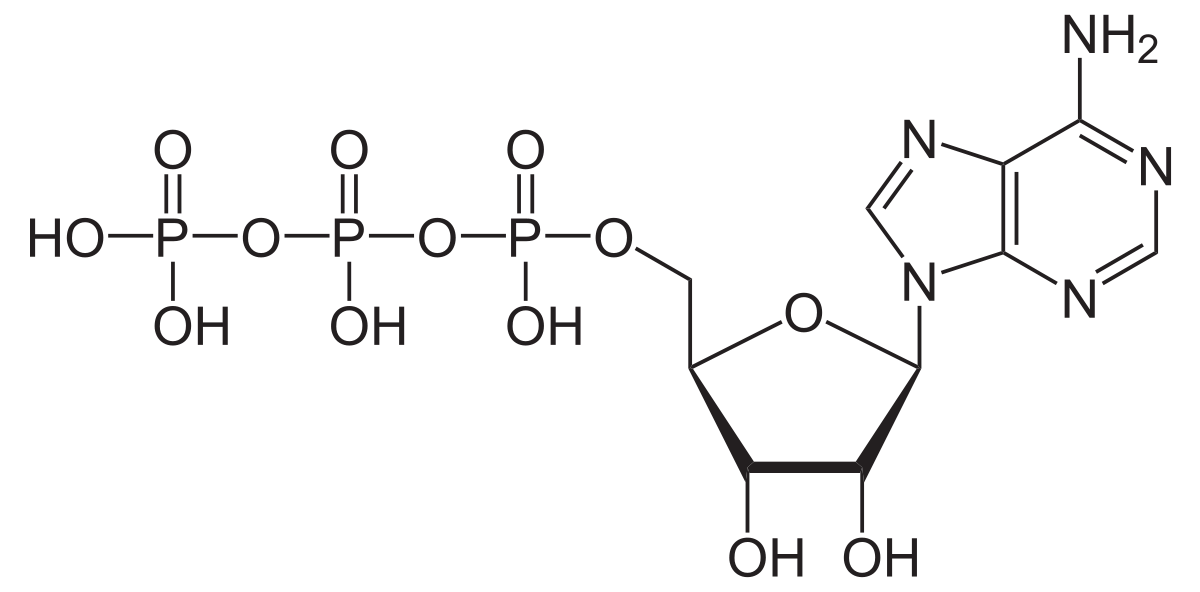
Ribose sugars consist of a 5-membered ring of 4 carbons and one oxygen, and two OH groups.
Deoxyribose sugars, which are found in DNA, are similar, but they only contain one OH group.
Adenine (A) is a nitrogenous base.
Purines are double-ringed nitrogenous bases. Adenine (A) and guanine (G) are both purines.
Pyrimidines are single-ringed nitrogenous bases. Cytosine (C), Thymine (T, found only in DNA), and Uracil (U, found only in RNA) are all pyrimidines.
Seite 5
Peptide Bonding Mechanism
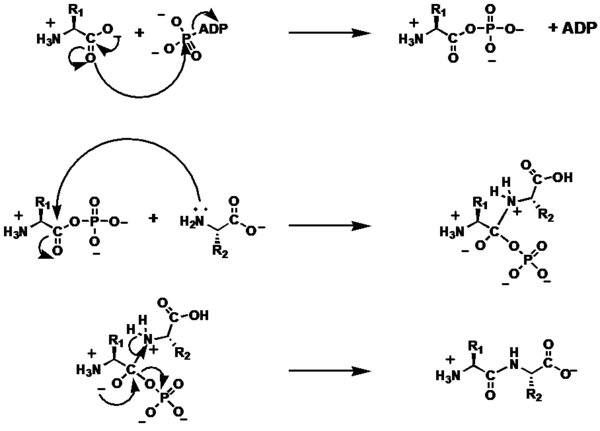
As previously stated, the peptide bond formation requires use of ATP.
In the below figure, ATP is shown as a phosphate group (PO3 2-) attached to adenine diphosphate.
Informationen
- Beschreibung
- Includes the mechanism of peptide bond formation, as well as some information on ATP.
- Erstellt von
- Simone Evans · Feb 2017
- Aktualisiert
- 16 Feb 2017
- Aufrufe
- 106
- Tags
- Bewertung