
Notizen
Electrode Potentials
Inhalt der Notizen (3)
Seite 1
Electrochemical cells make electricity
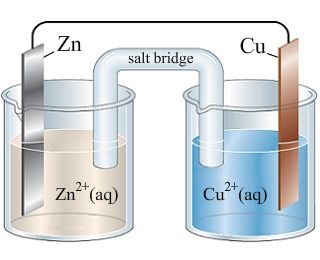
An electrochemical cell can be made from two different metals dipped in salt solutions of their own ions and connected by a wire (an external circuit).
There are always two reactions within an electrochemical cell - one's an oxidation and one's a reduction - it's a redox process.
Here's what happens in the zinc/copper electrochemical cell:
Zinc loses electrons more easily than copper. So in the half-cell on the left, zinc (from the electrode) is oxidised to form Zn2+ ions. This releases electrons into the external circuit.
In the other half-cell, the same number of electrons are taken from the external circuit, reducing the Cu2+ ions to copper atoms.
Electrons flow through the wire from the more reactive metal to the less reactive one.
A voltmeter in the external circuit shows the voltage between the two half-cells. This is the cell potential or EMF (electromotive force).
You can also have half cells involving solutions of two aqueous ions of the same element, such as Fe2+/Fe3+. The conversion from Fe2+ to Fe3+ or vice versa happens on the surface of a platinum electrode. The electrode is made of platinum because it is an inert metal, so it won't react with the ions.
Seite 2
The reactions happening at each electrode are reversible
The reactions that occur at each of the electrode in an electrochemical cell are reversible.
EXAMPLE
The reactions that are taking place in the Zinc/copper cell previously are:
Zn2+ + 2e- <-----> Zn
Cu2+ + 2e- <-----> Cu
The 'reversible' arrow shows that the reactions can go in either direction
These equations are half equations. When you write half equations for electrochemical cells, they're always written with the reduction reaction going in the forward directions (e- on the left hand side).
When two half cells are joined to made a cell, the direction the reaction will actually go in depends on how easily each metal loses e- (how well it is oxidised).
How easily a metal is oxidised is measured using electrode potentials. A metal that's easy to oxidise has a very negative electrode potential. One that's harder to oxidise has a less negative (or more positive) electrode potential.
Electrode potential of Zn2+/Zn = -0.76
Electrode potential of Cu2+/Cu = +0.34
The Zinc half-cell has a more negative electrode potential than the copper half cell. So in a zinc copper half cell:
Zinc is oxidised (the half equation shown above goes backwards).
Copper is reduced (the half equation show above goes forwards).
Once you know which direction each of the half equations will go in, you can write the equation for the overall reaction that will happen in the cell:
Cu2+ + Zn <------> Cu + Zn2+
Seite 3
Electrode potentials are measured against standard hydrogen electrodes
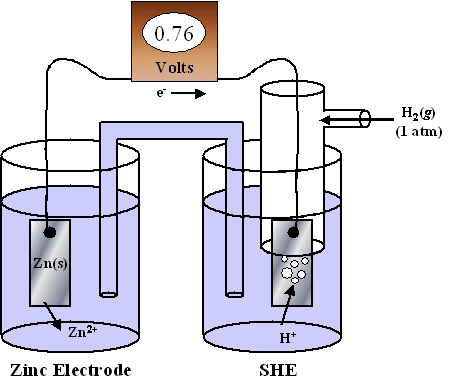
You measure the electrode potential of a half-cell against a standard hydrogen electrode.
The cell potential is affected by the conditions (temperature, pressure and concentrations).
To get around this, standard conditions are used to measure electrode potentials.
The standard electrode potential of a half cell is the voltage measured under standard conditions when the half-cell is connected to a standard hydrogen electrode.
Standard conditions are:
Any solutions must have a concentration of 1.00 mol/dm3
The temperature must be 298 K
The pressure must be 100kPa
The cell below would allow you to find the electrode potential of the Zn2+/Zn half-cell.
If standard conditions are maintained, the reading on the voltmeter when a half-cell is connected to the standard hydrogen electrode will be the standard electrode potential of that half-cell
Informationen
- Beschreibung
- A2 Chemistry (Electrode Potentials and Cells) Notiz am Electrode Potentials, erstellt von Lucy Nove am 27/02/2017.
- Erstellt von
- Lucy Nove · Feb 2017
- Aktualisiert
- 28 Feb 2017
- Aufrufe
- 6
- Bewertung