
Quiz
Wk 7 - Applied Microbiology and Haemotology
Dieses Quiz enthält Fragetypen, die sich im gewohnten Player öffnen.
Fragen in diesem Quiz (77)
1Select two reasons for preventing microbes from getting into food.
- APrevent slow decomposition process
- BPrevent bad odors
- CPrevent food spoilage
- DPrevent food related illnesses
2Select Five ways how could microbes contaminate food
- A• with soil
- B• preparation procedures
- C• improper storage
- D• harvesting/slaughtering
- E• handling
- F• incorrect food stacking in fridge
- G• delayed pesticides
3How does fermentation preserve food?
- AIncreases shelf life and safety of product and Improves digestibility, nutritional content
- BIncreases putrification and safety of product and speeds up disease process, nutritional content
4List Five relevant boxes to pathogenic bacteria, viruses and parasites that can cause illness through food or water
- ASalmonella spp. infection
Vibrio cholera
Vibrio parahaemolyticus - BRotavirus
Hepatitis A
Polio Vaccine
Adenovirus - CHelminths
Crytosporidium parvum
Entamaeba histolytica
Giardia lamblia - DBacillus cereus intoxication
Clostridium botulinum
Staphylococcus aureus
Campylobacter infection - ENorovirus
Astrovirus
Entrovirus (Echovirus) - FRhinovirus
Sinusitus
Pleurusy
TSS
- ASalmonella spp. infection
5Norovirus, Astrovirus and Entrovirus (Echovirus) are types of parasitic foodborne diseases
- ARichtig
- BFalsch
6Bacillus cereus, Clostridium botulinum, Staphylococcus aureus, Campylobacter infection, Salmonella spp. Vibrio cholera & Vibrio parahaemolyticus are types of Bacterial foodborne diseases
- ARichtig
- BFalsch
7Why does spoilage of food appear rapid when the microbes are on the food for long periods before the appearance of spoilage?
- A• Due to exponential growth pattern microbes
- B• Due to stationary pattern of microbes
8List Two uses for microbes in the industry.
- AGenetic engineering – deliberate modification of an organisms genome
- BRecombinant DNA technology – isolating a specific gene and inserting into a vector (plasmid) to form a recombinant molecule and producing large amounts of gene product
- CHigh transfection efficiency
9List Five reasons for treating waste water.
- A• Remove pathogens: bacteria, viruses, eggs and cysts of parasitic worms
- B• Remove nutrients that cause pollution
- C• Prevent foul odours: H2S, amines, oil and grease scum
- D• Prevent contamination of drinking water
- E• Remove toxins: metals, pesticides, herbicides
- F• Remove bad taste
10What is B.O.D?
- ABiochemical Oxygen Demand
- BBiological Oxydation Determination
11Why is Biochemical Oxygen Demand important?
- ADetermines the levels of biological degradable organic material present in water
- BDetermine the levels of biological mercury not organic material present in water
12What is the main process in secondary sewage treatment?
- AMicrobial digestion of organic material and hydrolysis
- BMicrobial digestion of organic material and Haemolysis
13Give 3 uses for Bacteriophage
- A• Possible treatment for bacterial infection
- B• Identify pathogenic bacteria (Phage typing)
- C• Recombinant DNA technology
- D• Complete eradication of Viruses
14What are the advantages of using HIV as a vector for gene therapy?
- A• Retrovirus
• Reverse transcriptase generates DS-DNA
• Integrated into host chromosome
• Gene replacement therapy
• Deliver and express gene - B• Rhinovirus
• Quickly transcriptase generates DS-DNA
• Non-conforming into host chromosome
• Prevention of Gene replacement therapy
• Deliver and express gene
- A• Retrovirus
15Name 5 different areas of study within the field of Haematology
- AHaemopoiesis
- BCoagulation
- CHaemoglobin
- DFormed elements of blood
- EBlood transfusion / cross matching
- FDialylsis
16What is Anaemia?
- AAn abnormal decrease of RBC
- BAn abnormal increase of RBC
17Explain what is meant by the term Leukaemia.
- AAn abnormal increase of WBC
- BAn abnormal decrease of WBC
18What is Haemopoiesis?
- AThe production of the formed elements of blood - WBC’s, RBC’s and platelets
- BThe breakdown of the formed elements of blood - WBC’s, RBC’s and platelets
19What is Erythropoiesis?
- AThe process which produces red blood cells (erythrocytes).
- BThe process which produces white blood cells (leukocytes).
20What is the correct term for a decrease in neutrophils?
- ANeutropaenia
- BNeutrophilia
21Where does Haemopoiesis occur? Select Two answers
- AFoetus - yolk sac, liver, spleen, bone marrow, lymph nodes
- BAdult - bone marrow
- CFoetus - liver, kidneys, placenta, bone marrow, lymph nodes
- DAdult - bone marrow, liver
22Describe the shape of a RBC. Why do RBCs have this shape? Select Two answers
- AShape allows for slow and constant diffusion of gasses, flexibility, change in shape/size
- BBiconcave disc - sturdy
- CBiconcave disc - flexible
- DShape allows for rapid diffusion of gasses, flexibility, change in shape/size
23Discuss the significance of the RBC membrane.
- Arapid diffusion of gasses
- Bslow yet constant diffusion of gasses
24List 3 Granulocytes that can be found in peripheral blood.
- ANeutrophils
- BBasophils
- CEosinophils
- DMonocytes
- ELymphocytes
25List each of the 5 WBC types found in peripheral blood
- ANeutrophils
- BMonocytes
- CLymphocytes
- DEosinophils
- EBasophils
- FLeukocytes
- GPlatelets
26Neutrophils are the most common type of WBC and have
- Asmall granules in cytoplasm
- Blarge granules in cytoplasm
27Eosinophils have
- Alarge strongly staining (orange/red) cytoplasm granules
- Bsmall strongly staining (blue/purple) cytoplasm granules
28Basophils have
- Alarge cytoplasmic granules (dark staining)
- Bsmall cytoplasmic granules (orange staining)
29Lymphocytes have a
- Alarge round nucleus/less cytoplasm
- Bno nucleus/lots of cytoplasm
30Monocytes are the largest WBC and have a
- Akidney shaped nucleus
- Bliver shaped nucleus
31Select type of WBC
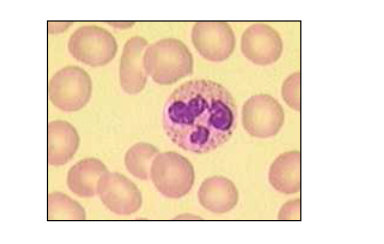
- ANeutrophils
- BEosinophils
32Select type of WBC
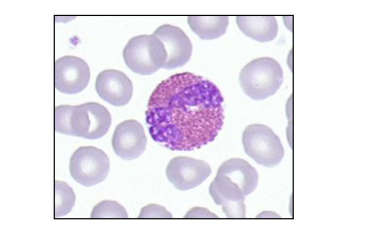
- AEosinophils
- BBasophils
33Select type of WBC
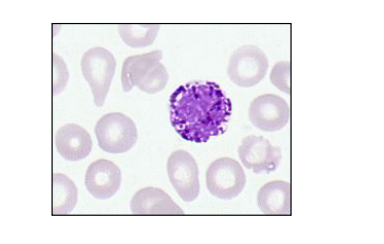
- ABasophils
- BNeutrophils
34Select type of WBC
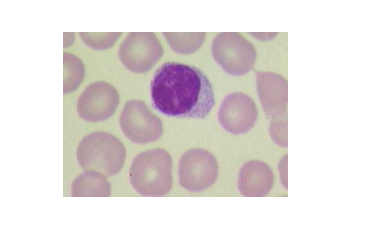
- ALymphocytes
- BBasophils
35Select type of WBC
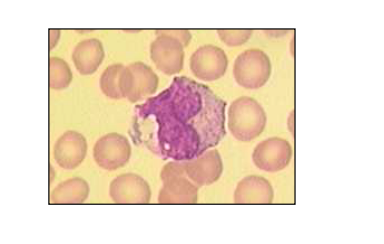
- AMonocytes
- BEosinophils
36What is the term used to describe variation in RBS size?
- AAnisocytosis
- BPoikilocytosis
37Select the correct definition of Elliptocytes (RBC Poikilocytosis)
- A– Oval shaped rather than thin or round
– Less pronounced defects
– Found in some types of anaemia - B– Thin elongated cigar shaped cells
– Change to membrane structure
– Found in various types of anaemia
- A– Oval shaped rather than thin or round
38Select the correct definition of Ovalocytes (RBC Poikilocytosis)
- A– Oval shaped rather than thin or round
– Less pronounced defects
– Found in some types of anaemia - B– Thin elongated cigar shaped cells
– Change to membrane structure
– Found in various types of anaemia
- A– Oval shaped rather than thin or round
39Select the correct definition of Codocytes (RBC Poikilocytosis)
- A– Loss of biconcave shape
– Increased surface area:volume ratio - B– Loss of biconcave shape - sphere
– Decreased surface area:volume ratio
– Found in many anaemias
- A– Loss of biconcave shape
40Select the correct definition of Spherocytes (RBC Poikilocytosis)
- A– Loss of biconcave shape - sphere
– Decreased surface area:volume ratio
– Found in many anaemias - B– Loss of biconcave shape
– Increased surface area:volume ratio
- A– Loss of biconcave shape - sphere
41Select the correct definition of Schistocytes (RBC Poikilocytosis)
- A– Irregularly contracted fragments
– Variable appearance
– Found in conditions with trauma to RBC’s e.g. burns - B– Elongated, crescent shaped
– Sickle cell anaemia
– Abnormal haemoglobin (HbS)
- A– Irregularly contracted fragments
42Select the correct definition of Drepanocytes (RBC Poikilocytosis)
- A– Elongated, crescent shaped
– Sickle cell anaemia
– Abnormal haemoglobin (HbS) - B– Irregularly contracted fragments
– Variable appearance
– Found in conditions with trauma to RBC’s e.g. burns
- A– Elongated, crescent shaped
43Select the correct definition of Acanthocytes (burr cells) (RBC Poikilocytosis)
- A– Multiple irregular thorny projections
– Changes in phospholipid metabolism
– Found in liver disease - B– Teardrop shape
– Stretched out of shape - excessive time (spleen)
– Found in many conditions
- A– Multiple irregular thorny projections
44Select the correct definition of Dacrocytes (teardrop cells) (RBC Poikilocytosis)
- A– Teardrop shape
– Stretched out of shape - excessive time (spleen)
– Found in many conditions - B– Multiple irregular thorny projections
– Changes in phospholipid metabolism
– Found in liver disease
- A– Teardrop shape
45Select the correct definition of Stomatocytes (RBC Poikilocytosis)
- A- Oval or rectangular area of central pallor
– “Cup” - shaped
– Found in liver disease - B– Short, evenly spaced pointed projections
– Acute blood loss, burns, uraemia - kidney failure
- A- Oval or rectangular area of central pallor
46Select the correct definition of Echinocytes (RBC Poikilocytosis)
- A– Short, evenly spaced pointed projections
– Acute blood loss, burns, uraemia - kidney failure - B– Oval or rectangular area of central pallor
– “Cup” - shaped
– Found in liver disease
- A– Short, evenly spaced pointed projections
47What is Polychromasia and what may it indicate?
- AAbnormal coloured RBC's (blue, orange) which may indicate increased number of immature RBC’s
- BAbnormal pale RBC's which may indicate decreased number of immature RBC’s
48What physiological processes do platelets have a role in?
- APrimary role is the prevention of blood loss
- BPrimary role is the encouragement of blood loss
49What does the term “Thrombocytopaenia” mean?
- ADecreased platelet count
- BIncreased platelet count
50What is the term for an increased number of Lymphocytes in the peripheral blood?
- ALymphocytosis
- BLymphopaenia
51Either of 2 principles can be used in Automated Cell Counting machines. What are these 2 principles?
- AManual or automated
- BDirect or indirect
52What blood cells can be manually counted using a Haemocytometer? (Can the chamber also be used to count anything else besides blood cells?)
- AAll blood cells. The chamber can also be used to count bacterial cells in suspension and WBC’s in CSF
- BAll blood cells aside from platelets. The chamber can also be used to count bacterial cells in suspension and WBC’s in CSF
53Different areas of a counting chamber are used for counting different types of blood cells. What areas are used for a manual WCC?
- AThe Diff
- BRelative count
54Explain why WBC types should always be reported as Absolute Number and not Relative numbers following a Diff.
- AAbsolute Number count indicates the exact number of cells per RBC/WBC which may differ from other relative levels of different cells.
- BDue to possible computer malfunctions, it is possible to have an incorrect relative number statement of sample.
55How do autoimmune diseases occur?
- AAn autoimmune disorder occurs when the body's immune system attacks and destroys healthy body tissue by mistake.
- BAn autoimmune disorder occurs when the body's digestive system attacks and destroys healthy body tissue by mistake.
56Describe the difference between passive and active vaccination.
- APassive immunity is provided when a person is given antibodies to a disease rather than producing them through his or her own immune system.
Active immunity results when exposure to a disease organism triggers the immune system to produce antibodies to that disease. - BPassive immunity results when exposure to a disease organism triggers the immune system to produce antibodies to that disease.
Active immunity is provided when a person is given antibodies to a disease rather than producing them through his or her own immune system.
- APassive immunity is provided when a person is given antibodies to a disease rather than producing them through his or her own immune system.
57What does MHC stand for?
- AMajor histocompatibility complex
- BMajor histopathology complex
58What is the purpose of MHC?
- AThe function of MHC molecules is to bind peptide fragments derived from pathogens and display them on the cell surface for recognition by the appropriate T cells.
- BThe function of MHC molecules is to bind T cell fragments derived from pathogens and display them on the cell surface for recognition by the appropriate T cells.
59Adaptive immunity refers to antigen-specific immune response and Innate immunity refers to nonspecific defense mechanisms
- ARichtig
- BFalsch
60Innate immunity refers to antigen-specific immune response and Adaptive immunity refers to nonspecific defense mechanisms
- ARichtig
- BFalsch
61....refers to antigen-specific immune response. The adaptive immune response is more complex than the innate. The antigen first must be processed and recognized. Once an antigen has been recognized, the adaptive immune system creates an army of immune cells specifically designed to attack that antigen. Adaptive immunity also includes a "memory" that makes future responses against a specific antigen more efficient.
- AAdaptive immunity
- BInnate immunity
62B Cells ....
- A.....proliferate into Memory B cells and plasma cells
- B..... do not proliferate into Memory B cells and plasma cells
63Memory B cells are derived from B cells. They are immune specific towards a certain bacterium or virus.
- ARichtig
- BFalsch
64Plasma cells are derived from B cells. They enlarge and secrete large amounts of antibodies.
- ARichtig
- BFalsch
65The Humoral response:
[blank_start]4.[blank_end] B cells produce memory cells. Memory cells provide future immunity.
[blank_start]1.[blank_end] Antigens bind to B cells.
[blank_start]3.[blank_end] B cells proliferate and produce plasma cells. The plasma cells bear antibodies with the identical antigen specificity as the antigen receptors of the activated B cells. The antibodies are released and circulate through the body, binding to antigens.
[blank_start]2.[blank_end] Interleukins or helper T cells costimulate B cells. In most cases, both an antigen and a costimulator are required to activate a B cell and initiate B cell proliferation.- A4.
- B1.
- C3.
- D2.
66A T cell, or T lymphocyte, is a type of lymphocyte (a subtype of white blood cell) that plays a central role in cell-mediated immunity.
- ARichtig
- BFalsch
67When a Macrophage engulfs a Pathogen, it becomes a
- AAntigen Presenting Cell
- BAntibiotic Presenting Cell
68Helper T cells recognize Antigen Presenting Cells and helps to stimulate B cells to divide into Plasma cells
- ARichtig
- BFalsch
69Helper B cells recognize Antigen Presenting Cells and helps to stimulate B cells to divide into Plasma cells
- ARichtig
- BFalsch
70Memory helper T cells are a part of the Memory bank which help to attack and destroy the same pathogen if it was to return again.
- ARichtig
- BFalsch
71[blank_start]T[blank_end] Cells are produced in the [blank_start]Thymus[blank_end], once they have matured they are sent to the [blank_start]Spleen[blank_end] or to circulate around the [blank_start]Lymph[blank_end] system.
- AT
- BB
- CThymus
- DBone marrow
- ESpleen
- FSternum
- GLymph
- HCardiovascular
72A Cytotoxic T cell (killer T cell) is a type of immune cell that can kill certain cells, including foreign cells, cancer cells, and cells infected with a virus.
- ARichtig
- BFalsch
73A cell‐mediated response involves mostly T cells and responds to any cell that displays aberrant MHC markers, including cells invaded by pathogens, tumor cells, or transplanted cells.
- ARichtig
- BFalsch
74The cell‐mediated response involves mostly [blank_start]T[blank_end] cells
- AT
- BB
75The humoral response (or antibody‐mediated response) involves mainly [blank_start]B[blank_end] cells
- AB
- BT
76Select the different types of T cells.
- AKiller T-cells
- BHelper T-cells
- CMacrophage
- DBank T Cells
77Poikilocytes are abnormally shaped red blood cells
- ARichtig
- BFalsch
Informationen
- Beschreibung
- Wk 7 - Applied Microbiology and Haemotology MEDI1000
- Autor
- Jessica Bulley
- Sprache
- English
- Aufrufe
- 44
- Schlagwörter
- Bewertung
- Noch keine Bewertungen Bewerte dieses Quiz