
Quiz
Human Evolution Quiz
Dieses Quiz enthält Fragetypen, die sich im gewohnten Player öffnen.
Fragen in diesem Quiz (12)
1The OOA model is based on the theory that the [blank_start]H. erectus[blank_end] left [blank_start]Africa[blank_end] and that [blank_start]outside of Africa[blank_end] these [blank_start]early hominin[blank_end] populations evolved into [blank_start]H. neanderthals[blank_end]. Then, earlier hominin populations were [blank_start]replaced[blank_end] by [blank_start]modern humans[blank_end] that evolved in [blank_start]eastern Africa[blank_end] and then [blank_start]migrated north[blank_end] into [blank_start]Europe[blank_end].
- AH. erectus
- BAfrica
- Coutside of Africa
- Dearly hominin
- EH. neanderthals
- Freplaced
- Gmodern humans
- Heastern Africa
- Imigrated north
- JEurope
2What type of tool culture is this? What hominin species is it associated with? What are the materials used and its use as a tool?
- AUpper Paleothilic.
- BHomo Sapiens
- CIvory, Bone, Antler
- DSpear-thrower, arrowheads, fishing hooks
3The Multiregional model is based on the theory that H. [blank_start]Erectus[blank_end] [blank_start]migrated[blank_end] out of [blank_start]Africa[blank_end] and [blank_start]evolved[blank_end] into [blank_start]modern humans[blank_end] in the different regions they migrated to. There was regular [blank_start]gene flow[blank_end] due to [blank_start]interbreeding[blank_end] between populations, so evolving [blank_start]independently[blank_end].
- AErectus
- Bmigrated
- CAfrica
- Devolved
- Emodern humans
- Fgene flow
- Ginterbreeding
- Hindependently
4Cultural Evolution is the transmission of [blank_start]knowledge[blank_end] from [blank_start]generation[blank_end] to [blank_start]generation[blank_end] by passing on of [blank_start]information[blank_end] that is not [blank_start]genetically[blank_end] derived.
- Aknowledge
- Bgeneration
- Cgeneration
- Dinformation
- Egenetically
5What type of tool culture is this? What hominin species is it associated with? What are the materials used and its use as a tool?
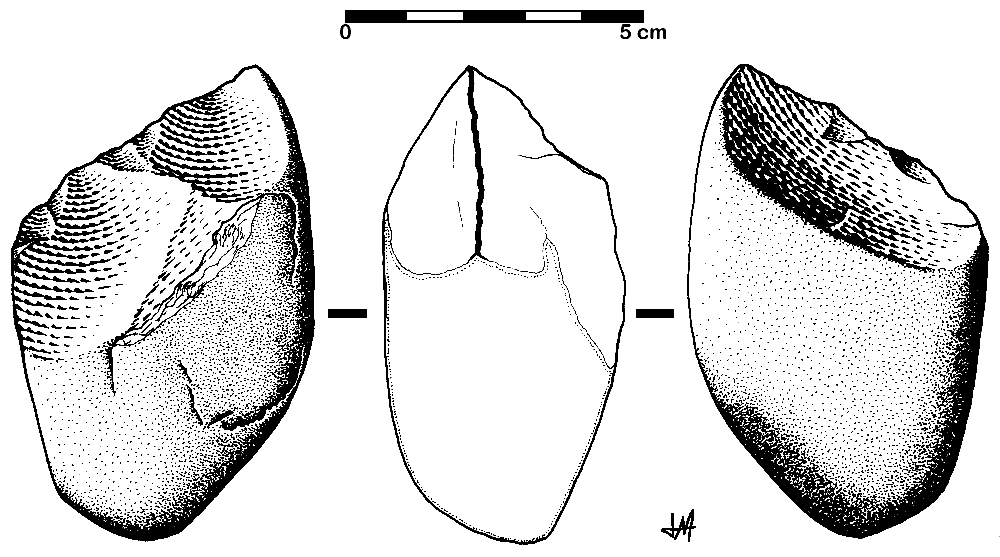
- AOldowan
- BH. Habilis
- CPebbles, stones roughly flaked
- DBreak bones, cut meat, scrape hide
6What type of tool culture is this? What hominin species is it associated with? What are the materials used and its use as a tool?
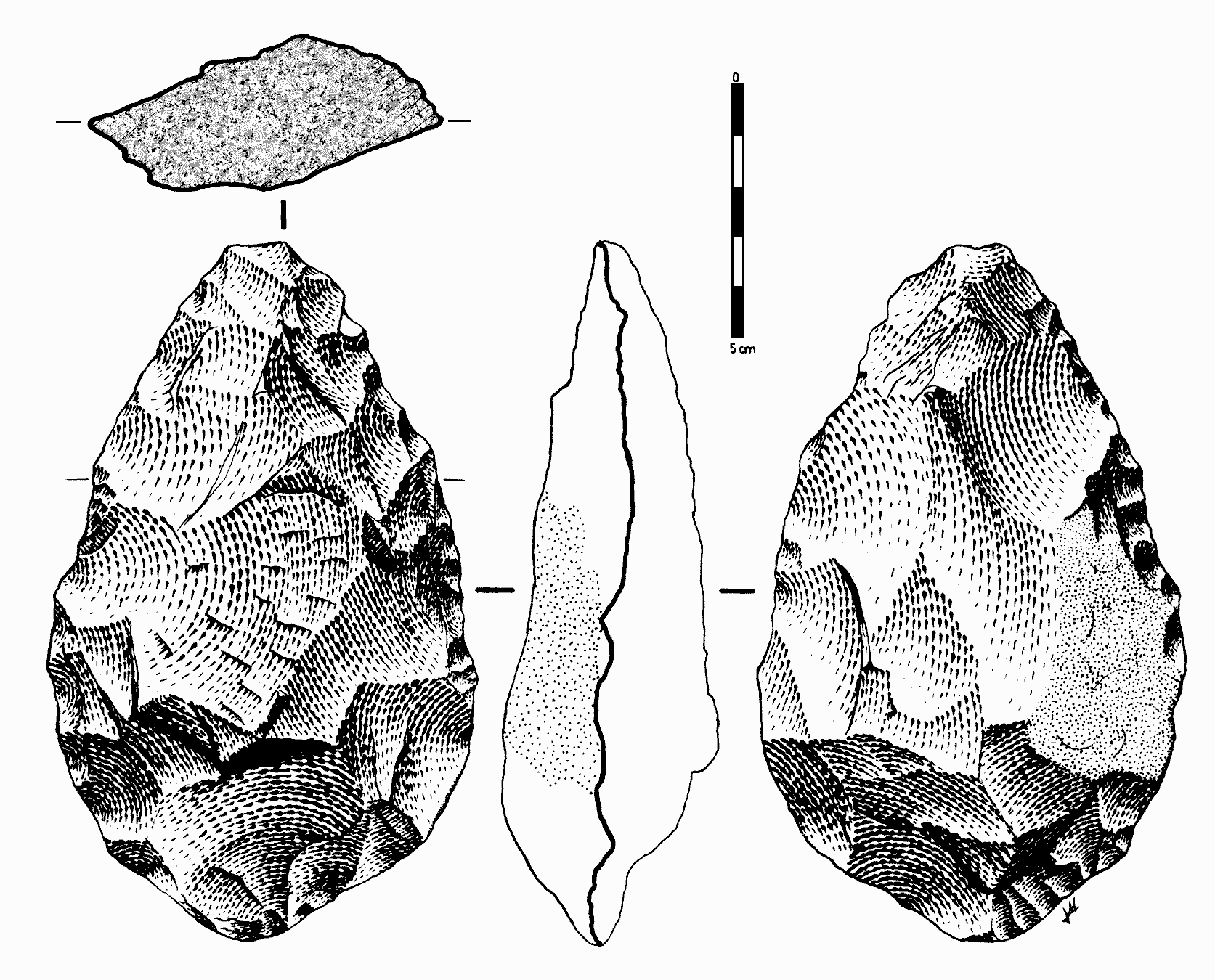
- AAcheulian
- BH. Erectus
- CFlint, flakes removed, tear-drop shape
- DHand-axe, pick, cleaners
7Advantage #1 of Bipedalism: More energy efficient. Because of this, they were better at [blank_start]moving[blank_end] over the open [blank_start]spaces[blank_end] of the new [blank_start]environment[blank_end].
- Amoving
- Bspaces
- Cenvironment
8Advantage #2 of Bipedalism: Less body surface area exposed to the sun, and increased air flow over the body. Because of this, it allows for better [blank_start]thermoregulation[blank_end] to avoid [blank_start]overheating[blank_end] in open exposed [blank_start]savannah[blank_end] druing the day.
- Athermoregulation
- Boverheating
- Csavannah
9Advantage #3 of Bipedalism: Freed up hands. Because of this, they can carry objects e.g [blank_start]food[blank_end] (from where it was killed or gathered back to the protection of home base), e.g [blank_start]infants[blank_end] (to help cling to parent as big toe became forward facing). Allowed improved manipulative [blank_start]ability[blank_end] of hand and better [blank_start]interaction[blank_end] with objects and [blank_start]tool[blank_end] making.
- Afood
- Binfants
- Cinteraction
- Dtool
- Eability
10Advantage #4 of Bipedalism: Eyes held higher above the ground. Because of this, they could see [blank_start]further/larger[blank_end] range of vsision over tall [blank_start]grass[blank_end] and across open [blank_start]space[blank_end]. It helped them spot [blank_start]predators[blank_end] or locate [blank_start]resources[blank_end] (food) at a distance.
- Afurther/larger
- Bgrass
- Cspace
- Dpredators
- Eresources

11Advantages of Bipedalism #5: Imposing form. It allows them to [blank_start]intimidate[blank_end] possible [blank_start]predators[blank_end].
- Aintimidate
- Bpredators
12What are the implications of the advanetgous bipedalism?
- ABipedal individuals were able to maintain activity levesl for extended periods of time
- BWere more successful in searching for and gatheriing resources (food) in more open and scattered habitat
- CBetter able to avoid and defend agaisnt the increased predtor threat out in the open savannah
- DTherefore, bipedal indiviudals were more successful at surviving in the changed environment and were selected for
Informationen
- Beschreibung
- Quiz on Section 1 of NCEA Level 3 Biology Human Evolution external
- Autor
- Shivani Kershaw
- Sprache
- English
- Aufrufe
- 3
- Schlagwörter
- Bewertung
- Noch keine Bewertungen Bewerte dieses Quiz