
Test
Human Evolution Quiz
Este test tiene tipos de pregunta que se abren en el reproductor de siempre.
Preguntas del test (12)
1The OOA model is based on the theory that the [blank_start]H. erectus[blank_end] left [blank_start]Africa[blank_end] and that [blank_start]outside of Africa[blank_end] these [blank_start]early hominin[blank_end] populations evolved into [blank_start]H. neanderthals[blank_end]. Then, earlier hominin populations were [blank_start]replaced[blank_end] by [blank_start]modern humans[blank_end] that evolved in [blank_start]eastern Africa[blank_end] and then [blank_start]migrated north[blank_end] into [blank_start]Europe[blank_end].
- AH. erectus
- BAfrica
- Coutside of Africa
- Dearly hominin
- EH. neanderthals
- Freplaced
- Gmodern humans
- Heastern Africa
- Imigrated north
- JEurope
2What type of tool culture is this? What hominin species is it associated with? What are the materials used and its use as a tool?
- AUpper Paleothilic.
- BHomo Sapiens
- CIvory, Bone, Antler
- DSpear-thrower, arrowheads, fishing hooks
3The Multiregional model is based on the theory that H. [blank_start]Erectus[blank_end] [blank_start]migrated[blank_end] out of [blank_start]Africa[blank_end] and [blank_start]evolved[blank_end] into [blank_start]modern humans[blank_end] in the different regions they migrated to. There was regular [blank_start]gene flow[blank_end] due to [blank_start]interbreeding[blank_end] between populations, so evolving [blank_start]independently[blank_end].
- AErectus
- Bmigrated
- CAfrica
- Devolved
- Emodern humans
- Fgene flow
- Ginterbreeding
- Hindependently
4Cultural Evolution is the transmission of [blank_start]knowledge[blank_end] from [blank_start]generation[blank_end] to [blank_start]generation[blank_end] by passing on of [blank_start]information[blank_end] that is not [blank_start]genetically[blank_end] derived.
- Aknowledge
- Bgeneration
- Cgeneration
- Dinformation
- Egenetically
5What type of tool culture is this? What hominin species is it associated with? What are the materials used and its use as a tool?
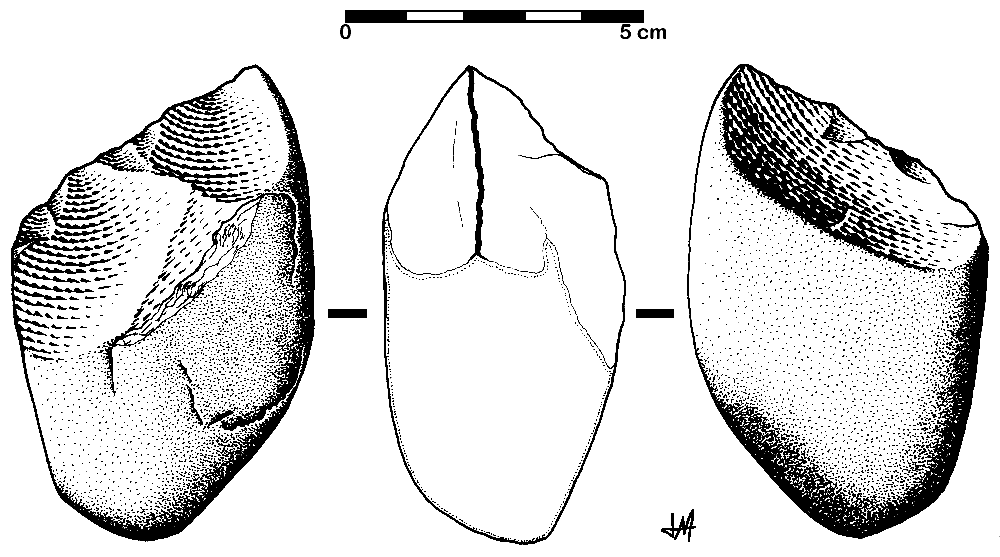
- AOldowan
- BH. Habilis
- CPebbles, stones roughly flaked
- DBreak bones, cut meat, scrape hide
6What type of tool culture is this? What hominin species is it associated with? What are the materials used and its use as a tool?
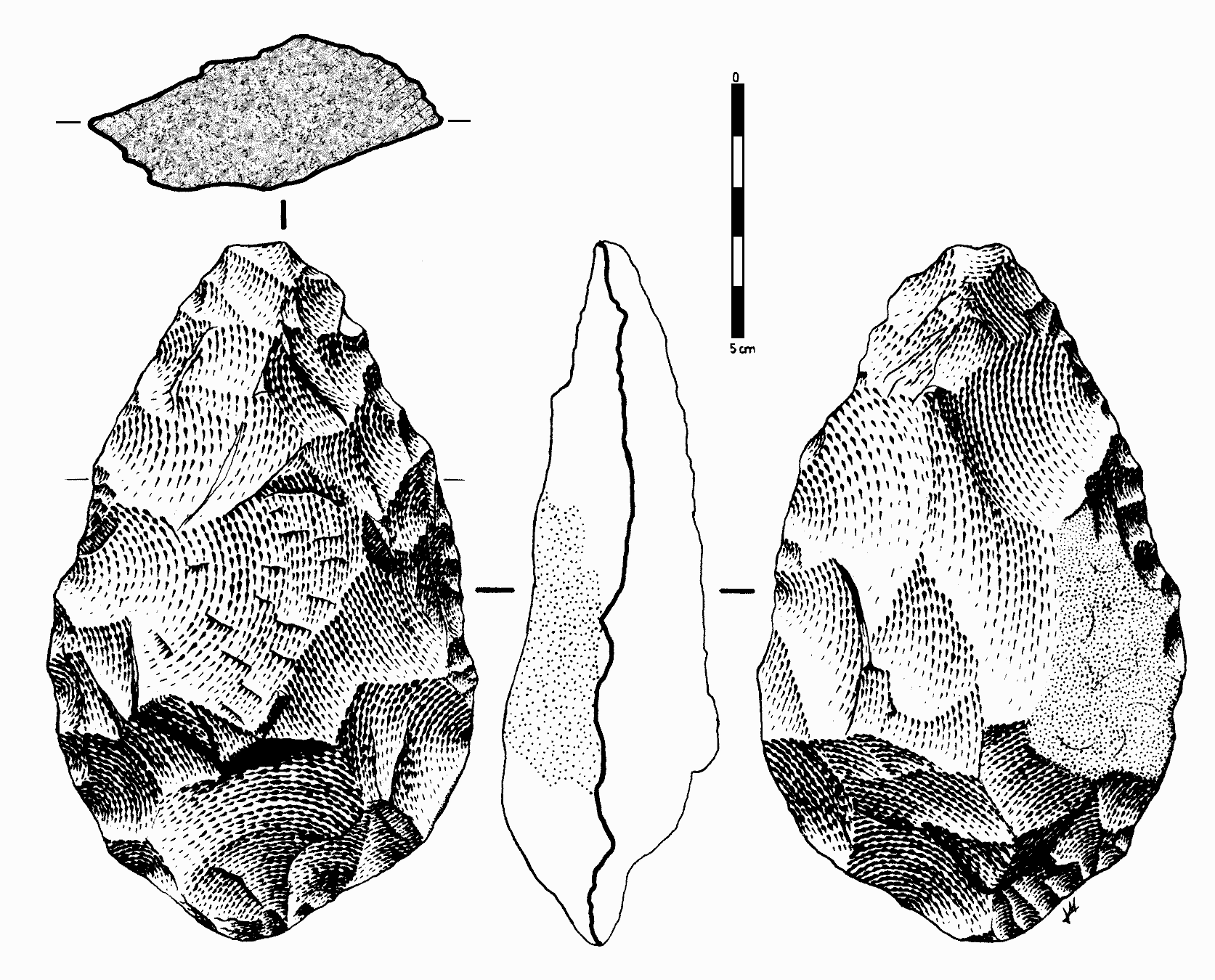
- AAcheulian
- BH. Erectus
- CFlint, flakes removed, tear-drop shape
- DHand-axe, pick, cleaners
7Advantage #1 of Bipedalism: More energy efficient. Because of this, they were better at [blank_start]moving[blank_end] over the open [blank_start]spaces[blank_end] of the new [blank_start]environment[blank_end].
- Amoving
- Bspaces
- Cenvironment
8Advantage #2 of Bipedalism: Less body surface area exposed to the sun, and increased air flow over the body. Because of this, it allows for better [blank_start]thermoregulation[blank_end] to avoid [blank_start]overheating[blank_end] in open exposed [blank_start]savannah[blank_end] druing the day.
- Athermoregulation
- Boverheating
- Csavannah
9Advantage #3 of Bipedalism: Freed up hands. Because of this, they can carry objects e.g [blank_start]food[blank_end] (from where it was killed or gathered back to the protection of home base), e.g [blank_start]infants[blank_end] (to help cling to parent as big toe became forward facing). Allowed improved manipulative [blank_start]ability[blank_end] of hand and better [blank_start]interaction[blank_end] with objects and [blank_start]tool[blank_end] making.
- Afood
- Binfants
- Cinteraction
- Dtool
- Eability
10Advantage #4 of Bipedalism: Eyes held higher above the ground. Because of this, they could see [blank_start]further/larger[blank_end] range of vsision over tall [blank_start]grass[blank_end] and across open [blank_start]space[blank_end]. It helped them spot [blank_start]predators[blank_end] or locate [blank_start]resources[blank_end] (food) at a distance.
- Afurther/larger
- Bgrass
- Cspace
- Dpredators
- Eresources

11Advantages of Bipedalism #5: Imposing form. It allows them to [blank_start]intimidate[blank_end] possible [blank_start]predators[blank_end].
- Aintimidate
- Bpredators
12What are the implications of the advanetgous bipedalism?
- ABipedal individuals were able to maintain activity levesl for extended periods of time
- BWere more successful in searching for and gatheriing resources (food) in more open and scattered habitat
- CBetter able to avoid and defend agaisnt the increased predtor threat out in the open savannah
- DTherefore, bipedal indiviudals were more successful at surviving in the changed environment and were selected for
Información
- Descripción
- Quiz on Section 1 of NCEA Level 3 Biology Human Evolution external
- Autor
- Shivani Kershaw
- Idioma
- English
- Visitas
- 3
- Etiquetas
- Valoración
- Aún sin valoraciones Valora este test