
Quiz
Hitler's Foreign Policy 1933 - 1938 Quiz
Dieses Quiz enthält Fragetypen, die sich im gewohnten Player öffnen.
Fragen in diesem Quiz (20)
1What were Hitler's main aims in foreign policy?
- ATo make Germany into a great power again.
- BTo unite all German speaking people under his rule.
- CTo gain territory for Germany in the east to provide Lebensraum ('living space') for the German people.
- DTo spread communism throughout the world.
- ETo gain revenge on the French.
2When Hitler came to power, reparations had been reduced and eventually cancelled in 1932. The remainder of the hated treaty remained in force, so in order to further his aims Hitler would have to:
• Change the territorial settlement of the Treaty of Versailles by regaining lands inhabited by German people that had been taken from Germany at Versailles, including the Saar and Danzig.
• Bring the 7 million German-speaking people in Austria, and the 4 million in Czechoslovakia and Poland, into his empire – this again involved destroying the peace settlement of 1919.
• Build up the German army so that his aims could be supported by force if necessary and to prove that Germany was a Great Power
• Expand in the East, probably against communist USSR – Hitler hated Communism. This aim was probably intended for the future when the Treaty of Versailles had been overturned and Germany confirmed as the greatest power in Europe.- ARichtig
- BFalsch
3Who did Hitler feel to be the main enemies of Germany?
- AFrance
- BBritain
- CUSSR
- DItaly
4Why did Hitler withdraw Germany from the 1932/33 disarmament conference?
- AIt became obvious that other countries, particularly France, would never disarm for fear of attack.
- BHe wanted to separate himself from the policies of the League
5Once they had withdrawn from the disarmament conference, Germany began to rearm, introducing conscription in 1935. Hitler’s excuse was that France had just increased its terms of conscription from 12 to 18 months, which would increase the number of trained soldiers in France.
- ARichtig
- BFalsch
6The rearmament of Germany was clearly against the Treaty of Versailles, so why did Britain and France not act? The only opposition was the formation of the short-lived [blank_start]Stresa[blank_end] Front to protest against the introduction of conscription in Germany. Also, Soviet [blank_start]Russia[blank_end], afraid of a strong Germany, joined the League of Nations. Many in Britain felt that the Treaty of Versailles was [blank_start]unfair[blank_end] and needed to be revised. On the other hand, the French were afraid of German [blank_start]recovery[blank_end] and wanted to see the Treaty [blank_start]strengthened[blank_end], not weakened, but could not act alone. Differences between Britain and France began to emerge, and Britain had sympathised with Germany rather than France.
Hitler took advantage of these [blank_start]differences[blank_end] between Britain and France to further his aims in foreign policy. Although he often [blank_start]threatened[blank_end] to use force to achieve his aims, every time he acted against the treaty he followed it with promises of [blank_start]peace[blank_end]. Britain paid more attention to these promises than to the [blank_start]reversal[blank_end] of the treaty.- AStresa
- BRussia
- Cunfair
- Drecovery
- Estrengthened
- Fdifferences
- Gthreatened
- Hpeace
- Ireversal
7In 1934 Hitler signed a [blank_start]ten[blank_end]-year non-aggression pact with Poland, which guaranteed the boundaries of Poland. This satisfied the Poles that Hitler would not try to take back the [blank_start]Polish Corridor[blank_end]. It pleased Britain, who saw it as further proof that Hitler’s aims were [blank_start]peaceful[blank_end], as it meant that Germany had accepted the frontier with Poland set up at [blank_start]Versailles[blank_end]. In forming the non-aggression pact with Poland, Hitler broke with tradition. Relations between Germany and Poland had never been particularly good. The pact was probably meant to keep up the [blank_start]appearance[blank_end] of non-aggression and buy Germany time for [blank_start]rearmament[blank_end].
- Aten
- BPolish Corridor
- Cpeaceful
- DVersailles
- Eappearance
- Frearmament
8What was the first set back suffered by Hitler?
- AThe Manchurian Crisis
- BFailed Anschluss
- CThe Anglo-German Naval Agreement
9Later in [blank_start]1934[blank_end] Hitler attempted Anschluss with Austria. He encouraged the Austrian Nazi Party to rebel and this resulted in the murder of the Austrian Chancellor, [blank_start]Dollfuss[blank_end]. It looked as if Hitler’s aim of the [blank_start]reunification[blank_end] of Germany and Austria (Anschluss) was going to be achieved. It was prevented by [blank_start]Mussolini[blank_end] moving his army to the frontier of Austria and guaranteeing Austrian independence. Hitler realised that his army was not strong enough, so he backed down and denied any [blank_start]involvement[blank_end] with the Austrian Nazi Party.
- A1934
- BDollfuss
- Creunification
- DMussolini
- Einvolvement
10Under the Anglo-German Naval Agreement of 1935, what percentage of the British fleet was the German army limited to (not including submarines)?
- A35%
- B70%
- C95%
11Hitler’s willingness to sign it was further proof to Britain of his peaceful intentions. By signing this agreement, Britain had agreed to Germany rearming. Clearly, Britain felt that if there was to be no agreement on disarmament, then it was important for Britain to limit the size of the German navy. It was a success for Hitler because it weakened the Stresa Front as Britain had not consulted France and Italy, and it led to Germany proceeding with rearmament without opposition.
- ARichtig
- BFalsch
12In January 1935 a plebiscite was held in the [blank_start]Saar[blank_end] to decide whether it should remain under the control of the [blank_start]League of Nations[blank_end], return to German control or join [blank_start]France[blank_end]. The Saar was inhabited by mainly German people, so the result was never in any doubt. Around [blank_start]90%[blank_end] voted to rejoin Germany, [blank_start]8%[blank_end] wanted to remain under the control of the League and [blank_start]2%[blank_end] wanted to join France. Nazi propaganda made great use of this. Victory in the plebiscite was publicised as the removal of one of the [blank_start]injustices[blank_end] of Versailles. It was greeted with great celebration in Germany. Hitler announced to the world that all cause of [blank_start]grievance[blank_end] between France and Germany had now been removed. The return of the Saar to Germany was not [blank_start]illegal[blank_end]. Hitler had kept within the terms of the Treaty of Versailles, which had provided for a plebiscite to be held after [blank_start]15[blank_end] years.
- ASaar
- BLeague of Nations
- CFrance
- D90%
- E8%
- F2%
- Ginjustices
- Hgrievance
- I15
- Jillegal
13On [blank_start]7[blank_end] March 1936 German soldiers marched into the Rhineland. This was against the Treaty of Versailles and the [blank_start]Locarno[blank_end] Pact, which the German Government had willingly signed in 1925. Hitler followed up the remilitarization with promises that Germany would sign a [blank_start]25[blank_end]-year non-aggression pact and had no further territorial [blank_start]ambitions[blank_end] in Europe. Britain, France and the League should have acted against Germany. All that happened was that German action was [blank_start]condemned[blank_end] by the League but, when a vote was cast, only Soviet [blank_start]Russia[blank_end] voted in favour of imposing [blank_start]sanctions[blank_end] on Germany.
- A7
- B25
- CLocarno
- Dambitions
- Econdemned
- FRussia
- Gsanctions
14Why was there no action against Hitler?
- AThe French government was divided and not prepared to act without the support of Britain, while Britain felt that Hitler was doing nothing wrong. Many people in Britain also felt that The Treaty of Versailles was unjust and therefore Hitler was right to change it.
- BHitler had chosen his moment carefully. Britain and France were more concerned about Mussolini’s invasion of Abyssinia.
- CGermany was only moving troops into its own territory. It was not like Mussolini, who had invaded another country.
- DNo one wanted war and people took for more notice of Hitler’s promises
- EAll of the above!
15The French army was far stronger than that of Germany in 1936 and sanctions would have crippled Germany, but Hitler had judged foreign reactions perfectly. Germany could have been stopped, but there was no support for opposition. If the French army had invaded the Rhineland, perhaps Hitler would have become more popular in Germany as the victim of foreign invasion. Britain was satisfied that Germany was justified and another grievance of the Treaty of Versailles had been eliminated. Once all of these grievances had been dealt with, Germany would be satisfied and live in peace with other nations. Hitler could have been stopped, but the will to use force against him was not there.
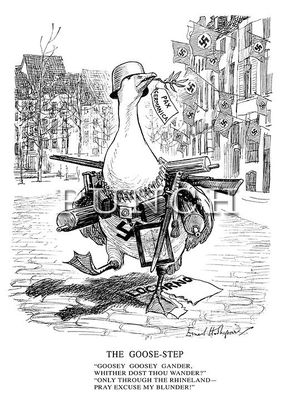
- ARichtig
- BFalsch
16In what ways did the Remilitarisation of the Rhineland have an effect on later events?
- AHitler had reversed the ToV without opposition, giving him more confidence and a stronger position in Germany.
- BIt marked the end of the Stresa Front as Hitler and Mussolini became allies in the Spanish Civil War after the Rome-Berlin Axis.
- CFrench security was not affected because the French had begun the building of the Maginot Line, a vast series of fortifications on the border between France and Germany.
- DTogether with the Abyssinian crisis, it marked the end of the League of Nations as a means of keeping peace.
- EAll of the above!
17The union of Austria and Germany ([blank_start]Anschluss[blank_end]) had been forbidden by the Treaty of Versailles. Hitler was born within the boundaries of Austria and had stated in Mein Kampf that he felt the rightful place of Austria was in a [blank_start]union[blank_end] with Germany. In [blank_start]1934[blank_end] the Austrian Nazis, encouraged by Hitler, had tried to seize power after the murder of the Austrian Chancellor, Dollfuss. This had been prevented by Mussolini who had been prepared to give [blank_start]support[blank_end] to Austria. By 1938, the situation had changed: Mussolini was now [blank_start]allied[blank_end] with Germany and occupied in the [blank_start]Spanish Civil War[blank_end], so he was unlikely to give help to Austria. One of Hitler’s aims was to unite all German-speaking people under his leadership, and the Austrians were German-speaking.
The [blank_start]Nazi[blank_end] Party remained strong in Austria and early in 1938 there were rumours of another Nazi plot to overthrow the Austrian government. The Austrian Chancellor, [blank_start]Schuschnigg[blank_end], appealed to Hitler for help to end the plotting. Hitler refused and, instead of helping, he put pressure on Schuschnigg and forced him to appoint [blank_start]Seyss-Inquart[blank_end], the leader of the Nazi Party in Austria, as Minister of the Interior, in charge of the police force. This was followed by a series of riots and demonstrations by the Nazis in Austria, [blank_start]encouraged[blank_end] by Hitler. In spite of his position, Seyss-Inquart supported the demonstrations and did [blank_start]nothing[blank_end] to stop them.- AAnschluss
- Bunion
- C1934
- Dsupport
- Eallied
- FSpanish Civil War
- GNazi
- HSchuschnigg
- ISeyss-Inquart
- Jencouraged
- Knothing
18Schuschnigg made a bold move to end the disturbances and try and save the [blank_start]independence[blank_end] of Austria. He called a [blank_start]plebiscite[blank_end] on whether the Austrian people wanted to remain independent or not. This alarmed Hitler. There were many Austrians who favoured Anschluss because they felt that the Austrian economy was too weak to remain independent, but Hitler was not prepared to take the [blank_start]risk[blank_end].
It was clear to everyone that Schuschnigg had [blank_start]defied[blank_end] Hitler by calling the plebiscite without his permission and he could not afford anything other than an overwhelming vote in favour of [blank_start]unification[blank_end] with Germany. To make certain that he got this and kept in control, Hitler moved German troops to the [blank_start]border[blank_end] and forced Schuschnigg to call off the plebiscite and resign from office. All through the crisis, Schuschnigg probably expected Britain and France to give assistance to Austria. When it was clear that this was not going to happen and wanting to avoid bloodshed, Schuschnigg [blank_start]resigned[blank_end].
Seyss-Inquart replaced Schuschnigg as Chancellor and invited the Germans into Austria to restore [blank_start]order[blank_end]. The German army entered on 12 March. First of all, opponents of Hitler were eliminated. Around [blank_start]80,000[blank_end] were rounded up and placed in concentration camps. Seyss-Inquart handed over power to Hitler and [blank_start]Anschluss[blank_end] was proclaimed. On 14 March, Hitler processed in triumph through Vienna. This was followed by a plebiscite in April in which [blank_start]99.75%[blank_end] of voters agreed to the Anschluss. Hitler could claim that he was only fulfilling the idea of [blank_start]self-determination[blank_end] expressed in Woodrow Wilson’s Fourteen Points.
Britain and France protested but did nothing; the League of Nations was not consulted. Although Anschluss was against the Treaty of Versailles, Britain had [blank_start]sympathy[blank_end] with Germany because the Austrians were German-speaking and German in tradition and culture; moreover, the Austrians has shown what they wanted in the plebiscite. The British government also feared [blank_start]communism[blank_end] in the USSR more than it did Nazism and welcomed a strong Germany because it saw it as a [blank_start]barrier[blank_end] to the USSR and communism, Hitler’s anti-communist beliefs strengthened this view.- Aindependence
- Bplebiscite
- Crisk
- Ddefied
- Eunification
- Fborder
- Gresigned
- Horder
- I80,000
- JAnschluss
- K99.75%
- Lself-determination
- Msympathy
- Ncommunism
- Obarrier
19Anschluss was not unpopular in Austria. Although the plebiscite results were exaggerated by Nazi presence, many Austrians welcomed being joined to the glory of the new Germany.
- ARichtig
- BFalsch
20In what ways did Anschluss prove valuable for Germany?
- AGermany now possessed land on three sides of the western part of Czechoslovakia – the Sudetenland – which was inhabited by over 3 million German-speaking people.
- BHitler now had the resources of Austria at his disposal. This included the army as well as economic resources or iron and steel.
- CIt proved the value of Hitler’s alliance with Mussolini
- DIt meant Hitler had control of his homeland.
- EIt showed that Hitler could do whatever he wanted.
Informationen
- Beschreibung
- GCSE History (Steps to War) Quiz am Hitler's Foreign Policy 1933 - 1938 Quiz, erstellt von Leah Firmstone am 30/10/2015.
- Autor
- Leah Firmstone
- Sprache
- English
- Aufrufe
- 715
- Schlagwörter
- Bewertung
- Noch keine Bewertungen Bewerte dieses Quiz