
Quiz
B8 Gas Exchange in Mammals Quiz
Fragen in diesem Quiz (20)
1What helps oxygen to be absorbed rapidly into the blood in the lungs?
- AA Air breathed in has less oxygen than air breathed out.
- BB Alveoli have thick walls and a large surface area.
- CC Alveoli have thin walls and a large surface area.
- DD The concentration of oxygen in the blood is higher than in the alveoli.
2The diagram shows some of the structures in a human lung.
Where is the carbon dioxide concentration highest?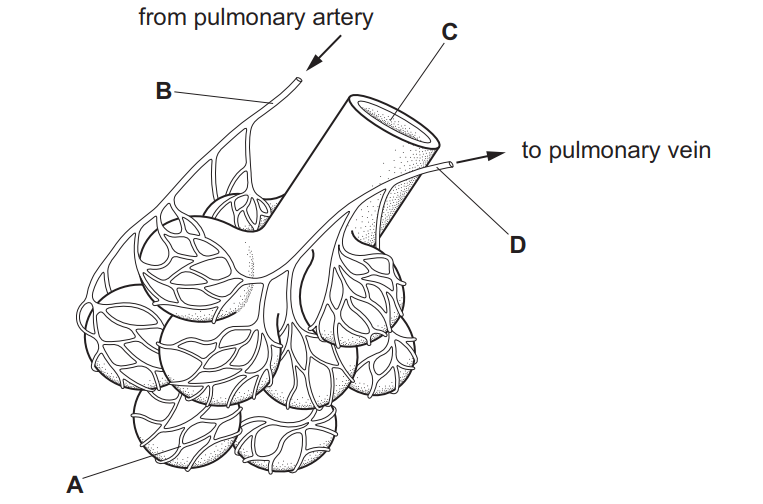
- AA
- BB
- CC
- DD
3A girl holds her breath for 30 seconds, breathes out, and then breathes in.
Compared with the air she breathes out, the air she breathes in contains less .......- AA carbon dioxide and water vapour.
- BB nitrogen and water vapour.
- CC oxygen and carbon dioxide.
- DD oxygen and nitrogen.
4 What makes alveoli suitable as a gas exchange surface?
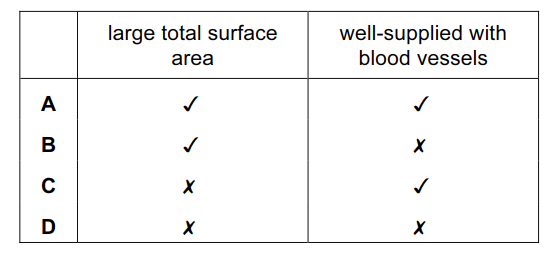
- AA
- BB
- CC
- DD
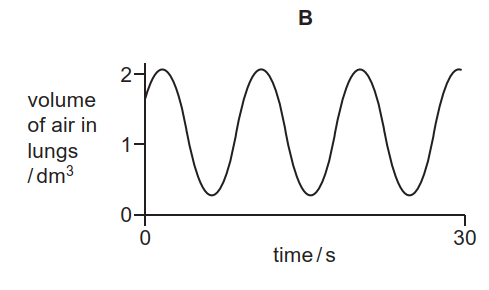
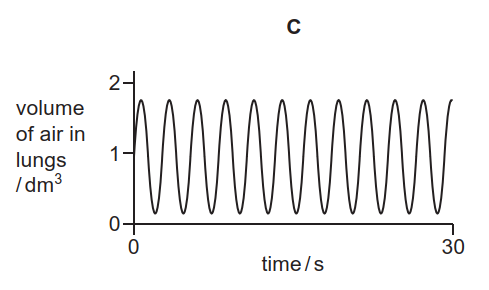
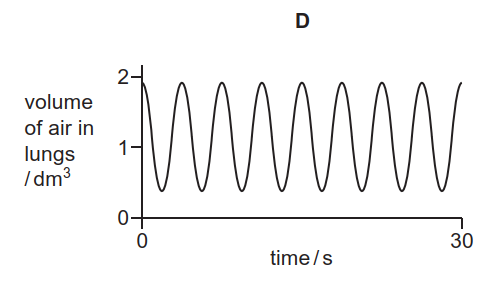
5The graph shows changes in the volume of air in the lungs of a person at rest, over a period of 30
seconds.
Which graph shows changes in the volume of air in the lungs of the same person immediately
after they have done five minutes of vigorous exercise?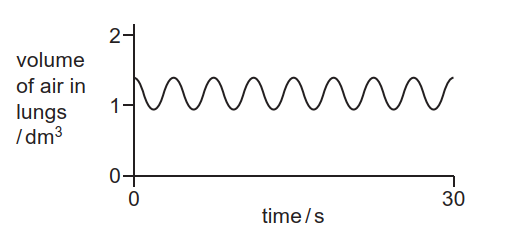
- AA
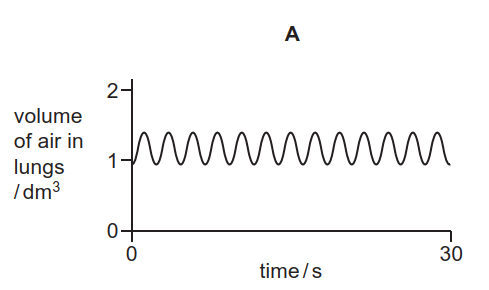
- BB
- CC
- DD
- AA
6A sample of expired air is collected in a gas jar. Another gas jar contains normal atmospheric air.
A lighted candle is placed inside each gas jar as shown. The time taken for each flame to go out is measured. As the candles burn they use up the oxygen available in the jar.
The table shows the results of this experiment.
The candle flame in jar X goes out in 15 seconds, while the candle flame in jar Y goes out in 9 seconds.
What is an explanation of the difference between the results in jars X and Y?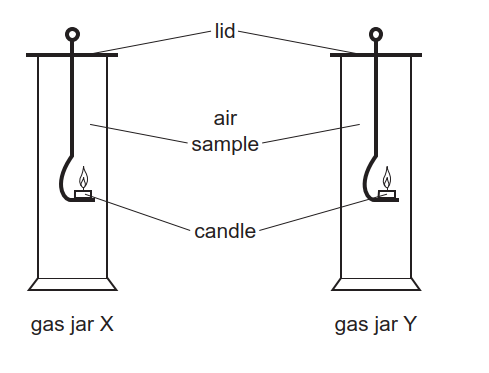
- AA Jar X contains atmospheric air which has more carbon dioxide.
- BB Jar X contains expired air which has more carbon dioxide.
- CC Jar Y contains atmospheric air which has less oxygen.
- DD Jar Y contains expired air which has less oxygen.
7The diagram shows a section through an alveolus and a capillary.
Why does carbon dioxide move from X to Y?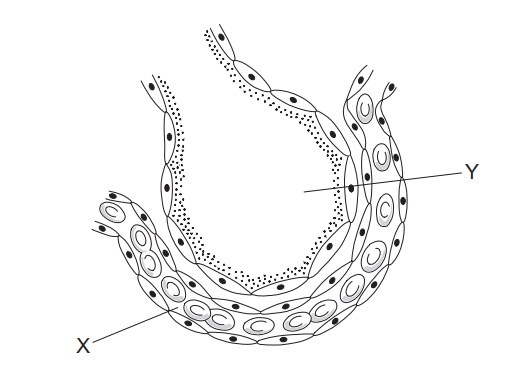
- AA Air has a lower concentration of carbon dioxide than blood.
- BB Carbon dioxide moves more freely in air than in blood.
- CC Carbon dioxide must replace oxygen.
- DD Diffusion of carbon dioxide can only be out of the blood.
8The diagram shows some structures in the human neck and thorax.
The lining of tube Q has cilia.
What is an important function of the cilia?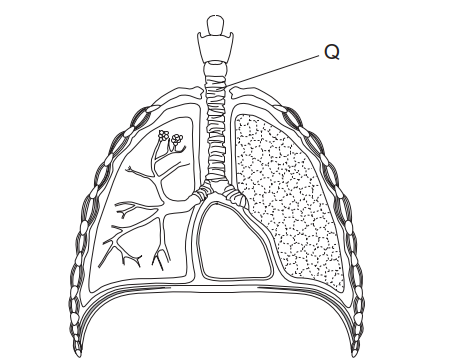
- AA to help in the exchange of gases
- BB to increase the internal surface area of tube Q
- CC to moisten the air entering and leaving the lungs
- DD to move mucus towards the throat
9The diagram shows some ciliated cells from the trachea.
What is the function of the parts labelled X?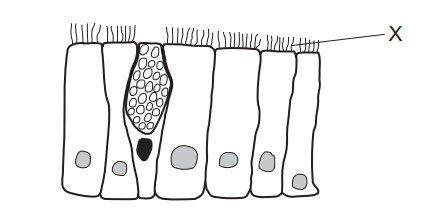
- AA detecting stimuli
- BB exchanging gases
- CC moving mucus
- DD trapping bacteria
10 What are the functions of the diaphragm and the cilia in the human gas exchange system?
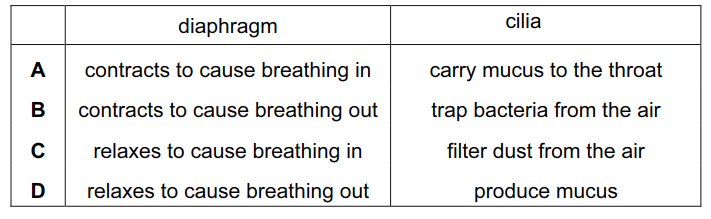
- AA
- BB
- CC
- DD
11The diagram shows changes in air pressure inside the lungs during a complete cycle of
breathing. Atmospheric pressure is 101 kPa.
Which position on the graph marks the point at which the ribs are beginning to be raised?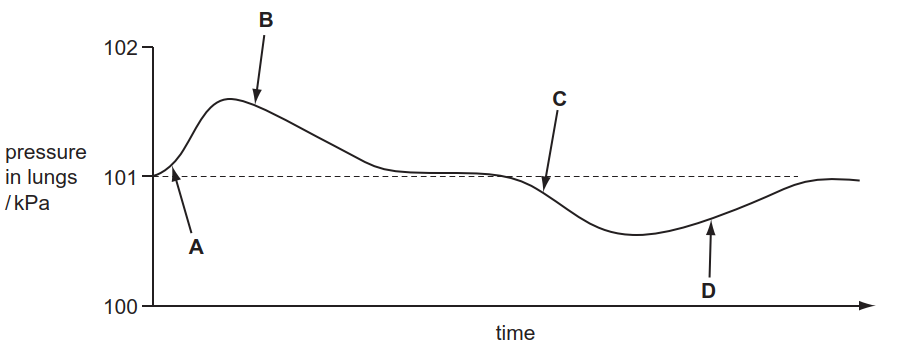
- AA
- BB
- CC
- DD
12The diagram shows someone blowing up a balloon.
What percentage of the gas in the balloon is carbon dioxide?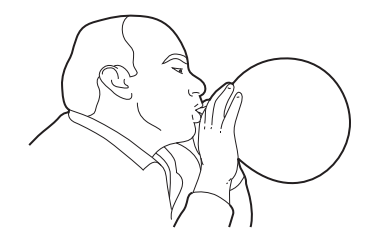
- AA 0.04 %
- BB 0.4 %
- CC 4.0 %
- DD 40%
13What increases the rate of diffusion of oxygen into red blood cells in the lungs?
- AA Air leaving the lungs is saturated with water vapour.
- BB Air leaving the lungs still contains 16 % oxygen
- CC Blood arriving in the lungs is saturated with oxygen.
- DD Blood is taken away from the lungs as it circulates.
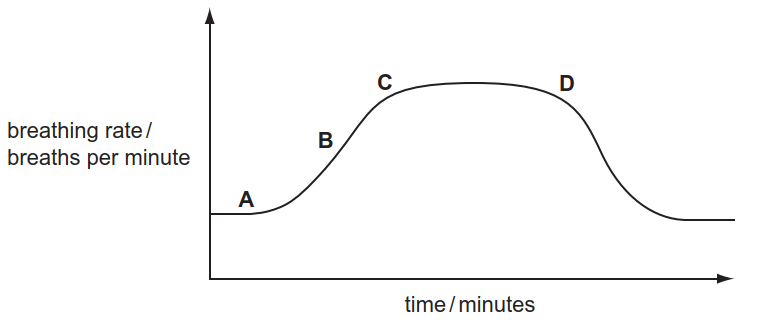
14 From the graph, when did the person begin a period of vigorous exercise after resting?
- AA
- BB
- CC
- DD
15The diagram represents the exchange of gases during breathing and during respiration in the body.
What is represented by X and by Y?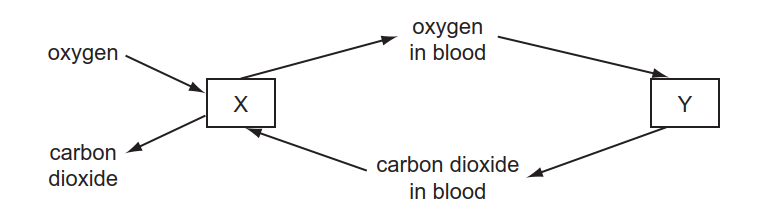
- AA X = lungs, Y = air
- BB X = lungs, Y = body cells
- CC X = body cells, Y = air
- DD X = body cells, Y = lungs
16Which route is taken by air passing into the lungs of a human?
- AA alveolus → trachea → bronchus
- BB bronchus → trachea → alveolus
- CC trachea → alveolus → bronchus
- DD trachea → bronchus → alveolus
17 What are features of gaseous exchange surfaces in mammals?
- AA thick-walled, dry, large area
- BB thick-walled, moist, small area
- CC thin-walled, dry, small area
- DD thin-walled, moist, large area
18The ribs are lowered as we breathe out.
Which characteristic of living organisms does this illustrate?- AA growth
- BB movement
- CC respiration
- DD sensitivity
19What is the order of decreasing diameter of the structures found in the breathing system?
- AA alveoli → bronchi → capillaries
- BB alveoli → capillaries → bronchi
- CC bronchi → alveoli → capillaries
- DD capillaries → bronchi → alveoli
20The diagram shows the main structures in the breathing system.
Which row identifies the larynx, bronchus, trachea and bronchioles?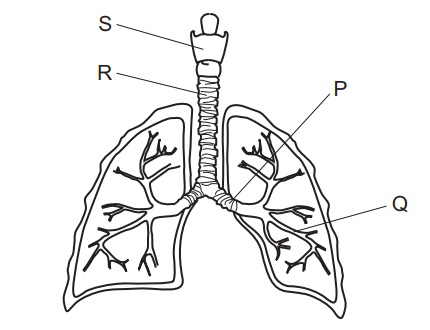
- AA larynx = P; bronchus = Q; trachea = R; bronchioles = S
- BB larynx = R; bronchus = P; trachea = S; bronchioles = Q
- CC larynx = S; bronchus = P; trachea = R; bronchioles = Q
- DD larynx = S; bronchus = Q; trachea = P; bronchioles = R
Informationen
- Beschreibung
- Quiz on IGCSE Coordinated Sciences Topic B8 Gas Exchange in Mammals
- Autor
- Jeffrey Piggott
- Sprache
- English
- Aufrufe
- 5.961
- Schlagwörter
- Bewertung
- Noch keine Bewertungen Bewerte dieses Quiz