
Quiz
Geoelectrics
Erstelle ein kostenloses Konto, um dieses Quiz zu beenden
Speichere deinen Fortschritt und sieh dir dein Endergebnis an.
oder mit deiner E-Mail registrieren
Schon ein Konto? Anmelden
Fragen in diesem Quiz (58)
1Is the amount of pore space the most important factor controlling electrical conductivity?
- ARichtig
- BFalsch
2What are the types of current flow?
- AElectronic, Ionic
- BMetallic, Aqueous
3What are the two mechanisms by which we recognise the presence of an electrical inhomogeneity in the
Earth?- ABy the generation of current circulating within a conductive body
- BBy the generation of current not circulating within a resistive body
- CBy generating currents that penetrate the boundary between two regions with di ferent electrical properties.
- DBy generating currents that not penetrate the boundary between two regions with different electrical properties
- ABy the generation of current circulating within a conductive body
4The penetration of an electromagnetic field into the earth depends on:
- AFrequency of oscillation
- BConductivity of the earth
- CDepth of investigation
- DCurrent flow paths
5What is an inductive response
- AAn inductive response occurs when current flows within the conductive region in proportion to its conductivity and the time rate of change of the applied magnetic field
- BAn inductive response occurs when the currents will be distorted by the presence of the anomalously conductive body.
6Specific exploration problems are characterised by speci c ranges in depth of interest leading to dif erent preferred frequencies. What are the range of depths and frequencies used in Oil and Gas exploration?
- AFrequency range: 1-10^-4 Hz
Depths 10-1000 m - BFrequency range: 100-10^-1 Hz
Depths 10-100 m - CFrequency range: 10-10^-3 Hz
Depths 1-100 m
- AFrequency range: 1-10^-4 Hz
7How is called a measure of how easy it is to produce an electrical polarisation within a material?
- AGalvanic Response
- BInductive Response
- CDielectric Constant
- DPermitivity of the material
8The electrical properties of the rocks depend on...
- AThe constituent minerals
- BTheir mineral associations
- CRock porosity
- DFluid content
- EPermitivity
- FDielectric constant
9The main difference between resistivity-resistance and conductivity-conductance is that the former is related to the material and is a physical property of it (intensive property: does not depend on the system size or the amount of material in the system)
- ARichtig
- BFalsch
10The materials can be classified according to their conductivity into groups. Select the groups:
- AConductors, conductivity less than 10^5 S/m
- BSemi-conductors 10^-8 S/m < Conductivity < 10^5 S/m
- CInsulators Conductivity < 10^-8 S/m
- DMetallic conductivity less than 10^5 S/m
- ESulphides 10^-8 S/m < Conductivity < 10^5 S/m
- FAislators Conductivity < 10^-8 S/m
11Mostly, the conduction nature in rocks is mainly electronic (Metallic conduction and/or Electronic semi-conductors)
- ARichtig
- BFalsch
12The main difference between Metallic Conduction and Electronic Semiconductors is that the latter needs a much more significant amount of energy (heat) for the electrons to become dissociated from their home atoms
- ARichtig
- BFalsch
13In terms of Metallic conduction, it can be said that the conductivity in metals depends on:
- Athe number density of free electrons, the electron charge and the electron mass.
- Bthe number density of free electrons, the electron charge, the electron mass and the relaxation time
14Fluid conductivity depends also upon temperature because the mobility of the ions in solution decreases with temperature.
- ARichtig
- BFalsch
15Metallic conductors resistivity depends on temperature. When the temperature increases the conductivity of the metal decreases.
- ARichtig
- BFalsch
16When an external electric fi eld is applied the electrons accelerate along the fi eld lines and a current is produced. This
current would increase without limit if the electrons did not occasionally "collide" with the nuclei. The average
time between collisions for a given electron is called- AThe relaxation time
- BIntrinsic time
- CExtrinsic time
17The electronic semi-conductors are metallic materials just as native metals, the only difference is that they have a smaller number of free electrons with lower mobility.
- ARichtig
- BFalsch
18Electronic semi-conductors need a signi cant amount of
energy for the electron to become dissociated from their "home" atoms. One source of this is heat, the number of conduction electrons in these type of material depends on:
Energy required to free an electron, Boltzmann Constant, and the absolute temperature
So it can be concluded that:- AFor semiconductors a higher temperature results in more free electrons and therefore a higher conductivity.
- BFor semiconductors a higher temperature results in more free electrons and therefore a lower conductivity.
- CFor semiconductors a higher temperature results in less free electrons and therefore a higher conductivity.
- DFor semiconductors a higher temperature results in less free electrons and therefore a lower conductivity.
19It is possible to obtain movement of ions within a solid due to imperfections
- ARichtig
- BFalsch
20In terms of Aqueous Electrolytes, the conductivity will depend on:
- AAmount of water present
- BSalinity
- CTemperature
- DConnectivity
- EArchie's law
- FCementation factor
21Archie’s Law: It is a purely empirical law attempting to describe ion flow (mostly sodium and chloride) in clean, consolidated sands, with varying intergranular porosity. Electrical conduction is assumed not to be present within the rock grains or in fluids other than water.
So it can be said that the variables within the equation are:- AAn empirically defined constant
- Bthe cementation factor
- CResistivity of the Aqueous solution
- DPorosity
- ERock's bulk resistivity
- FFormation factor
- AAn empirically defined constant
22What happens to Archie's law when part of the pore space is filled by air, natural gas, carbon dioxide or petroleum (insulators) ??
- AThe equation remains the same
- Ban empirical constant is added
- CBoltzmann constant is added to the equation
- Dthe volume fraction of pores with water power to the saturation exponent is added
23The tortuosity is defined by the relation between the average length of the path through the crack and the length of the rock lc/l
- ARichtig
- BFalsch
24The diminution ratio is the division between the cross-section area of the crack and the cross-section total area
- ARichtig
- BFalsch
25Is a measure of the void (i.e., "empty") spaces in a material, and is a fraction of the volume of voids over the total volume, between 0 and 1, or as a percentage between 0 and 100%
- APorosity
- BCrack
- CJoint
26The electric permittivity is defines as...
- Aa measure of the degree to which a given material becomes polarized.
- Belectric dipole moment per unit volume
- Cthe amount of charge which is separated and the distance through which it has moved
27The relative dielectric constant (Er or K) can be defined as...
- Athe ratio of the material's permittivity to the permittivity of free space
- Bthe subtraction of the material's permittivity to the permittivity of free space
- Cthe multiplication of the material's permittivity to the permittivity of free space
28What are the most important values in terms of relative dielectric constant
- AWater and Soil
- BBasalt, Coal Dolomite
- CLimestone, Granite Quartz
29When the current flows more easily in some direction than in others is called Anisotropy
- ARichtig
- BFalsch
30The longitudinal resistivity is always greater than the transverse resistivity.
- ARichtig
- BFalsch
31The anisotropy coefficient SQRT(RT/RL) >= 1
- ARichtig
- BFalsch
32Types of anysotropy
- AAzimuthal anisotropy (Dipping layers, Dominant set of vertical fractures)
- BDepth dependant anisotropy (the nature of the fracture fill changes with depth)
- CTransverse
- DLongitudinal
33The main difference between IP and SP is that the former is mainly used to determine massive ore bodies whereas the latter is mainly used to determine disseminated ore bodies
- ARichtig
- BFalsch
34Select the main uses of the SP method
- APresence of massive ore bodies
- BSulphide mineralization
- CGroundwater
- DGeothermal
- EGeological mapping
- FChargeability
35What is the cheapest and simplest method to apply? (In terms of near-surface geophysics)
- ASP
- BIP
- CITS
- DSeismic Refraction
- EGravity
- FGPR
36The sign of the potential is an important diagnostic factor in the interpretation of SP anomalies. What kind of mineral potentials are expected for negative anomalies of hundreds of mV
- ASulphide ore bodies, Graphite ore bodies, Magnetite, coal and manganese
- BQuartz veins, pegmatites
37In mineral exploration the components of the SP are called the Mineral Potential and the "Background potential" What are the uses of the latter?
- AMassive ore bodies
- BDisseminated ore bodies
- CGeothermal research
- DHydrogeological research
38What type of electric conduction occurs in very weakly conducting materials (or insulators) when an external alternating
current is applied, so causing atomic electrons to be shifted slightly with respect to their nuclie.- AElectrolytic
- BElectronic
- CDielectric
39How is called one of the main groups of SP that are generally of the order of mV and mainly arise due to water circulation, small
mineral quantities, biologic and topographic ef ects (human activities may also produce SP signals)- AElectrokinetic Potential
- BBackground Potential
- CDiffusion Potential
- DMineral Potential
40How is the called one of the main groups of SP that occur in regions of anomalous concentrations of sul fide ores (also near graphite) and
can be of the order of hundreds of mV or even V.- AElectrokinetic potential
- BDiffusion potential
- CMineral potential
- DBackground potential
41Buried sulphide masses are known to cause SP anomalies. In terms of the effect observed and the physical cause of this effect. Which of the following is true?
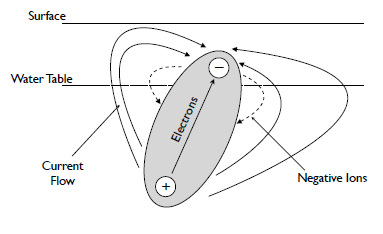
- AGroundwater is thought to be common factor responsible for SP. The potentials are generated by the flow of water by water acting as an electrolyte and as a solvent of different minerals.
- BA negative anomaly of hundreds of mV is expected
- CA postive anomaly of hundreds of mV is expected
- DOne proposal can explain all SP observations
- E1. Above water table: dissolved electrolytes gain electrons from the ore body and are reduced.
2. Below the water table: an oxidation reaction occurs transferring electrons back to the ore body.
3. Electrons are then conducted through the ore body completing the circuit. - FIt is possible that only the presence of variable redox conditions within the subsurface is required to generate large SP anomalies, without need of a subsurface conductor to "close the circuit."
42The SP potentials tend to increase in positiveness with the direction of water flows as the electric charge flows in the opposite direction.
- ARichtig
- BFalsch
43How is called the mechanism by which SP anomalies are generated that is useful to map subsurface barriers or conduits of flow. (These are generated by the flow of aqueous electrolytes through narrow channels (pores))
- AElectrokinetic or Streaming potentials
- BDiffusion
- CElectrolytic
44In practice, to ensure good ground contact in the field and to obtain reliable measurements, What sort of actions should be taken?
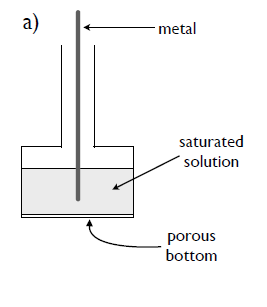
- APorous-pot electrodes
- BNon-porous electrodes
- CThe Resistance of the voltimeter must be large enough 10^8 Ohm
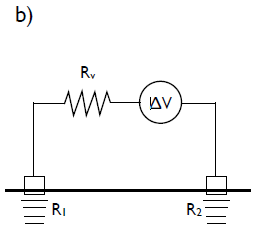
- DThe electrodes should be kept dry and shaded to ensure good ground contact (when the fixed electrode is used)
- EThe electrodes should be kept wet and shaded to ensure good ground contact (when the fixed electrode is used)
45There are diff erent possible arrangements in which the equipment can be deployed?
- AStatic array
- BFixed Spacing
- CFixed Electrode
46The advantage of using a fixed spacing SP survey is that you can use a shorter wire and the reduced importance of telluric currents (generally long-wavelength currents induced in the ground by geomagnetic fluctuations).
- ARichtig
- BFalsch
47The major advantage of using a fixed spacing SP survey is that generally needs to operators to moves the system
- ARichtig
- BFalsch
48The gridded measurements in the SP fixed spacing survey should ultimately form a closed loop and the sum of all potentials within that loop should equal zero if not the remainder represents an error and should not be distributed among the readings
- ARichtig
- BFalsch
49The main disadvantage of using a fixed electrode system (sp) is that system include generally more measurement errors and that is not easy to perform by a single operator
- ARichtig
- BFalsch
50The main advantage of using a fixed electrode system is that the larger separation between electrodes does not allow telluric currents to influence the results
- ARichtig
- BFalsch
51SP can be easily executed on Ice.
- ARichtig
- BFalsch
52Problems associated with acquiring SP data and things that must be taken into account:
- AElectrode polarization
- BRain (Ground-contact strength and ground conductivity)
- CTelluric variations (Daily drift variations)
- DArtificial sources of electricity in the surroundings (or in the vicinity)
- EA shift in the equipotential lines in relation to an ore body (current will flow preferentially in the less resistive unit.)
- FLongness of the wire
53the observed current and potential due to a single source in a half space is identical to that from the method of images inspired model of two sources in an in finite space.
- ARichtig
- BFalsch
54Consider a vertical, infinite length, ellipsoidal ore body. Sketch the expected SP anomaly profile over this body
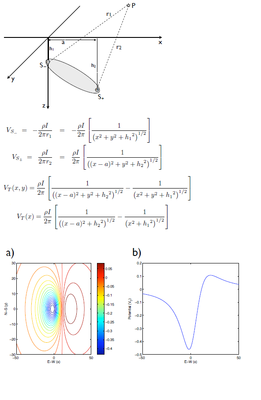
- AA vertically body will have no positive anomaly
- BA vertically body will have a positive anomaly
- Cthe anomaly peaks are not simply located above the poles
- Dthe anomaly peaks are simply located above the poles
- EFor a dipping body, the negative anomaly associated with the shallower, negative pole is much more pronounced
- FFor a dipping body, the negative anomaly associated with the shallower, negative pole is much less pronounced
- GA vertically body will have a negative anomaly that will be centered on the negative pole (in an homogeneous medium).
- HA vertically body will have a positive anomaly that will be centered on the negative pole (in an homogeneous medium).
55For a tilted ore body how can you determine the depth to the sink
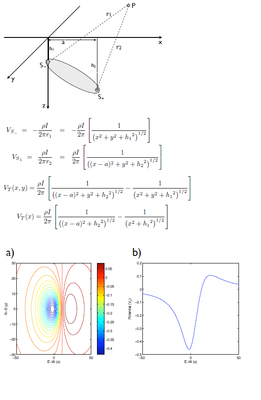
- AFrom the half-width of the anomaly profile x1/2=h0.73
- BFrom the half-width of the anomaly profile x1/2=h0.766
56For a Vertically ore body (finite length l) how can you determine the depth to the sink
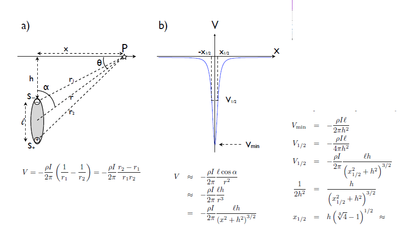
- AFrom the half-width of the anomaly profile x1/2=h0.73
- BFrom the half-width of the anomaly profile x1/2=h0.766
57Is the method of the ratio and the method of the Vmin give the true position of the ore body
- ARichtig
- BFalsch
58When the profi le is drawn the
reference (zero) potential needs to be set as the value for which the potential becomes constant far from the
body, this process is helped by a good lateral extent of measurements and a low level of noise.- ARichtig
- BFalsch
Informationen
- Beschreibung
- Exam1
- Autor
- Vanerahal
- Sprache
- English
- Aufrufe
- 25
- Schlagwörter
- Bewertung
- Noch keine Bewertungen Bewerte dieses Quiz