
Quiz
DNA questions not from the lectures
Fragen in diesem Quiz (60)
1 In RNA, glycosidic bonds occur between:
- Aribose and nucleotide base ribose and nucleotide base
- Bdeoxyribose and nucleotide base
- Cribose and phosphate
- Ddeoxyribose and phosphate
- Etwo nucleotide bases
2Chromatin structure
- AIs constant across each chromosome
- BStrongly influences gene expression Strongly influences gene expression
- CCannot impact heritable traits
- DRequires only a few proteins
3Writer and Eraser enzymes (more than one answer may apply)
- AAct randomly
- BAre not required during DNA replication
- CModify histones
- DImpact gene expression
- EAre unrelated to epigenetic changes
4Gene duplication (more than one answer may apply)
- ACreates an opportunity for organisms to diversify
- BAlways results in new functions
- CDamages the DNA irreparably
- DProvides a mechanism for altering the function of the gene product
5Transgenic organisms (more than one answer may apply)
- AUtilize somatic gene transfer
- BContain a "foreign" gene introduced into the germ line
- CHave been created in only limited numbers
- DPass on their transgenes to progeny
6DNA is replicated 5' to 3'. Why is this directionality the only one observed in living organisms?
- ABecause of the anti-parallel nature of DNA
- BBecause RNA synthesis is required
- CBecause of the energy requirement for fidelity/proof-reading
- DBecause the ssDNA binding proteins bind 5' to 3'
7DNA
- ACodes directly for proteins without any intermediary
- BIs contained in the nucleus in prokaryotes
- CUtilizes hydrogen bonds to maintain sugar-phosphate backbone stability
- DNone of the above
8"Dideoxy" (or Sanger) sequencing of DNA
- AUses deoxynucleotides for chain termination
- BCan be performed using chemical methods
- CRequires the ability to recognize the base at each position
- DRelies on DNA polymerase that must be thermally stable
- EEngages DNA ligase and ssDNA binding proteins
9Transposons (more than one answer may apply):
- AAre mobile elements that can insert into any DNA sequence
- BCome in a single type
- CAre found in both prokaryotes and eukaryotes
- DCan be easily "cured" (eliminated from an organism)
10Okazaki fragments at the replication fork for DNA synthesis (more than one answer may apply):
- AAre essential for leading strand synthesis
- BAre essential for lagging strand synthesis
- CAre comprised only of deoxyribonucleotides
- DAre comprised only of ribonucleotides
- EAre comprised of ribonucleotides and deoxyribonucleotides
11DNA repair (more than one answer may apply):
- ADoes not target all DNA
- BPreserves genetic information for the next generation of cells/organism.
- CInvolves only a small number of proteins
- DIs confined to only two classes of DNA damage
- ERequires 3-5% of coding regions in higher organisms
12Indicate the functions associated with DNA polymerase [more than one answer may apply]:
- APolymerizes nucleotides from 5' to 3'
- BCreates RNA primers
- CExhibits 3' to 5' exonuclease activity
- DExhibits 5' to 3' exonuclease activity
- ESeals together Okazaki fragments
13The Avery-McLeod-McCarty experiment provided evidence that __________ and not ___________serves as the genetic material:
- AProteins | DNA
- BRNA | Proteins
- CDNA | Proteins
- DPolysaccharides | DNA
14The role of telomerase is:
- ATo extend the 5'-end of linear DNA
- BTo shorten the 5'-end of linear DNA
- CTo extend the 3'-end of linear DNA
- DNot important to normal cells
- EDependent on an internal DNA template for extending DNA
15Nucleosome structure (more than one answer may apply]:
- AIs driven primarily by RNA components
- BIs invariant across a single chromosome
- CStrongly influences gene expression and can determine epigenetic traits
- DIs formed by DNA wrapping in a right-handed direction around the core histone octamer
- EIs more loosely packaged when lysines in the histones are acetylated
16Which of the following has a function in both the leading and lagging strand during replication (more than one answer may apply]?
- ADNA polymerase
- BDNA ligase
- CssDNA binding proteins
- DOkazaki fragments
- EDNA clamp loader
17Somatic gene therapy
- AGenerates effects that can be inherited
- BAffects germ cells primarily
- CCan result in the production of a protein required by an individual
- DHas no side effects
18Place the following in order of assembly from the most basic structure to the most complex (type in letters without spaces or commas as in abcde):
a. Folded solenoid
b. Condensed chromatin
c. Solenoid structure
d. "Naked" DNA
e. Nucleosomes- Adecab
- Becbad
- Cdebac
- Dacbed
19In a DNA microarray experiment, you use two different short ssDNAs as probes, one with a label that fluoresces green (green DNA probe) and the other fluoresces red (red DNA probe). Note that an equal mixture of the two probes appears as yellow. The results shown below were obtained following completion of the experiment.
Which of the following can you conclude from the results (more than one answer may apply)?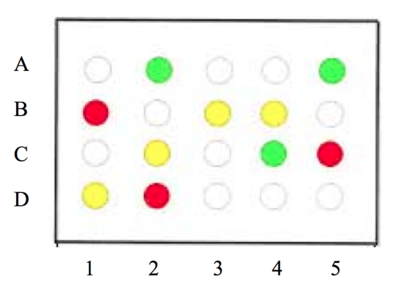
- AThe DNA samples in A2, A5, and C4 contain similar sequences to the green DNA probe but not to the red DNA probe.
- BThe DNA samples in A2, A5, and C4 contain complementary sequences to the green DNA probe but not to the red DNA probe.
- CThe DNA samples in B1, C5, and D2 contain similar sequences to the red DNA probe but not the green DNA probe.
- DThe DNA samples in B1, C5, and D2 contain complementary sequences to the red DNA probe but not the green DNA probe.
- EThe DNA samples in B3, B4, C2, and D1 contain similar sequences to both the green DNA probe and the red DNA probe.
- FThe DNA samples in B3, B4, C1, and C2 contain complementary sequences to both the green DNA probe and the red DNA probe.
20DNA replication
- AIs carried out by multiple independent proteins that do not associate
- BUtilizes the DNA clamp and clamp loader to coordinate the leading and lagging strands
- CDiffers significantly in prokaryotes and eukaryotes in the basic proteins required
- DResults in high levels of errors that cannot be repaired by DNA polymerase activity
21Polymerase Chain Reaction (PCR) is....
- AThe key process in RFLP analysis
- BLimited to genomic DNA
- CUsed to amplify DNA sequences
- DIs the key process for DNA cloning
- EPerformed at a single temperature
22The sugars (to which the bases in DNA are linked) are connected to one another by what type of bond?
- AAlpha-glycosidic
- BBeta-glycosidic
- CPhosphodiester
- DPeptide
23The nucleotide sequence of one DNA strand is 5'-GGATTTTTGTCCACAATCA-3'. The sequence of the newly synthesized daughter strand is:
- A5'-CCTAAAAACAGGTGTTAGT-3'
- B5'-TGATTGTGGACAAAAATCC-3'
- C5'-ACTAACACCTGTTTTTAGG-3'
- D5'-GGATTTTTGTCCACAATCA-3'
24The properties of histones (more than one answer may apply):
- ACannot be altered
- BAffect chromatin density
- CAffect the mutation rate of DNA
- DModulate gene expression
- EAre dependent on DNA size
25Which of the following are fundamental processes of DNA repair (more than one answer may apply)?
- AIdentifying DNA damage
- BEnsuring the cell cycle continues during the process of repair
- CSignaling to cellular systems when DNA damage requires repair
- DCorrecting DNA damage
26The key recognition surface for proteins to discern sequence in the 3-dimensional structure of a DNA is:
- APhosphodiester backbone
- BMajor groove
- CMinor groove
- DCenter of stacked base pairs
27Origins of replication are rich A-T base pairs:
- ATo be recognized readily
- BTo facilitate ease of opening to initiate transcription
- CTo promote primase binding
- DTo ensure a unique sequence
28Which of the following is accurate regarding the DNA replication process (more than one answer may apply)?
- ANo mistakes are made during this process
- BMultiple proteins are involved
- CLow mutation rate (i.e., few errors) is essential for survival of the organism
- DFollows a conservative mechanism
29Sequences of genes generated by duplication (more than one answer may apply):
- ADo not recombine to generate new functions for the encoded protein
- BCan diverge significantly and maintain similar function
- CCan diverge significantly and exhibit different functions
- DNever diverge in sequence
30Eukaryotic DNA replication
- AInitiates at a single origin
- BRequires duplication of histones as well as DNA strands
- CUses mechanisms that destroy patterns of histone modification
- DUtilizes enzymes that differ significantly from prokaryotic replication
311. Nucleosomes:
- AContain two sets of three histone monomers
- BInclude histone and non-histone proteins
- CPackage DNA into a compact form
- DAre more tightly packaged when serine is phosphorylated
- EAre more tightly packaged when lysine is acetylated
32Chromosomes within cells (more than one answer may apply):
- AAre randomly located
- BOccupy distinct physical regions where genes are silenced and where genes are expressed
- CContain genes fixed in a precisely ordered pattern that corresponds to order of expression
- DMove when expressed to a central region of the cell
33The orientation of replication by DNA polymerases from 5' to 3' using 5'-dNTPs (more than one answer may apply):
- AIs required to ensure that the complementary strand is oriented anti-parallel
- BProvides energy from the release of pyrophosphate (and its hydrolysis) to drive the reaction forward
- CAllows proofreading by DNA polymerases
- DIs not universal in all organisms
34Restriction nucleases:
- AAre required to sequence DNA
- BAre required to reproducibly generate specific fragments of DNA
- CProtect DNA in eukaryotic organisms
- DCannot be helpful in identifying individuals
35 In DNA, hydrogen bonds occur between:
- ARibose and nucleotide base
- BDeoxyribose and nucleotide base
- CTwo deoxynucleotide bases
- DRibose and phosphate
- EDeoxyribose and phosphate
36Which of the following does NOT characterize the DNA replication process?
- AMistakes can be made during the replication process, but most are detected and corrected by DNA polymerases
- BThis process utilizes a semi-conservative mechanism
- COrganisms can generally tolerate a high error rate in replication
- DThis process engages a large number of proteins
37Telomerases
- AAre composed solely of amino acids
- BAre found in both prokaryotes and eukaryotes
- CProtect the ends of linear DNA Protect the ends of linear DNA - correct
- DSynthesize DNA 3' to 5'
38Transposons (more than one answer may apply):
- AMove in a distinct pattern
- BMove in a more or less random pattern
- CCan use different types of deletion/insertion strategies
- DAre similar across all organisms
- ECan replace telomerase in some organisms
39The human genome:
- AHas numerous highly repetitive sequences
- BContains approximately 3 million base pairs
- CContains approximately 3 million genes that encode proteins
- DUses over 30% of the sequence in coding proteins
40 DNA ligase (more than one answer may apply):
- ASynthesizes DNA primers
- BHas an important role in lagging strand synthesis during replication
- CHas an important role in leading strand synthesis during replication
- DSeals recombinant DNA sequences with overlapping ends
- EUnzips double-stranded DNA
41The proteins for DNA replication that are NOT involved directly at the moving replication fork include (more than one answer may apply):
- ADNA polymerase
- BDNA primase
- CDNA helicase
- DTopoisomerase
- EssDNA binding protein
- FDNA ligase
42Homologous recombination:
- AIs restricted to eukaryotes that are diploid
- BIs only used in repairing dsDNA breaks that occur randomly
- CIs a complex process that repairs dsDNA breaks
- DDoes not require strict control
43 Which of the following sequences would denature from the sequence 5'-CGATGTCC-3' at the highest temperature?
- A5'-CGATGTCC-3'
- B5'-GCTACAGG-3'
- C5'-GGACATCG-3'
- D5'-ATGCGCTA-3'
44In prokaryotes, what protein binds first to DNA to start the replication process?
- AHelicase
- BDnaA
- CDNA primase
- DTopoisomerase
- EDNA polymerase
45Epigenetic information (more than one answer may apply):
- AIs randomized when the DNA is copied
- BIs present in the DNA sequence
- CDepends on modifications of histones
- DIs fixed and unchanging
- EMay be influenced by environmental impacts
46DNA size (in terms of number of base pairs) varies significantly among eukaryotic organisms. Which of the following is an accurate statement:
- AGene size (in terms of number of base pairs) is directly proportional to DNA size
- BGene density (number of genes per base pair) differs between eukaryotic organisms
- CGene density in eukaryotes is similar to prokaryotic organisms
- DThe number of genes is directly proportional to the number of chromosomes
- EThe number of genes is directly proportional to DNA size
47Restriction nucleases (more than one answer may apply):
- ARecognize specific sequences in DNAs and break both strands within this sequence
- BAre found in almost all molds
- CWere designed from other types of nucleases to fragment DNA
- DGenerate staggered ends or blunt ends
48Regulation of DNA expression
- ATargets the same genes in the same way for all species
- BIs unimportant
- CMay vary significantly for the same organ in different species May vary significantly for the same organ in different species - correct
- DIs the same for all cell types
49The first synthetic step in DNA replication requires
- ADNA polymerase
- BDNA ligase
- CDNA primase DNA primase - correct
- DDNA helicase
- EssDNA binding proteins
50What amino acids would you expect to find frequently modified in histones (more than one answer may apply)?
- AGlutamic acid
- BGlycine
- CLysine
- DSerine
- ETryptophan
51DNA replication (more than one answer may apply)
- AGenerates two identical copies of dsDNA with one strand that is "parental" and one strand that is "daughter"
- BIs continuous on both strands of the DNA
- CIs highly accurate in terms of maintaining the sequence
- DRequires protection of the exposed ssDNA segments
- ERequires synthesis of a DNA primer to start the process of copying each DNA strand
52PCR requires (more than one answer may apply)
- AAll 4 deoxynucleoside triphosphates
- BA single dideoxynucleoside triphosphate
- CdsDNA
- DRNA
- EOligonucleotide primers
- FTemperature-stable DNA polymerase
53Regulation of DNA expression:
- AIs not importantIs not important
- BIs the same for all species
- CIs essential in determining what proteins are produced Is essential in determining what proteins are produced - correct
- DIs determined by protein coding regions
54Plasmids (more than one answer may apply):
- ACan be used to amplify recombinant DNA
- BAre found primarily in eukaryotes
- CAre separate from chromosomal DNA and replicate independently
- DAre generally small, linear DNAs
55The leading template strand is oriented from __________, and its complementary strand is oriented from ____________.
- A3' to 5' | 3' to 5'
- B3' to 5' | 5' to 3'
- C5' to 3' | 5' to 3'
- D5' to 3' | 3' to 5'
56Single nucleotide polymorphisms (SNPs) (more than one answer many apply):
- AAre uncommon in genomes within the same species
- BCan be associated with changes in protein sequence that may predispose individuals to diseases
- CAre easily identified by DNA sequencing
- DAre single base pair changes
- EAre of little interest
57Epigenetic changes (more than one answer may apply):
- ACan appear at any age
- BArise due to DNA sequence changes
- CAffect each cell in the same way
- DCan arise randomly
- ECan be generated from lifestyle impacts
58Chargaff and colleagues demonstrated in the 1940's that the molar amounts of adenine and thymine in DNA were equivalent (%A = %T) and a similar equivalency applied to guanine and cytosine (%G = %C) (the "pair rule"). From this one can deduce that:
- AAdenine and guanine will always be present in different molar amounts
- BCytosine and thymine will always be present in different molar amounts
- CPurines and pyrimidines will always be present in different molar amounts
- DPurines and pyrimidines will always be present in equivalent molar amounts
59Replication in eukaryotes (more than one answer may apply):
- AIs fundamentally different from prokaryotes
- BRequires a complex composed of multiple proteins to begin the process
- CStarts at the same time at each of the replication origins
- DStarts at a single replication origin
- EOccurs during the S phase of the cell cycle
60The multi-protein complex generated by the clamp loader formed at the replication fork
- ALowers the amount of energy required for replication
- BIncreases the amount of energy utilized by DNA polymerase
- CProvides coordination of leading and lagging strands Provides coordination of leading and lagging strands - correct
- DIs designed to protect ssDNA
Informationen
- Beschreibung
- 1st year Biochemistry and molecular biology Quiz am DNA questions not from the lectures, erstellt von MrSujg am 29/11/2015.
- Autor
- MrSujg
- Sprache
- English
- Aufrufe
- 407
- Schlagwörter
- Bewertung
- 4,0 von 5 · 2 Bewertungen Bewerte dieses Quiz