
2.1.6 Cell division, cell diversity and cellular organisation
Folien in diesem Satz (11)
-
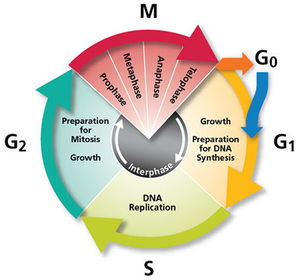
- 1. Mitosis - type of nuclear division consisiting of prophase, metaphase, anaphase and telophase, that produces 2 daughter cells genetically identical to each other and the parent cell and maintains the chromosome number.
- 2. Cytokinesis - cytoplasmic division following nuclear division
- 3. G0 phase of interphase - optional phase where cells may undergo apoptosis (programmed cell death), differentiation or senescence (where it can no longer divide)
- 4. G1 phase of interphase - cells grow, transcription of genes to make mRNA, organelles duplicate, protein synthesis
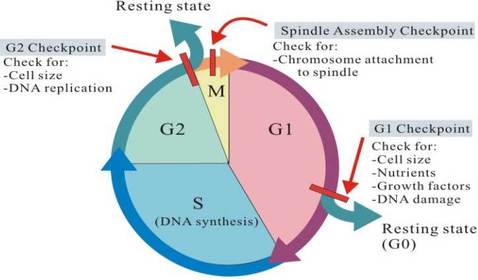
- 5. G1/S checkpoint (aka. restriction point) - check to see if cell is ready to begin DNA synthesis
- 6. S phase of interphase - DNA replicates so, each chromosome consists of a pair of identical sister chromatids
- 7. G2 phase of interphase - cells grow
- 8. G2/M checkpoint - check cell is ready for mitosis
-
- G1/S checkpoint and G2/M checkpoint prevent uncontrolled division of cells and detect and repair damage to DNA. They ensure the cell cycle cannot be reversed and that DNA is only duplicated once during each cycle.
-
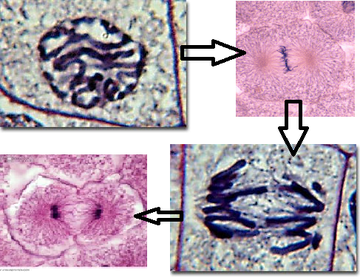
- 1. Prophase - Replicated chromosomes shorten and thicken as DNA supercoils, nuclear envelope breaks down, centriole in animal cells divides and move to opposite ends of the cell, cytoskeleton forms tubulin spindle between the centrioles.
- 2. Metaphase - at the equator chromatids attach to the spindle by their centromeres
- 3. Anaphase - centromeres of each chromatid splits, motor proteins walk along the tubulin threads and pull each sister chromatid in opposite directionn towards opposite poles
- 4. Telophase - separated chromosomes reach the poles, new nuclear envelope surrounds each set of chromosomes, the cell now contains 2 identical nuceli.
- Cytokinesis in animal cells: plasma membrane folds inwards and nips in the cytoplasm, creating two identical cells
- Cytokinesis in plant cells: end plate forms where the equator of the spindle was, new plasma membrane and cellulose cell wall laid down on either side of the end plate, creating two identical cells.
-
Significance of mitosis and meiosis
- Mitosis:
- Asexual reproduction - reproduction for some protoctists such as amoeba, some plants forming runners such as strawberry plants, some animals such as female sharks kept in captivity without males and some fungi such as yeast
- Growth of multicellular organisms
- Tissue repair
- Meiosis:
- Produces a haploid gamete. Increases genetic variation in a species through combining genetic material from two unrelated individuals. The gametes are unique due to independent assortment and crossing over.
-
- Produces haploid gametes - cells which have only one set of chromosomes
- Homologous chromosomes - matching chromosomes, containing the same genes at the same loci, but which may contain different alleles for some of the genes
- Meiosis - type of nuclear division that results in the formation of cells containing half the number of chromosomes of the parent cell
-
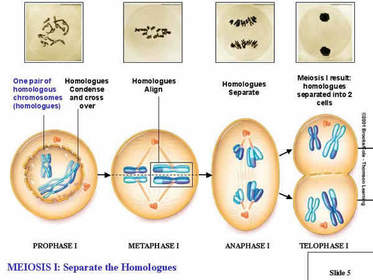
- Prophase 1: chromatin condenses and chromosomes supercoil. Nuclear envelope breaks down and spindle forms. Chromosomes come together in their homologous pairs and crossing over occurs - where non-sister chromatids wrap around each other and swap sections
- Metaphase 1: Pairs of homologous chromosomes arrange randomly and attatch to the spindle at the equator (independent assortment.)
- Anaphase 1: Motor proteins drag the homologous chromosomes apart, each consisting of 2 chromatids because the centromeres do not divide. Crossed-over areas separate resulting in allele shuffling.
- Telophase 1 - in animal cells, nuclear envelopes form and cytokinesis occurs, followed by a short interphase where chromosomes uncoil. Each nucleus contains half the number of chromosomes but each chromosome consists of 2 non-identical chromatids. In plant cells, the cell goes from anaphase 1 to prophase 2.
-
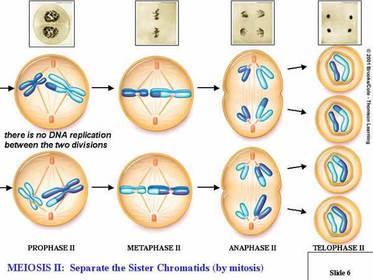
- Prophase 2: if nuclear envelopes have reformed, they break down. Chromosomes coils supercoil and condense. Spindles forms.
- Metaphase 2: chromosomes attach by their centromere to the equator of the spindle. Chromatids are randomly arranged
- Anaphase 2: centromeres divide, chromotids are pulled apart by the motor proteins which drag them along the spindle. Chromatids are randomly segregated - independent assortment.
- Telophase 2: nuclear envelope forms around each of the 4 haploid nuclei. In animals, the 2 cells divide to form 4 haploid cells. In plant cells, a tetrad of 4 haploid cells is formed.
-
- Erythrocytes - carry oxygen from lungs to respiring cells. Derive from stem cells in the bone marrow. Very small and biconcave- large SA;V ratio so oxygen diffuses into them. Flexible due to developed cytoskeleton - can travel through very narrow capillaries. Few organelles - more space for haemoglobin.
- Neutrophils - ingest invading pathogens. Large with multi-lobed nucleus. Attracted to and travel towards infection sites by chemotaxis. Ingest pathogens by phagocytosis.
- Sperm - male gametes. Lots of mitochondria - provide ATP for undulipodium to move and propel cell towards ovum. Small, long and thin - can move easily. Enzymes in specialised lysosome in head - digest outer covering of ovum to allow sperm head to enter ovum. Head contains haploid male gamete nucleus and very little cytoplasm.
- Palisade cells - leaf cells adapted for photosynthesis. Long and cylindrical - pack together with a little air space for carbon dioxide to circulate so it enters cells. Large vacuole - chloroplasts are positioned near to outside of cell reducing diffusion distance for CO2. Contain chloroplasts - site of photosynthesis. Cytoskeleton and motor proteins - chloroplasts can be moved to adapt to light intensity.
- Guard cells - cells in the lower epidermis which control what leaves and enters the leaf. Can swell and the cellulose cell wall is more flexible at the tips which means the tips bulge and create a stoma - a gap. Gaseous exchange and transpiration can occur.
- Root hair cells - hair like projection increase SA for water and mineral ions. Special carrier proteins in plasma membrane for active transport of mineral ions. Water follows by osmosis. Able to produce ATP for active transport.
-
- Squamous and epithelial tissue - lines free surfaces of the body such as skin, respiratory and digestive systems and blood vessels. Almost made entirely out of cells which are very close to each other - forms continuous sheets. No blood vessels - receive nutrients via diffusion. Some contain cilia or microvilli. Short cell cycles - replace damaged tissue. Specialised to carry out function.
- Cartilage - immature cells (chondroblasts) divide by mitosis and secrete the extracellular matrix and then mature. Matrix maintained by less active chondrocytes. Hyaline cartilage - forms embryonic skeleton, covers ends of long bones in adults, joins ribs to sternum, found in nose, trachea and larynx. Fibrous cartilage - between discs between vertebrae and in knee joint. Elastic cartilage - outer ear and epiglottis.
- Muscle tissue - well-vascularised, made of elongated fibres which contain myofilaments which allow muscle to contract. Skeletal muscle - packaged by connective tissues, joined to bones by tendons and causes bones to move. Cardiac muscle - makes up heart walls and allows heart to beat. Smooth muscle - occurs in intestine walls, blood vescles, uterus and urinary tract and propels substances along these tracts.
- Xylem - carry water and minerals from plant roots to all parts of plant. Lignin is deposist in the cambium cell walls which reinforces them, waterproofs them and kills the cells. The ends of the cells break down and form continuous coloumns with wide lumens.
- Phloem sieve tubes - transfer products of photosynthesis in solution, from leaves to parts of the plants that do not photosynthesise such as roots, flowers and shoots. Not many organelles. Sieve plates form between the cells. Companion cells retain their organelles and continue metabolic functions to provide ATP for active loading of sugars into phloem.
-
- Stem cells are a renewing source of undifferentiated cells.
- Differentiation - process by which stem cells become specialised into different types of cell
- Stem cell - unspecialised cell able to express all of its genes and divide by mitosis
- Tissue - group of similar cells that work together to perform a specific function
- Organ - group of tissues which work together to perform a function
- Erythrocytes and neutrophils derive from stem cells in the bone marrow
- Xylem vessels and phloem sieve tubes are produced from the meristems
- Meristematic tissue - tissue in a plant which contains stem cells and from which all other plant tissues are derived by cell differentiation. Found at root and shoot tips and in the cambium of vascular bundles.
- Plant organs i.e. leaf, root, stem and flower
- Organ systems - a number of organs working together to carry out an overall function i.e. digestive system
-
- Bone-marrow transplants - stem cells from bone marrow are used to treat diseases of the blood and immune system (i.e. sickle-cell anaemia & leukaemia)
- Drug research - stem cells can make particular types of human tissues and these can be used for drugs tested, rather than animals
- Developmental biology - scientists can research how multi-celled organisms develop, grow and mature. Research how cells are developed and their functions and see what goes wrong when cells are disease.
- Repair of damaged tissues - i.e. to treat type 1 diabetes, Alzheimers, s, spinal-cord injuries, grow specific organs for transplanting
Informationen
- Beschreibung
- A level Biology (Module 2: Foundations in Biology) Folienset am 2.1.6 Cell division, cell diversity and cellular organisation, erstellt von Zoe Mitchell am 30/12/2016.
- Erstellt von
- Zoe Mitchell
- Aufrufe
- 3
- Bewertung