
Karteikarten
Cell Division and Basic Genetics
Karten in diesem Stapel (41)
- 1cell divisionprocess by which cells make more cells;
includes binary fission and the cell cycle (meiosis and mitosis) - 2binary fissioncell division in bacteria and archaeons
- 3gametesegg and sperm
- 4prokaryotic cellsa unicellular organism without a nucleus
- 5eukaryotic cellsa cell with a true nucleus
- 6cell cycledescribes the life of a eukaryotic cell;
phases include: G1, S, G2, and M - 7M phasethe parent cell divides;
meiosis or mitosis - 8G1 phase"gap" phase;
regulatory proteins are made and activated - 9S phase"synthesis" phase;
DNA is replicated - 10G2 phase"gap" phase;
cell makes lipids and enzymes - 11karyotypethe organized portrait by number and shape of chromosomes representative of a species
- 12haploida cell with 1 set of chromosomes;
n - 13diploidcells with 2 sets of chromosomes;
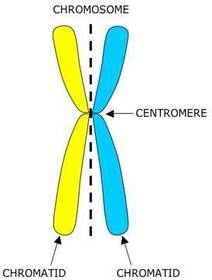
2n - 14sister chromatidstwo identical DNA copies attached at a centromere
- 15mitosisautosomal cell division;
"nuclear division";
starts with a diploid cell and ends with two diploid cells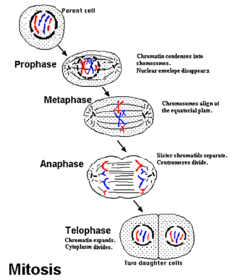
- 16cytokinesiscytoplasmic division
- 17non-sister chromatidschromatids attached to different centromeres
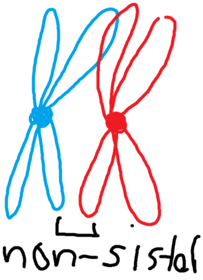
- 18crossoverthe physical breakage and reunion between nonsister chromatids;
occurs in prophase I - 19meiosisdivision of sex cells into gametes;
consists of two parts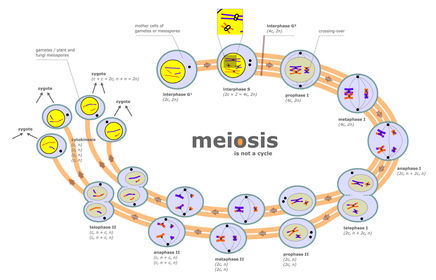
- 20alleledifferent form of a gene
- 21homologous chromosomespair of duplicated chromosomes
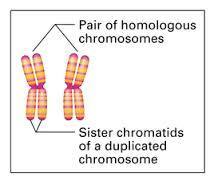
- 22Gregor Mendelfather of genetics;
discovered genes, not traits, are inherited - 23traita characteristic
- 24dominantthe trait that always appears in the F1 generation if present
A - 25recessivethe contrasting trait from a dominant trait that only appears in the F1 generation if the dominant trait is not present
a - 26genotypea combination of alleles
- 27phenotypethe physical expression of a genotype
- 28principle of segregation (Mendel's Law of Segregation)the separation of alleles into different gametes
- 29principle of independent assortment (Mendel's Law of Independent Assortment)the segregation of one set of alleles of a gene pair is independent of the segregation of another set of alleles of a different gene pair
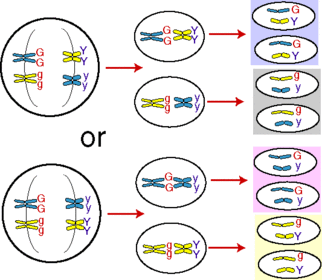
- 30pedigreediagram of ancestral relationships among individuals
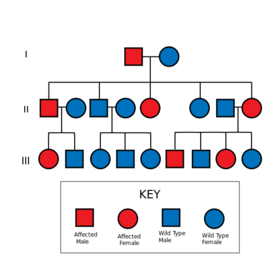
- 31autosomeschromosomes that are not sex chromosomes;
23 pairs of autosomes in humans - 32sex chromosomesX and Y chromosomes;
the 24th pair of chromosomes in humans - 33nondisjunctionchromosomes that fail to separate normally in meiosis
- 34linkeddifferent alleles on the same chromosome
- 35recombinantsan offspring with a different combination of alleles from that of either parent resulting from one or more crossovers in prophase I
- 36formula for total possible number of unique gametes2^n where n = haploid number
- 37Dominant Diseasea disease that shows up in all generations and affects males and females equally;
Huntington's;
Aa or AA - 38Recessive Diseasea disease that usually shows up in every other generation and affects males and females equally;
cystic fibrosis, tay-sachs, sickle cell anemia;
aa - 39Sex-Linked Recessive Disease (X-Linked Recessive Disease)diseases that affect each generation equally and predominates in males;
color blindness, hemophilia;
(X^n)(X^n), (X^n)(Y) - 40homozygous (pure-breed)AA or aa
- 41heterozygousAa
Informationen
- Beschreibung
- Made for Rockhurst University course, General Biology I.
- Erstellt von
- badern
- Aufrufe
- 155
- Tags
- Bewertung