
Karteikarten
Motivation
Karten in diesem Stapel (41)
- 1What is motivation?Psychological process that causes direction, intensity, and persistence of voluntary actions that are goal directed
- 2What are the three things that affects motivation?-Individual differences
-The situation
-The organizational context - 3Formula for PerformancePerformance = F( Motivation x Ability x Environment).
Poor performance does not = a lack of motivation. - 4Vrooms’s Expectancy Theory (VIE)Expectancy
"Can I do the task?”
Instrumentality
”Will I be rewarded for succeeding?”
Valence
”Do I want the reward?” - 5What will happen if one of the VIE (Valence, Expectancy, or Instrumentality) is 0.no motivation if any are zero
(Motivation increases as you add desired outcomes linked to performance) - 6What is Self-Efficacy?A person’s belief about his/her ability to successfully accomplishing a specific task.
Low S.E. = learned helplessness
High S.E = maximum performance - 7How can self-efficacy be increased?- Mastery experiences
- Feedback
- Modeling
- Social persuasion
Managers, coworkers, job design, training, and rewards can provide some or all of these - 8What are the basics of Goal Setting Theory- Goal Specificity
"Specific goals are better than “do your best” goals
- Goal Difficulty
"Difficult goals are better than easier goals" - 9What is the definition of Stretch GoalsBy definition, it is a goal that you don’t know how to reach.
Stretch goals should be supplementary to other goals - 10What does the S stand for in Practical Applications: SMARTERSpecific – What, how, where, when, and with whom the task needs to be accomplished
- 11What does the M stand for in Practical Applications: SMARTERMeasurable – how much, how well, at what cost
- 12What does the A stand for in Practical Applications: SMARTERAchievable – challenging, yet accepted
- 13What does the R stand for in Practical Applications: SMARTERRelevant – within employee’s control
- 14What does the T stand for in Practical Applications: SMARTERTime-framed – due date and when assessed
- 15What does the E stand for in Practical Applications: SMARTERExciting – employee commitment, not just compliance
- 16What does the R stand for in Practical Applications: SMARTERReviewed – feedback and recognition on goal progress and accomplishment
- 17Distributive Justice isFairness of the outcomes
Affects attitudes towards personal outcomes - 18Procedural Justice isFairness of the process
Affects attitudes towards the organization - 19Interactional/Interpersonal Justice isFairness of the enactment of the process (i.e., treatment)
Affects attitudes towards management - 20What are the three rules for allocating resources for distributive justiceEquity – resources are distributed to employees with respect to their abilities or contributions
Equality – resources are distributed so each person gets the same outcome, regardless of their contributions
Need – resources are distributed to the person who needs them more - 21Adam’s Equity TheoryInputs -- what employee brings/gives to the job (skill, age, education and so on)
Outcomes -- what the employee receives from the job (salary, benefits and so on)
Comparison - 22What does Information Justification meangiving people adequate information about procedures that affect them
- 23Basics of Reinforcement Theorydecisions concerning present or future behaviors are largely influenced by the consequences of rewards associated with past behaviors
- 24Reinforcement Schedules ContinuousEach time behavior occurs it is reinforced
- 25Reinforcement Schedules Fixed intervalAt fixed time intervals, the behavior is reinforced
- 26Reinforcement Schedules Variable intervalAt random time intervals the behavior is reinforced
- 27Reinforcement Schedules Fixed ratioAfter a fixed number of occurrences, the behavior is reinforced
- 28Reinforcement Schedules Variable ratioAfter a random number of occurrences, the behavior is reinforced.
(Variable ratio is considered the best) - 29What are some arguments for Monetary rewards as reinforcement-Money is close to an universal motivator
-Monetary rewards convey symbolic meaning
-Money supplements intrinsic rewards
-High performers expect pay-for-performance and are more likely to quit if they don’t receive adequate levels - 30What are some arguments against Monetary rewards as reinforcement-Rewards punish
-Rewards rupture relationships
-Rewards ignore reasons for problems
-Rewards discourage risk taking
-Rewards undermine interest - 31Did you know......83% of companies with a pay-for-performance system indicate that their incentive plan was “only somewhat successful or not working at all"
- 32What does Job Design increaseWith job design the idea is to try to increase INTRINISC motivation (i.e., more effort and persistence).
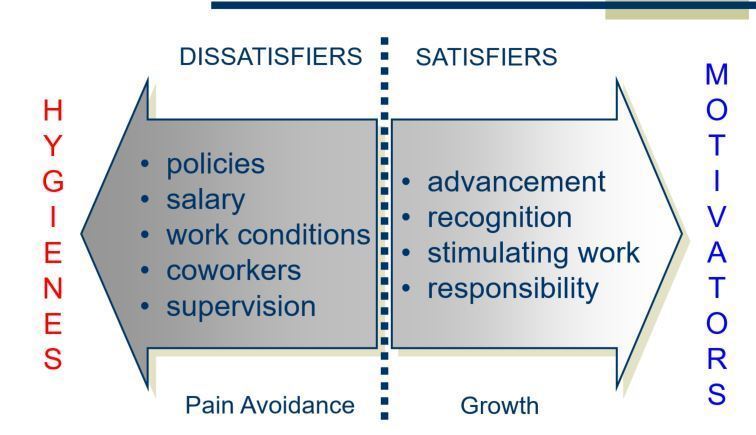
This compliments other motivational strategies (i.e., goals, self-efficacy, expectancy, reinforcement, etc.)…..once implemented, they run themselves… - 33Herzberg Motivation-Hygiene Theory
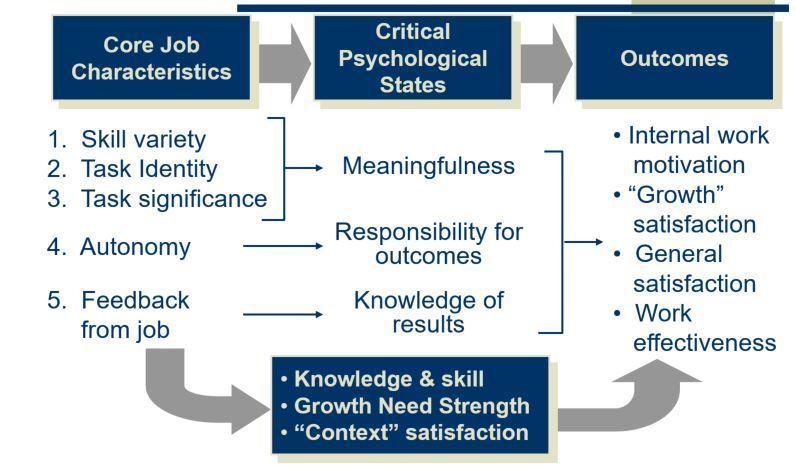
- 34Job Characteristics Theory
- 35What are some recent Advances in Motivation Theory and ResearchPositive Affect
High positive affect = active, enthusiastic, excited, alert
Negative Affect
High negative affect = distressed, nervous, angry, hostile - 36Work moods can.....influence the performance of individuals or groups
- 37What are the three Antecedents of Work Moods-Individual
Affective disposition (i.e., personality)
-Group
Group characteristics
-Organization
Design of work space, office layout, etc. - 38The Pygmalion Effect isA persistently held belief in a person or subject such that the belief becomes a reality.
Overwhelming evidence indicates that the expectations you have of others impact their behavior and subsequent performance. - 39Is the Pygmalion effect necessarily intentional?Can be unintentional and subtle – individuals respond to the cues and adjust their behavior accordingly
- 40How should you use The Pygmalion Effect?Set high goals, facilitation, feedback
Stay positive – expect success!
Learn to use and recognize information that can be used to boost an individual’s expectations - 41Did you know.....The Pygmalion Effect may have a limited effect on performance over time (i.e., effects diminish over time). However, it is still crucial because confidence early in a task has an impact on performance. After a task is well-learned, one can then focus more on goals, etc.
Informationen
- Beschreibung
- Business/Economics Karteikarten am Motivation, erstellt von mark tompkins am 29/04/2018.
- Erstellt von
- mark tompkins
- Aufrufe
- 34
- Bewertung