
Karteikarten
Exchange surfaces and breathing
Karten in diesem Stapel (18)
- 1Why do multicellular organisms need specialised exchange surfaces?Larger animals are not able to receive oxygen through diffusion as the outer surfaces are unsuitable for gas exchange.
Active organisms have an increased metabolic rate so cells will nee more oxygen. - 2What are the features of an efficient exchange system?1, Large surface area
2. thin permeable surface
3. moist exchange surface - 3How is the mammalian lung adapted for efficient gaseous exchange?1. Many alveoli
2. Alveolus wall is one cell thick
3. Capillary wall is one cell thick
4. walls consist of squamous cells
5. Capillaries in close contact with the alveolus wall
6.Narrow capillaries
7. Red blood cells are closer to the capillary wall - 4What is the function of cartilage?Structure.
Holds the trachea and bronchi open and
prevents collapse when the air pressure is low during inhalation - 5What is the function of Cilia?Move in a synchronised pattern to waft mucus up the airway to the back of the throat.
Once there, the mucus
is swallowed and the acidity of the stomach will kill any bacteria - 6What is the function of the goblet cells?Secrete mucus.
Traps tiny particles from the air
Reduces risk of infection - 7What is the function of the smooth muscle?Can contract to restrict airway
Prevents harmful substances from reaching the alveoli - 8What is the function of the elastic fibers?Reverses the effect of the smooth muscle
When the smooth muscle constricts it deforms the elastic fibres. As the smooth muscle relaxes, the elastic
fibres recoil to their original size and shape, helping to dilate the airway - 9outline the mechanism of inspiration in mammals.Inspiration
1. Diaphragm contracts to becoming flatter, pushing digestive muscles down
2. External intercostal muscles contract to raise ribs
3. Volume of chest cavity increases
4. Pressure in chest cavity drops below atmospheric pressure
5. Air moves into lungs - 10outline the mechanism of expiration in mammals.Expiration
1. Diaphragm relaxes and is pushed up by displaced organs underneath
2. External intercostal muscles relax and ribs fall
3. Volume of chest cavity decreases
4. Pressure in lungs increases and rises about atmospheric pressure
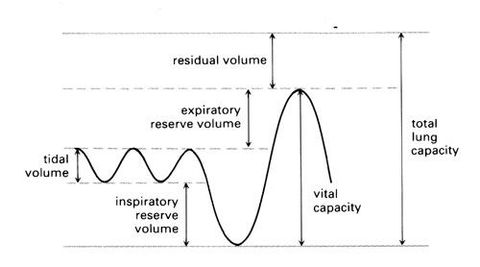
5. Air moves out of lungs - 11Define Tidal Volume.The volume of gas exchanged during just one breath in and out.
- 12Define Vital Capcity.The maximum volume of air that can be exchanged during one breath in and out.
- 13How does a Spirometer work?A spirometer consists of a chamber filled with oxygen floating on a tank of water. A person breaths from a mouthpiece
attached to a tube connected to the oxygen tank. Breathing in takes oxygen from the chamber so it sinks down, and
breathing out pushing air back into the chamber which floats up. The movements of the chamber is recorded using a
datalogger. - 14how can a spirometer be used to measure vital capacity?measure the distance on the graph between peak and the trough line representing a single force inspiration and expiration.
- 15How can a Spirometer be used to measure Tidal volume?Measure the distance on the graph between the peak and the trough of the line in a single normal breath in and out.
- 16how can a spirometer be used to measure breathing rate?divide the number of breathes by the time in minutes to
calculate the number of breaths per minute during normal breathing - 17How can a Spirometer be used to measure Oxygen uptake?Divide (the amount of oxygen (dm3) times 60) by the time taken in seconds.
- 18what data can be collected from a spirometer and how can the data be interpertated?
Informationen
- Beschreibung
- A Levels Biology (F211) Karteikarten am Exchange surfaces and breathing, erstellt von megan.radcliffe16 am 26/11/2014.
- Erstellt von
- megan.radcliffe16 · Nov 2014
- Aktualisiert
- 10 Feb 2018
- Aufrufe
- 682
- Tags
- Bewertung