
Karteikarten
Evolution
Karten in diesem Stapel (192)
- 1Natural SelectionA process in which individuals that have certain inherited traits tend to survive and reproduce at higher rates than other individuals because of those traits.
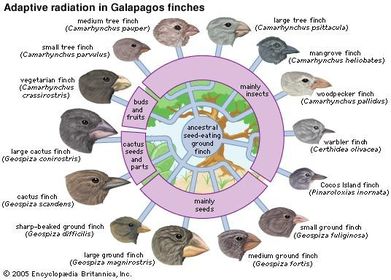
- 2adaptive radiationPeriod of evolutionary change in which groups of organisms form many new species whose adaptations allow them to fill different ecological roles in their communities.
- 3speciationAn evolutionary process in which one species splits into two or more species.
- 4artificial selectionThe selective breeding of domesticated plants and animals to encourage the occurrence of desirable traits.
- 5homologous structuresStructures in different species that are similar because of common ancestry.
- 6analogousHaving characteristics that are similar because of convergent evolution, not homology.
- 7convergent evolutionThe evolution of similar features in independent evolutionary lineages.
- 8Ecological nicheThe specific role a species has in its environment
- 9founder effectGenetic drift that occurs when a few individuals become isolated from a larger population and form a new population whose gene pool composition is not reflective of that of the original population.
- 10bottleneck effectGenetic drift that occurs when the size of a population is reduced, as by a natural disaster or human actions. Typically, the surviving population is no longer genetically representative of the original population.
- 11genetic driftA process in which chance events cause unpredictable fluctuations in allele frequencies from one generation to the next. Effects of genetic drift are most pronounced in small populations.
- 12gene flowThe transfer of alleles from one population to another, resulting from the movement of fertile individuals or their gametes
- 13sexual dimorphismDifferences between the secondary sex characteristics of males and females of the same species.
- 14allopatric speciationThe formation of new species in populations that are geographically isolated from one another.
- 15sympatric speciationThe formation of new species in populations that live in the same geographic area
- 16rooted phylogenetic treeeach node with descendants represents the inferred most recent common ancestor of the descendants, and the edge lengths in some trees may be interpreted as time estimates.
- 17polytomyIn a phylogenetic tree, a branch point from which more than two descendant taxa emerge. A polytomy indicates that the evolutionary relationships between the descendant taxa are not yet clear.
- 18sister taxaGroups of organisms that share an immediate common ancestor and hence are each other’s closest relatives.
- 19biological species conceptDefinition of a species as a group of populations whose members have the potential to interbreed in nature and produce viable, fertile offspring but do not produce viable, fertile offspring with members of other such groups.
- 20macroevolutionEvolutionary change above the species level. Examples of macroevolutionary change include the origin of a new group of organisms through a series of speciation events and the impact of mass extinctions on the diversity of life and its subsequent recovery.
- 21microevolutionEvolutionary change below the species level; change in the allele frequencies in a population over generations.
- 22intersexual selectionA form of natural selection in which individuals of one sex (usually the females) are choosy in selecting their mates from the other sex; also called mate choice.
- 23punctuated equilibriaIn the fossil record, long periods of apparent stasis, in which a species undergoes little or no morphological change, interrupted by relatively brief periods of sudden change.
- 24Gradualisma theory or a tenet assuming that change comes about gradually or that variation is gradual in nature
- 25autopolyploidAn individual that has more than two chromosome sets that are all derived from a single species.
- 26allopolyploidA fertile individual that has more than two chromosome sets as a result of two different species interbreeding and combining their chromosomes.
- 27heterochronyEvolutionary change in the timing or rate of an organism’s development.
- 28paedomorphosisThe retention in an adult organism of the juvenile features of its evolutionary ancestors.
- 29homeotic geneAny of the master regulatory genes that control placement and spatial organization of body parts in animals, plants, and fungi by controlling the developmental fate of groups of cells.
- 30monophyleticPertaining to a group of taxa that consists of a common ancestor and all of its descendants. A monophyletic taxon is equivalent to a clade.
- 31paraphyleticPertaining to a group of taxa that consists of a common ancestor and some, but not all, of its descendants.
- 32polygenic inheritanceAn additive effect of two or more genes on a single phenotypic character.
- 33shared ancestral characterA character, shared by members of a particular clade, that originated in an ancestor that is not a member of that clade.
- 34shared derived characterAn evolutionary novelty that is unique to a particular clade.
- 35Carolus LinnaeusLooked for order in the diversity of life through taxonomy for the greater glory of
God.
Developed the system of binomial nomenclature (Genus species). - 36Cuvier - GeologistGood…
Older fossils dissimilar to current life forms
From one layer to the next, some species disappeared
Bad…
Catastrophism - 37Hutton - GeologistHutton – geological features by processes still operating today.
Good…. Geological Gradualism - 38Lyell - GeologistPrinciple of
Uniformitarianism
– mechanisms of
change were constant
over time. - 39Hutton + Lyell“ the same processes are
working gradually over
long periods of time.” - 40Jean-Baptiste LamarckUse and Disuse + Inheritance
Use and Disuse
Inheritance - 41Adaptive Radiation example
- 42Theory of Evolution in three words......Decent With Modification
- 43Geologists and Biologists that came before DarwinCarolus Linnaeus
1707 – 10 January 1778
Sweedish Botanist, Physicial and Zoologist
Jean-Baptiste Lamarck (French Naturalist)
(1 August 1744 – 18 December 1829)
Hutton (Geologist, uniformitarianism)
(1726-1797)
Georges Cuvier - Geologist
(August 23, 1769 – May 13, 1832)
Sir Charles Lyell (Geologist)
(14 November 1797 – 22 February 1875)
(French Naturalist and Zoologist) - 44Darwin’s Observations and Inferences Observation 1members of a population often vary greatly in
their traits. - 45Darwin’s Observations and Inferences Observation 2Traits are inherited from
parents to offspring. - 46Darwin’s Observations and Inferences Observation 3All species are capable of
producing more offspring than their environment can
support. - 47Darwin’s Observations and Inferences Observation 4Owing to a lack of food or other
resources, many of these offspring do not survive. - 48Darwin’s Observations and Inferences Inference 1Individuals whose inherited traits
give them a higher probability of surviving and
reproducing in a given environment tend to leave
more offspring than other individuals - 49Darwin’s Observations and Inferences Inference 2This unequal ability of individuals
to survive and reproduce will lead to the
accumulation of favorable traits in the
population over generations. - 50How long does artificial selection take?VERY FAST
- 51How long does Natural Selection take?Very fast (catastrophic
pressure) to very slow (natural pressure) - 52Natural selection works onindividuals within an
environment. Individuals DO NOT evolve, rather
populations evolve. - 53Evidence – For Descent w/ Modification1. Direct Observation
2. Homology
3. Fossil Record
4. Biogeography - 54How old is the Earth?Earth 4.6 Billion Years Old
- 55Evidence – BiogeographyEarth 4.6 Billion Years Old
Pangaea 250 mya
Broke up 20 mya
Comparison of organisms similarities and
differences
Endemic – Found there and only there - 56EndemicFound there and only there
- 57Pangaeawas a supercontinent that existed during the late Paleozoic and early Mesozoic eras formed 250 - 300 mya. Began breaking apart after about 100 million years
- 58Analogous traits arisewhen groups
independently adapt to similar
environments in similar ways - 59Convergent evolution does NOTprovide information about ancestry
- 60Darwin's TheorySpecies/populations change over time, they adapt, evolve over time by natural selection.
- 61A theory of Science is based on.....a broad collection of data and supporting evidence.
- 62GenesThe basic unit of heredity, DNA code
- 63GenotypeThe Genes ex.
- 64PhenotypeThe physical characteristics,
EX: Red Hair - 65Does Genotype always lead to Phenotype?NO - some phenotypes are not heritable
- 66SpeciesGroup of actually or potentially interbreeding natural population (individuals) which can and will interbreed to produce fertile offspring
- 67PopulationA group of individuals of the same species that live in the same are and interbred
- 68Evolution works on.....Populations
- 69Natural Selection works on ...Individuals
- 70Microevolution works on ....Changes in allele frequencies in a population
- 71Three main causes that drive genetic changes1. Natural Selection
2. Genetic Drift
3. Gene Flow - 72Sources of Genetic VariationMutation
Position and Number altered
Reproduce Quickly
Sexual reproduction - 73Point MutationAlter one base in a gene
- 74Source of most genetic variationSexual Reproduction
- 75Hardy Weinberg equilibriump2 + 2pq+ q2 = 1
- 76What does the Hardy Weinberg Equilibrium formula state?If you give me the frequency of genes in a population, I will tell you the frequency of individuals in a population
- 77Calculate p allelep = White x 2 + Pink x 1
Total Population X 2
White is X 2 because each white individual has two p alleles
Pink is X 1 because its genotype pq has one p allele.
The total population has to be doubled to account for each individual having
2 alleles - 784 Key Points of Genetic Drift1. Genetic drift is significant in small populations
2. Change may be random
3. It can lead to a loss of genetic variation
4. Can cause harmful alleles to be fixed - 79Relative FitnessContribution to the gene pool of the next generation RELATIVE to the contributions of others
EX: "survival of the fittest", some males lock horns - 803 Modes of SelectionDirectional, Disruptive and Stabilizing
- 81Directional SelectionFavors individuals at one end of the phenotypic
- 82Disruptive SelectionFavors individuals at both extremes of the phenotypic range
- 83Stabilizing selectionFavors intermediate variants and acts against extreme phenotypes
- 84Sexual selectionnatural selection for mating success
- 85What can sexual selection result in?sexual dimorphism
- 86Male showinessdue to mate choice can increase a male's chances of attracting a female, while decreasing his chances for survival
- 87The good genes hypothesis suggests...that if a trait is related to male health, both the male trait and female preference for that trait should be favorably selected
- 88What do you need in order to distinguish species?1. Morphology
2. Physiology
3. Biochemistry
4. DNA - 89Reproduction IsolationBiological barriers that impede members of two different species from producing viable, fertile offspring
- 90Reproduction Isolation PurposeLimit hybrids; offspring from interspecific mating
- 91Prezygotic barriersblock fertilization
- 92Postzygotic barrierspreserve isolation after fertilization
- 93Morphological speciescharacterized by body shape
EX: Pheidole barbata - 94Ecological speciescharacterized by its ecological niche
EX: Galapagos finches - 95Phylogenic speciessmallest group sharing common ancestor
- 96What has a high degree of allopatric speciation?Island Biology
- 97Two forms of PolyploidyAutopolyploid
Allopolypoid - 98Patterns with Hybrid Zones*A hybrid zone can occur in a single band where adjacent species meet
*Hybrids often have reduced fitness compares with parent species
*The distribution of hybrid zones can be more complex if parent species are found in multiple habitats within the same region - 99Rate of Speciation*Punctuated Equilibrium
*Gradualism
*Once speciation occurs, divergence can happen quite quickly - 100Two things that Rate of Speciation tells us...1. It may be millions of years to create a new species.
2. Once gene flow has been interrupted, there must be continued divergence to become reproductively isolated - 101How Old is the Earth?4.6 Billion Years
- 102Origin of EarthEarth's early atmosphere likely contained water vapor and chemicals released by volcanic eruptions (nitrogen, nitrogen oxides, carbon dioxides, methane, ammonia, hydrogen, hydrogen sulfide)
- 103Earliest evidence of life on Earth?3.5 Billion Years ago
- 104RibozymesAn RNA that functions as an enzyme too. AKA Catalytic RNA
- 105Sedimentary Rocksare deposited into layers called Strata and are the richest source of fossils
- 106The fossil record reveals....changes in the history of life on Earth
- 107Fossil TypesMolds/Prints
Trace
Amber - 108Sedementary StrataReveal the relative age of fossils
- 109Radiometric DatingHow the absolute age of fossils can be determined
- 110Half-life of an isotopetime require for half the parent isotope to decay
- 111What happens to a "parent" isotope?it decays to a "daughter" isotope at a constant rate
- 112Age of prokaryotes3.5 Billion Years
- 113Age of oxygen2.7 Billion Years
- 114Age of Eukaryotes2.1 Billion Years
- 115Age of Cambrian Explosion542 Million Years
- 116Age of Colonization of Land500 Million Years
- 117Age of Jurassic200 Million Years
- 118First single celled organismsStromatolites, Mats
(3.5 Million Years, or earlier)
"Transformed life on the planet" - 119Multicellularity (1.5bya)The first multicellular organisms were most likely algae
Ice ages suppress the process
565mya Earth thaws and diversity increases - 120Evidence for Endosymbiont Model1. Replicated - Direct observation (5yrs)
(the following are similarities between endosymbionts and prokaryotes)
2. Enzymes and transport systems
3. Replication
4. DNA
5. Size
6. Antibiotics / Ribosomes - 121First Eukaryotes (2.1bya)Endosymbiont model
Mitochondria & Plastids
See pg 517
Mitochondria first - 122Oxygenic Pathway (2.7bya)02 dissolves in water
02 reacts with Fe to create Iron Oxide
02 then saturates water
02 gasses out and reacts with Fe on land
02 then saturates the atmosphere
Mass extinction
of the prokaryotes… why? - 123Cambrian ExplosionMajor changes
Soft bodies herbivores
become armored
predators
Sponges
Cnidarians
Molluscs - 124Land Colonization (500mya)Organisms moving onto the land had to adapt to arid conditions
Plant adaptations
Animal adaptations - 125Affecting Life on EarthThree major processes affecting life on this planet
1. Continental drift
•
2. Mass Extinctions
•
3. Adaptive Radiations
• - 126Continental DriftProcess of plates moving (plate tectonics not discovered until 1915*
thanks Spring 2012 students)
Rate
Pangaea - 127If all the continents come together what two significant things would happen?1. Habitat alteration – Canada used to be equatorial. Sea rise and fall.
Where will the polar bears go?
2. Allopatric speciation – geographic isolation causing speciation. - 128Evolutionary TrendsExtracting a single evolutionary
progression from the fossil record can be
misleading - 129Evolutionary NoveltiesThe eye
The ear - 130Systemicsdiscipline focused on classification and determining evolutionary relationships
- 131PhylogenyEvolutionary history of a species
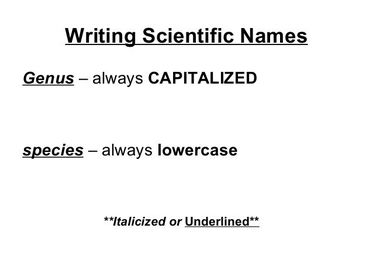
- 132Correct way to write Scientific namesCardiospermum halicacabum
- 133Taxonomic Hierarchy
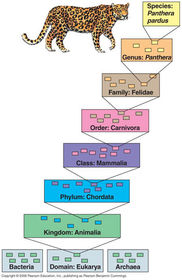
- 134Example of a rooted tree
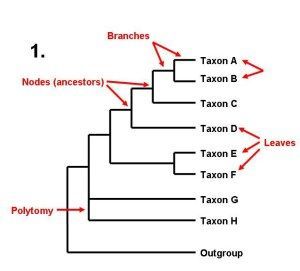
- 135Cladogram
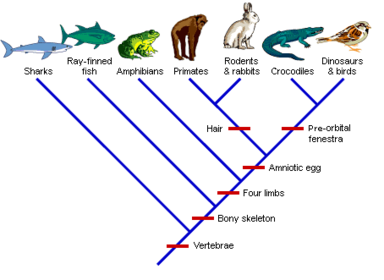
- 136Shared primitive characterA characteristic that share beyond the clade under study
- 137Ingroupgroup of related species under study
- 138Outgroupa species or group of species that are closely related to, but are outside he ingroup
- 139Phylogramslength of branches reflect the number of changes that have occurred to a particular DNA sequence in that lineage
- 140Ultrametric treesthe pattern is the same as a phylogram, but all branches traced to a common ancestor are the same length. Illustrates survival period for the lineage rather than the number of DNA changes
- 141How does an Ultrametric tree differ from a phylogram?on an Ultrametric tree the branches traced to a common ancestor are the same lenth
- 142Hypothesis for the origin of life on Eartha. Abiotic synthesis of organic monomers.
b. Abiotic synthesis of polymers.
c. Formation of protobionts.
d. Origin of genetic information. - 143Is evolution goal oriented?NO
Evolution simply depends on the environment which the organisms live and try to survive. - 144The Endosymbiotic TheoryThe theory of Endosymbiosis explains the origin of
chloroplasts and mitochondria and their double membranes.
This concept postulates that chloroplasts and mitochondria
are the result of years of evolution initiated by the
endocytosis of bacteria and blue-green algae.
According to this theory, blue green algae and bacteria
were not digested; they became symbiotic instead. - 145Environmental challenges of living on landObtaining enough water
Preventing excessive water loss
Getting enough energy
The photosynthesis/water trade-off - 146What type of mutation plays the most important role in increasing the number of genes in the gene pool?Duplication (Gene duplication is an important source of new genetic material)
- 147Which of the following is the best example of gene flow?Wind blows pollen from one population of plants to another and cross-fertilization occur (Over several generations the two populations will become more similar)
- 148Which of the following reproductive barriers actually prevents individuals of closely related species from copulating successfully?Mechanical Isolation
(With mechanical isolation, mating cannot occur successfully due to incompatibility of reproductive parts) - 149Mutations in what class of genes have probably been responsible for many of the changes leading to the great diversity of life existing today?Developmental genes
(Small changes in developmental genes such as Hox genes can produce large morphologic changes) - 150There are two groups of pine trees that appear to be very similar phenotypically and genotypically. However, one releases pollen in January, when the female structures of that group are receptive, and one in March. What kind of reproductive barrier is this?temporal isolation
(Temporal isolation occurs when two similar species have sexual rediness at different times) - 151How did some strains of Staphylococcus aureus become resistant to antibiotic drugs?Some members of the bacteria population must have had a genetic variation that made them resistant to antibiotics, and these bacteria had greater reproductive success than sensitive individuals. (Those bacteria that survived the various antibiotic drugs passed on to subsequent generations the genes that enabled them to resist the drug)
- 152Lyell's principle of unifomitarianism _______?strongly influenced Darwin's view of how living organisms could change over time. (Darwin eventually embraced the idea of an old Earth rejected the idea that living organisms had been specially created. He applied the idea of slow change to the evolution of oranisms.)
- 153In Hardy-Weinberg equation, p2 represents ____________?the expected frequency of homozygous dominant individuals in the population
(the frequency of the dominant allele (A); thus p2 represnts the frequency of homozygous dominant individuals (AA:p*p=p2) - 154Selection that acts over evolutionary time to preserve traits that increase an individuals ability to mate is known as _______?sexual selection
(In sexual selection, secondary characteristics that may not seem to be adaptive in the general sense may give an individual an advantage in gaining a mate and producing fertile, viable offspring) - 155In the Hardy-Weinberg equilibrium, 1 represents ______________?the sum of the frequencies of the genotypes for a particular gene locus
(The sum of the frequencies of the genotypes must equal 1 in any population) - 156What is the name of the theory that suggests that eukaryotic organisms evolved from engulfing prokaryotic organisms and then creating an obligate relationship with them?Endosymbiont
- 157What is the term given to an organism that becomes able to reproduce (accelerated reproductive development) before the body is an adult (somatic development).Paedomorphosis
- 158Scientific names (Genus species) are better to use than common names because they clear up ambiguities, particularly misunderstandings based on language barriersTrue
- 159Show the events of life on Earth in the correct order.* Origin of Earth - 4.6 Billion Years
*Prokaryotes- 3.5 Billion Years
*Oxygen - 2.7 Billion Years
*Eukaryotes - 2.1 Billion Years
*Cambrian Explosion - 542 Million Years
*Colonization of Land - 500 Million Years
Jurrasic - 200 Million Years - 160cephalic index or cranial indexis the ratio of the maximum width of the head of an organism (human or animal) multiplied by 100 divided by its maximum length (i.e., in the horizontal plane, or front to back). The index is also used to categorize animals, especially dogs and cats.
- 161long-headedFemales - less than 75
Males - less than 75.9
Scientific name: DOLICHOCEPHALIC - 162Short headedFemales- 75-83
Males- 76-81
Scientific Name: MESATICEPHALIC - 163short-headedFemales- greater than 83
Males- greater than 81.1
Scientific name: BRACHYCEPHALIC - 164What prevents closely related species from reproducing?Behavioral isolation is an important evolutionary mechanism that helps members of the same species identify each other as proper mates.
- 165Intrasexual selectionselection within the same sex
*example, some male animals compete against one another, physically, for access to females* - 166Intersexual selectionselection between the two sexes
*the bright plumage of a male peacock does not help it physically overcome rival males.But female peacocks tend to prefer male peacocks with bright plumage:* - 167Evolution is a process resulting in changes in the ________ of populations over timegenetic makeup
- 168correct order from the most broad classification to most specific.Dumb
Kings
Play
Chess
On
Fine
Glass
Sets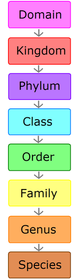
- 169Which of the following i a key observation that must be explained in a unifying theory of life?Many basic characteristic are shared by all living things (Organisms do share many basic characteristics. Darwin reasoned that the diverse organisms found on Earth today evolved from a few common ancestors)
- 170The breeding of plants and animals for particular traits by humans is called....artificial selection
- 171What did Darwin observe about species on islands?They are often closely related to species from the nearest mainland or neighboring islands. (If a species that dispenses from a mainland to an island succeeds in its new environment, it may give rise to several new species as populations spread to other islands in the archipelago.)
- 172Vestigial organs are ............remnants of structures that were useful to an organism's ancestors, but which are no non-functional or show reduced function (For example: some species of snakes have remnants of pelvic and leg bones)
- 173During his voyage around the world, Darwin was inspired to think about evolution by............*fossils he collected
*studying adaptations of organisms to their environments
* the works of others such as Lamarck
*the unique organisms he saw in the Galapagos Islands - 174At the time Charles Darwin sailed on HMS Beagle............several biologists had proposed that species might change over time, but none had suggested a convincing mechanism that might cause the change
- 175Two lines of evidence to support Darwin's theory of descent with modification in natural populationsOrganisms within a population vary, and all populations produce more offspring then can be supported by the environment, resulting in competition for survival within the population
- 176On an evolutionary tree.......homologous characteristics form a nested pattern
- 177In Darwin's view of descent with modification.......natural selection can improve the match between an organism and its environment
(Natural selection acting in a particular environment can increase the compatibility between an organism and its environment) - 178A population of zooplankton is exposed to a small number of predatory fish that feed on the larger-sized (adult) zooplankton. What prediction would most likely occur based on the principles of natural selection?The population will come to contain adult zooplankton that reach sexual maturity when they are still relatively small.
(This would permit the zooplankton to reproduce in spite of the predation pressure on larger individuals) - 179What insight did Darwin gain from reading Thomas Malthus's essay on human suffering?Organisms have the capacity to produce more offspring than the environment can support (Matheus contended that human suffering is a product of humans reproducing faster than food and other resources can increase. This is actually a characteristic of many life-forms on Earth.)
- 180The scala naturae, or scale of nature, is based on the ideas of..........Aristotle
(Aristotle believed that all life forms could be arranged o a ladder, or scale, of increasing complexity) - 181Animals that possess homologous structures probably..............evolved from the same ancestor
(Homology refers to similarity attributable to common ancestry) - 182All know organisms translate genetic information to produce protein molecules via the same genetic code. This finding strongly supports the hypothesis that..........all organisms are decended from a single common ancestor
(A common genetic code is overwhelming evidence that all life is related) - 183Evidence from molecular biology supports the theory of evolution by demonstrating that...............closely related organisms have more similar DNA and proteins than more distantly related organisms
(Evolutionary relationships among species are reflected in their DNA and proteins. If two species have similar libraries of genes and proteins, with sequences of monomers that match closely, the sequences most likely descended from a common ancestor) - 184Lyell's principle of uniformitarianism..........strongly influenced Darwin's view of how living organisms could change over time
(Darwin eventually embraced the idea of an old Earth and rejected the idea that living organisms had been specially created. He applied the idea of slow change to the evolution of organisms.) - 185HerbivoryAn example of the process of evolution
(Herbivory is involved in the process of natural selection, since populations of herbivores must become adapted to particular plant species on which they feed) - 186Carolus Linnaeus is considered to be the founder of .......... and he..........the binomial classification system........thought that resemblances among different species reflected the pattern of their creation
(Although he is considered the founder of taxonomy, Linnaeus accepted the theory of creation) - 187Abiotically produced vesicles display which of the following rudimentary qualities necessary for life?the ability to perform simple reproduction and metabolism
(Abiotically produced vesicles are capable of dividing and performing simple metabolic reactions) - 188According to the theory of evolution anatomical and molecular homologies should ______________?produce very similar patterns of evolutionary relatedness
(According to evolutionary theory, anatomical and molecular homologies should generally produce evolutionary patterns that corroborate each other) - 189Researchers can use molecular homologies to ________________?reveal the number of mutations in a particular sequence that has occurred in each species since they diverged from a common ancestor
(Over long periods of time, insertions and deletions accumulate) - 190What is the correct order of the geologic eras, from most ancient to most recent?Paleozoic
Mesozoic
Cenozoic
(The Paleozoic was followed by the Mesozoic. The current era is the Cenozoic) - 191The modern idea of extinction as a common occurrence in Earth's history was first proposed in the early 19th century writings of ________________?Cuvier
(Cuvier advocated catastrophism, speculation that extinctions apparent in the fossil record corresponded to a catastrophe, such as a flood or drought) - 192Birds and mammals have a four-chambered heart, but most reptiles have a three-chambered heart. How does this fact affect the construction of phylogenic trees for these groups?The most likely tree is not always the most parsimonious (Evidence shows that the ancestors of mammals diverged from reptiles before the ancestors of birds did; therefore, there is no common ancestor of birds and mammals that had a four-chambered heart. This character must have evolved twice)
Informationen
- Beschreibung
- Biology Karteikarten am Evolution, erstellt von Sisa Fable am 15/02/2015.
- Erstellt von
- Sisa Fable
- Aufrufe
- 167
- Bewertung