
Karteikarten
Marketing
Karten in diesem Stapel (46)
- 1What is marketingMarketing is all about delivering value to everyone who is affected by a transaction
- 2What is the role of marketing in a businessIt depends on the business, It can be integrated with all business activities or it can be limited to sales and advertising.
- 3What is a stakeholderA person or organisation that has a 'stake' in the outcome
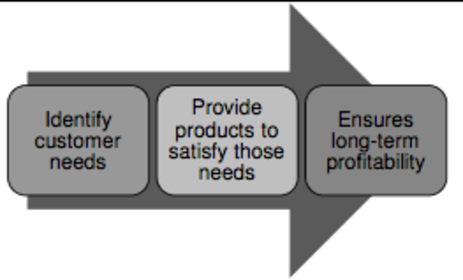
- 4—The Marketing Concept
- 5ConsumerThe ultimate user of a product
- 6Needs VS WantsA need is a necessity while a want is a desire. 'I need food, I want chocolate'
- 7BenefitThe outcome that satisfies a need or want and creates the buying power for a product. 'The perceived value a customer gets out of a product'
- 8DemandConsumers desire for a product and the ability to buy the product.
- 9MarketAll current and potential consumers that share a common need. They must be willing and able to purchase a product as well as having the authority to do so.
- 10Market placeAny shop or medium used to conduct an exchange e.g (dairy, shops, supermarkets)
- 11MarketspaceLocations (mainly online) where buyers and sellers never meet and only know each other by their usernames. e.g. trade me/online shopping.
- 12What is utilityThe usefulness consumers receive from buying, using and consuming a product. (thirsty = quenched)
- 13What are four different types of utilityform, time, place and possession
- 14What do each a buyer and seller receive from an exchangeA buyer receives a product that satisfies a need while the seller receives something (usually money) of equivalent value.
- 15What are four aspects needed for an exchange to take place?1. At least two people
2. An agreed value of exchange
3. Willingness to trade
4. Free to accept or reject deal - 16What is a productA bundle of attributes including features, functions, benefits and uses.
- 17What are the three ways a product can take form?A product can be a good, service or an idea
- 18What are the five types of productsConsumer goods, consumer services, non-for-profit, business to business and ideas, places and people.
- 19Consumer goodsTangible products purchased by individual consumers for individual or family use
- 20Consumer servicesIntangible products. Pay for use but never own. Accounts for 60% of GNP
- 21B2B (Business to business)From one organisation to another. Industrial goods are brought for use in business operations.
- 22Non-for-ProfitIncludes charities, zoos, museums, government and churches.
- 23Ideas, places and peopleIdeas include community behavior (don't drink and drive) while places include tourist locations and attractions. People models, athletes and other celebrities.
- 24ValueThe intangible and tangible benefits a consumer receives from a product
- 25Value propositionA marketplace offering that fairly and accurately sums up the value that a customer will realize if he or she purchases the product.
- 26What is 'the life time value of a customer'The profit they expect to make from this customer in the future
- 27Competitive advantageA companies ability to out perform the competition, providing the consumers with a benefit competitors can't provide.
- 28Distinctive competencyA companies superior capability in comparison to its direct competitors
- 29Differential BenefitsProperties of a product that set them apart from competitors by providing unique benefits
- 30The value chainA series of activities involved in designing, producing, marketing, delivering and supporting any products.
- 31—The value chain. Each link has the potential to add or detract value from the product
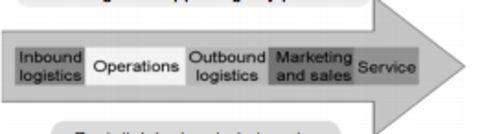
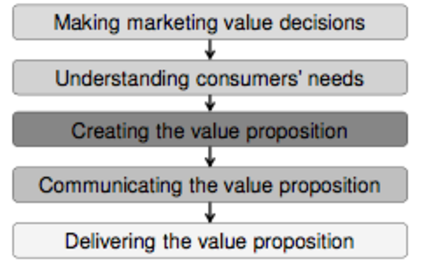
- 32What are the five steps in making and delivering value
- 33What is the marketing planA document that describes the marketing environment, objectives and strategy and who is responsible for each part.
- 34What is a market segmentA distinct group of customer who a similar to each other in some way.
- 35Mass MarketAs many customers as possible
- 36Target MarketThe market segment(s) an organization focuses its marketing efforts on
- 37What are the four P's of the marketing mixPlace, product, price and promotion strategies
- 38Product(4 p's)A good, service, idea, place or person. Includes design, packaging, features and associated services
- 39Place (4 p's)The availability of the product to the customer at the desired time and location.
- 40Price(4 p's)The value a customer gives up in exchange for a desired product
- 41Promotion(4 p's)All activities undertaken to inform and encourage customer to buy the product
- 42When and what is the production era?1900s-1930s. Producing the product as efficiently as possible. Goal is to be the most efficient producer in a mass market
- 43When and what is the selling era?1930s-1960s. When marketing is primarily viewed as a sales function.
- 44When and what is the consumer era1960s. A philosophy focused on satisfying consumers needs and wants
- 45When and what is the New era?1970s-1990s. Improving products so that they meet needs better than competitors. Also sought to benefit employees, shareholders and communities.
- 46When and what is the new millennium?Mid 1990s onwards. Building long term bonds with customers. Customers exchange two things of value: money and information.
Informationen
- Beschreibung
- Week one - what is marketing
- Erstellt von
- Jeny Erebymar
- Aufrufe
- 59
- Tags
- Verlauf
-
- Erstellt von brooke hattie · 30 Apr 2015
- Kopiert von Jeny Erebymar · 30 Apr 2015
- Bewertung