
Karteikarten
OCR F214 - Excretion
Karten in diesem Stapel (31)
- 1What is excretion?Removal of metabolic waste from the body
- 2Why must carbon dioxide be excreted?Has 3 main effects:
1. Too much carbon dioxide in the blood reduces oxygen transport
2. Carbon dioxide can combine with Hb
3. Excess carbon dioxide can cause respiratory acidosis. - 3Why do nitrogenous compounds have to be excreted?1. Body cannot store proteins or amino acids
2. It would be wasteful to excrete whole amino acids, so they are deaminated.
3. This forms ammonia which is highly toxic and very soluble.
3. Ammonia then enters the ornithine cycle and produces urea which is transported to the kidneys for excretion. - 4What shape do liver cells have?Simple cuboidal shape with many microvilli on their surface
- 5What are kupffer cells and what is their function?1. Specialised macrophages
2. Move about within sinusoids
3. Are involved in breakdown and recycling of red blood cells. - 6What is deamination?Removal of an amine group from an amino acid
- 7Why must ammonia not be allowed to accumulate?Because it is highly toxic and very soluble
- 8What happens to ammonia after deamination?1. It is converted into a less toxic and soluble compound called urea via ornithine cycle.
- 9What substances are detoxified by the liver?1. Drugs
2. Alcohol
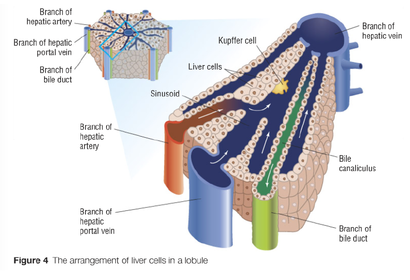
3. Hydrogen peroxide - 10Arrangement of the liver
- 11How is alcohol (ethanol) detoxified?1. Ethanol is dehydrogenated by enzyme ethanol dehydrogenase (2H accepted by NAD) produces ethanal.
2. Ethanal is dehdrogenated further by enzyme ethanal dehydrogenase (2H accepted by NAD) produces acetate
3. Acetate combines with coenzyme A to produce acetyl coA - 12What happens if you consume too much alcohol?1. NAD is also required to oxidise fatty acids
2. If liver has to detoxify too much alcohol there won't be enough NAD to deal with fatty acids.
3. Fatty acids are then converted back into lipids and stored in hepatocytes.
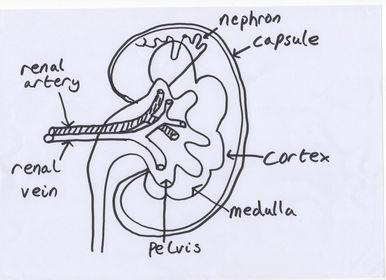
4. This causes a condition known as 'fatty liver' which can lead to cirrhosis. - 13Structure of the kidney
- 14What are the four parts of the nephron?1. Proximal convoluted tubule (PCT)
2. Loop of Henle
3. Distal convoluted tubule (DCT)
4. Collecting duct - 15Where does selective reabsorption occur?Proximal convoluted tubule
- 16Process of selective reabsorption1. Sodium/potassium pump removes sodium ions from cells lining PCT.
2. Sodium ions are transported into the cell along with glucose or amino acids via co-transporter proteins by facilitated diffusion.
3. As glucose or amino acids move into the cell, this decreases the water potential so water follows by osmosis.
4. Small proteins may have entered the tubule so are reabsorbed by endocytosis - 17What is the role of the loop of Henle?Create a very low water potential in the medulla
- 18What is the name give to the hormone that alters the permeability of the collecting duct?Anti-diuretic hormone (ADH)
- 19How does ADH alter the permeability of the collecting duct?1. Cells in the wall of the collecting duct have membrane receptors for ADH.
2. ADH binds to the receptors and cause a series of enzyme-controlled reaction inside the cell.
3. The end result of these reactions is to insert water permeable channels (aquaporins) in the walls of the collecting duct. - 20How is the concentration of ADH in the blood adjusted?1. Water potential of the blood is monitored by osmoreceptors in the hypothalamus (brain).
2. When water potential is low, osmoreceptors shrink and stimulate neurosecretory cells (specialised neurones).
3. Neurosecretory cells produce and release ADH.
4. ADH is made in the cell body of these neurones.
5. ADH is stored in the posterior pituitary gland.
6. When neurosecretory cells are stimulated, an action potential flows down the axon and causes ADH to be released. - 21What causes kidney failure?1. Diabetes
2. Hypertension (high blood pressure)
3. Infection - 22What are the treatments for kidney failure?1. Dialysis
2. Kidney transplant - 232 types of dialysis?1. Haemodialysis
2. Peritoneal dialysis - 24Haemodialysis1. Blood from vein passed into machine that contains artificial dialysis membrane.
2. Herapin is added to prevent clotting.
3. Usually done at clinic but can be learnt and done at home - 25Peritoneal Dialysis1. The filter is the bodies own abdominal membrane.
2. Surgeon implants a permanent tube in the abdomen.
3. Dialysis solution is poured through tube.
4. After several hours the solution is drained from the abdomen tube.
5. Patient can walk around during dialysis - 26Advantages of kidney transplant1. Freedom from dialysis
2. Diet less limited
3. Physically feeling better
4. Better quality of life
5. No longer see yourself as ill - 27Disadvantages of kidney transplant1. Need immunosuppressants for life of kidney.
2. Major surgery
3. Risks of surgery e.g. infection
4. Checks needed for signs of organ rejection.
5. Side effects e.g. immunosuppressant drugs increase risk of infections - 28What hormone does pregnancy testing test for?hCG (human chorionic gonodotrophin)
- 29How does the pregnancy test stick work?1. hCG in urine binds to complementary antibodies.
2. This hCG-antibody complex moves up test stick with urine.
3. The antibody complex only binds to complementary immobilised antibodies specific to them.
4. Binding of antibody complex produces line.
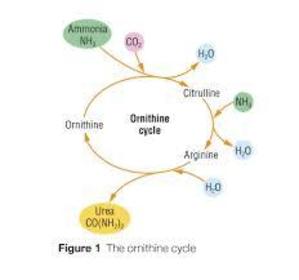
5. 2 lines indicate positive result - 30Draw the ornithine cycle
- 31Why do animals that live in dry conditions have longer loops of henle?1. The longer the loop of Henle, the more water that can be absorbed from the filtrate.
2. More ions are pumped into the medulla creating a very low water potential.
3. More water moves out of the collecting duct into capillaries.
4. This produces concentrated urine
Informationen
- Beschreibung
- Biology Karteikarten am OCR F214 - Excretion, erstellt von umer.sabir am 15/05/2014.
- Erstellt von
- umer.sabir
- Aufrufe
- 1.150
- Bewertung