
Flowchart
language finction
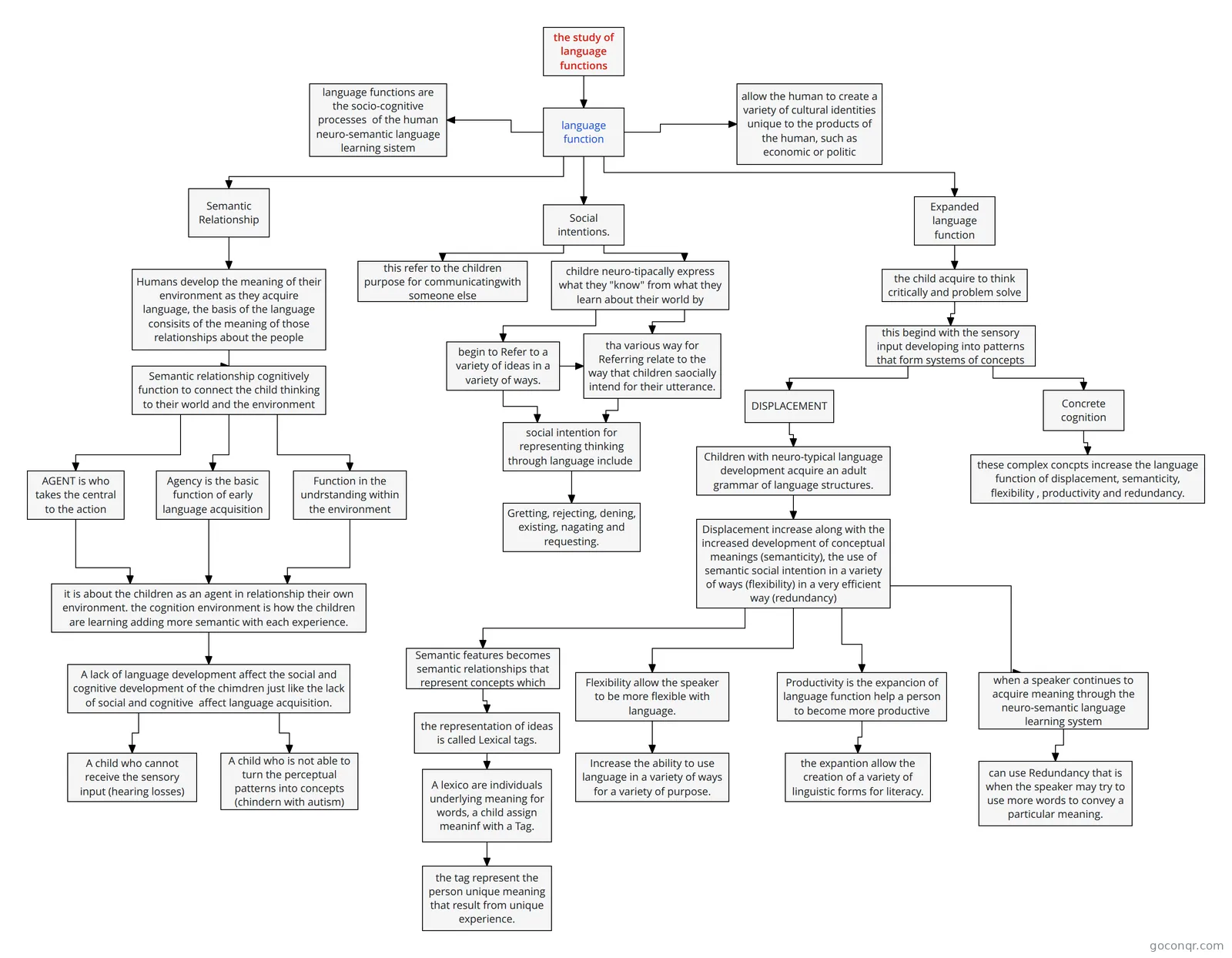
Flowchart: language function
Flowchart content
the study of language functions
language function
allow the human to create a variety of cultural identities unique to the products of the human, such as economic or politic
language functions are the socio-cognitive processes of the human neuro-semantic language learning sistem
Semantic Relationship
Humans develop the meaning of their environment as they acquire language, the basis of the language consisits of the meaning of those relationships about the people
Semantic relationship cognitively function to connect the child thinking to their world and the environment
AGENT is who takes the central to the action
Agency is the basic function of early language acquisition
it is about the children as an agent in relationship their own environment. the cognition environment is how the children are learning adding more semantic with each experience.
Function in the undrstanding within the environment
A lack of language development affect the social and cognitive development of the chimdren just like the lack of social and cognitive affect language acquisition.
A child who cannot receive the sensory input (hearing losses)
A child who is not able to turn the perceptual patterns into concepts (chindern with autism)
Social intentions.
childre neuro-tipacally express what they "know" from what they learn about their world by
begin to Refer to a variety of ideas in a variety of ways.
tha various way for Referring relate to the way that children saocially intend for their utterance.
social intention for representing thinking through language include
Gretting, rejecting, dening, existing, nagating and requesting.
this refer to the children purpose for communicatingwith someone else
Expanded language function
the child acquire to think critically and problem solve
this begind with the sensory input developing into patterns that form systems of concepts
DISPLACEMENT
Children with neuro-typical language development acquire an adult grammar of language structures.
Displacement increase along with the increased development of conceptual meanings (semanticity), the use of semantic social intention in a variety of ways (flexibility) in a very efficient way (redundancy)
Semantic features becomes semantic relationships that represent concepts which overlap and layer to form complex meaning.
the representation of ideas is called Lexical tags.
A lexico are individuals underlying meaning for words, a child assign meaninf with a Tag.
the tag represent the person unique meaning that result from unique experience.
Flexibility allow the speaker to be more flexible with language.
Increase the ability to use language in a variety of ways for a variety of purpose.
Productivity is the expancion of language function help a person to become more productive
the expantion allow the creation of a variety of linguistic forms for literacy.
when a speaker continues to acquire meaning through the neuro-semantic language learning system
can use Redundancy that is when the speaker may try to use more words to convey a particular meaning.
Concrete cognition
these complex concpts increase the language function of displacement, semanticity, flexibility , productivity and redundancy.
Information
- Description
- this is a concept map about the use cognitive of the language.
- Created by
- leonardo olaya
- Views
- 31
- Tags
- Rating