
Flowchart
Untitled
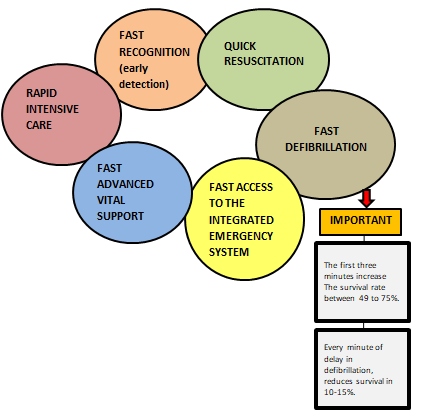
Flowchart content
Cardiopulmonary Resuscitation (Basic Reanimation)
What is it?
It is the realization of all the maneuvers to restore an efficient oxygenation and circulation in an individual in PCR
The goal
The goal is to keep the flow of oxygenated blood to the brain and other vital organs until more definitive medical treatment can restore normal heart rhythm.
In what patients?
All patient in PCR (cardiorespiratory arrest) it must be reanimated
Cardiocerebral and cardiopulmonary resuscitation (RCPC)
They can be considered conditions
1.PCR represents the terminal stage of an incurable chronic disease.
2. Impossibility of establishing superior nervous functions
As in the case of
Traumatic Brain Destruction
3 "No RCPC" (eg in the clinical history), by prior consent of the sick person or his relatives.
By
Prior consent of the sick person or his relatives.
Steps (ABC) of PCR
2: Cleaning and unblocking if necessary.
1: Open the airways and assess their permeability
A irways
B reathing or ventilation
1:Evaluate breathing (MES maneuver for 10 seconds)
2:Give 2 rescue breaths to check permeability and oxygenate
C irculation
1:Evaluate circulation (central pulse for 10 sec.)
2: Start heart compressions if there is no pulse, rhythm and frequency according to age
Chain of Survival
what to do?
Patient who does not respond
Ask for help
*Security on the scene Place
*the victim in the supine position
*Open the airway MES maneuver for 10 sec.
* Evaluate breathing.
Breathe normal
It does'nt breathe
*Continue ABCD *Evaluation Rescue position
Activate Emergency system. Airway. Give 2 ventilations Maintain permeability.
Evaluate Circulation.
Carotid pulse Signs of life for 10 sec. (movements, breathing, response)
Pulse Present
Absent Pulse
*Patient in Rescue ventilation 10 x min.
+Evaluate circulation
+c/2 min.
Patient in Begin RCPC (30: 2). As soon as you have one. Cardiorespiratory arrest.
Evaluate Rhythm
DOWNLOAD NOT INDICATED
Keep RCPC 30: 2 for 5 cycles (2 min). Reevaluate patient and rhythm
DOWNLOAD INDICATED
(TV-FV) Defibrillation: 1 download 150-200 J two-phase or 360 single-phase. Maintain RCPC 30: 2 for 5 cycles (2 min). Reevaluate patient and rhythm
PC: it is the absence of spontaneously effective cardiac activity that leads to the interruption of the perfusion of the vital organs
Difficult in patients with general anesthesia
Cardiac arrests in the operating room (PCQ) linked to anesthesia.
Respiratory causes
- Difficulty of intubation, obstruction of the airways
- Failure of the anesthesia device (malfunction, hypoxic gas mixture, incorrect respirator settings, CO 2 rebreathing, disconnection, etc.)
- Barotrauma, inhalation of gastric contents
- Respiratory depression (upon awakening from anesthesia, in the induction of locoregional anesthesia, etc.), etc.
Requires
Monitoring
Cardioscope (EKG)
Blood pressure
Pulximetry
Exhaled carbon dioxide monitoring
The capnometry (numerical value of carbon dioxide [CO 2] contained in the expired gases)
-Capnography (graphic representation of CO 2 movements in respiratory cycles)
Decrease in petco2 (reflecting alveolar CO2 pressure)
proportional to the decrease in cardiac output, precedes the drop in blood pressure and even, in some cases, the change in heart rate.
DRUGS
Adrenalin
Antiarrhythmics
Baking soda
Injections of 1 mg of adrenaline should be repeated every 3-5 minutes during all medicalized CPR.
It only improves short-term survival with the use of amiodarone in refractory VFs in relation to the use of lidocaine or a placebo
in case of persistent VF / VT after applying three shocks, 300 mg of amiodarone should be administered in bolus, in the same sequence of resuscitation after the injection of 1 mg of adrenaline. A complementary dose of 150 mg can be administered in the case of refractory or recurrent VF / VT followed by a continuous infusion of 900 mg in 24 hours.
should be reserved for PC cases associated with hyperkalemia or an overdose of tricyclic antidepressants.
REFERENCES
Carry P, Gueugniaud P. Reanimación cardiopulmonar hospitalaria [Internet]. Www-clinicalkey-es.ez.unisabana.edu.co. 2015 [cited 30 March 2019]. Available from: https://www-clinicalkey-es.ez.unisabana.edu.co/#!/content/emc/51-s2.0-S1280470314697255
Olasveengen T, De caen A. 2017 Consenso internacional sobre resucitación cardiopulmonar y atención cardiovascular de emergencia Resumen de recomendaciones con tratamiento [Internet]. Www-clinicalkey-es.ez.unisabana.edu.co. 2017 [cited 30 March 2019]. Available from: https://www-clinicalkey-es.ez.unisabana.edu.co/#!/content/journal/1-s2.0-S0300957217306755
Navarro Machado V, Rodríguez Suárez G. REANIMACIÓN CARDIOPULMONAR BÁSICA [Internet]. Sld.cu. [cited 30 March 2019]. Available from: http://www.sld.cu/galerias/pdf/sitios/urgencia/4rcp.pdf
Eveling Gabriela Baez Caballero
Teacher: Astrid Viviana Robayo
Adult care II
Date: 30/03/19
Cardiopulmonary Resuscitation (Basic Reanimation)
Information
- Description
- Flowchart on Untitled, created by gabi baez on 31/03/2019.
- Created by
- gabi baez
- Views
- 0
- Rating