
Flowchart
Sociocultural Theory and Second Language Learning
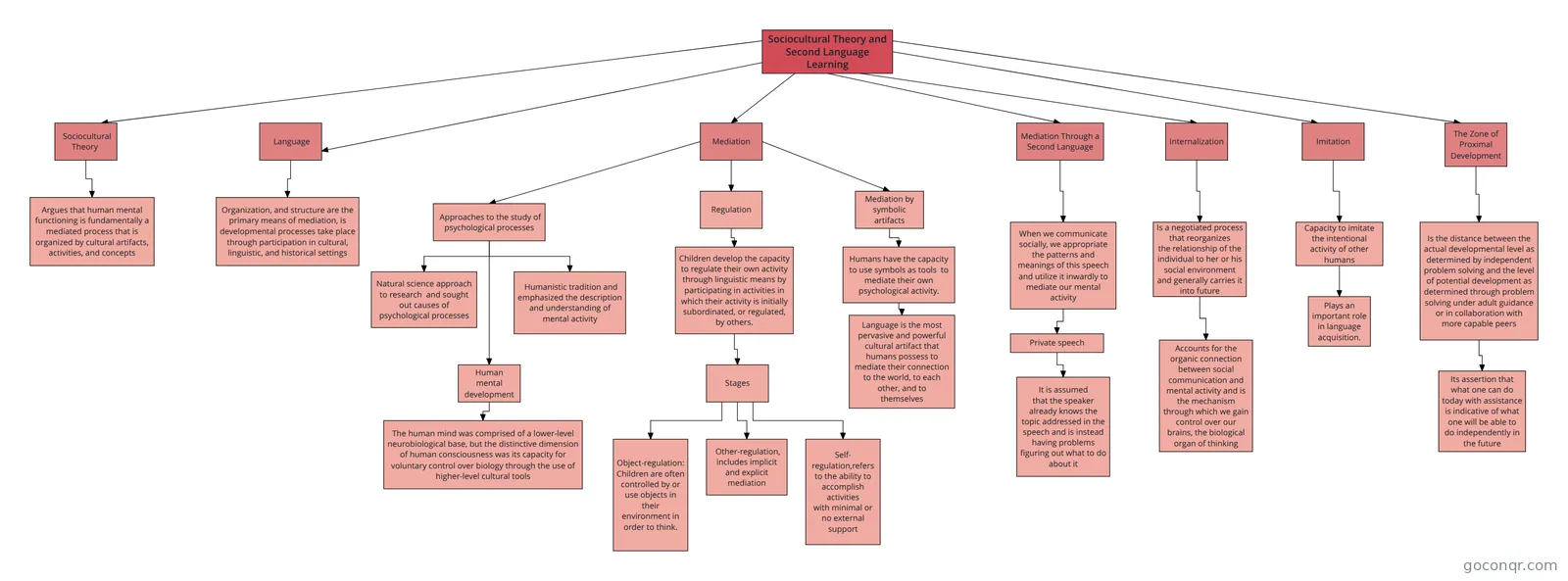
Flowchart: sociocultural theory and second language learning
Flowchart content
Sociocultural Theory and
Second Language Learning
Sociocultural Theory
Argues that human mental functioning is fundamentally a mediated process that is organized by cultural artifacts, activities, and concepts
Language
Organization, and structure are the primary means of mediation, is developmental processes take place
through participation in cultural, linguistic, and historical settings
Mediation
Approaches to the study of psychological processes
Natural science approach to research and sought out causes of psychological processes
Humanistic tradition and emphasized the description
and understanding of mental activity
Human mental development
The human mind was comprised of a lower-level neurobiological base, but the distinctive dimension of human consciousness was its capacity for voluntary control over biology through the use of higher-level cultural tools
Regulation
Children develop the capacity to regulate their own activity through linguistic means by participating in activities in which their activity is initially subordinated, or regulated, by others.
Stages
Object-regulation: Children are often controlled by or use objects in their
environment in order to think.
Other-regulation, includes implicit and explicit
mediation
Self-regulation,refers to the ability to accomplish activities
with minimal or no external support
Mediation by symbolic artifacts
Humans have the capacity to use symbols as tools to mediate their own psychological activity.
Mediation Through a Second Language
Language is the most pervasive and powerful cultural artifact that humans possess to mediate their connection to the world, to each other, and to
themselves
When we communicate
socially, we appropriate the patterns and meanings of this speech and utilize it inwardly to mediate our mental activity
Private speech
It is assumed
that the speaker already knows the topic addressed in the speech and is instead
having problems figuring out what to do about it
Internalization
Is a negotiated process that reorganizes
the relationship of the individual to her or his social environment and generally carries it into future performance
Accounts for the organic connection between social communication and
mental activity and is the mechanism through which we gain control over our
brains, the biological organ of thinking
Imitation
Capacity to imitate the intentional activity of other humans
Plays an
important role in language acquisition.
The Zone of Proximal Development
Its assertion that
what one can do today with assistance is indicative of what one will be able to
do independently in the future
Is the distance between the actual developmental level as determined by independent problem solving and the level of potential development as determined through problem solving under adult guidance or in collaboration with
more capable peers
Information
- Description
- Flowchart on Sociocultural Theory and Second Language Learning, created by Valeria Chavez on 30/06/2020.
- Created by
- Valeria Chavez
- Views
- 5
- Rating
More on Social and Cultural Factors in Language Learning