
Second Language Acquisition
39 resources created by 33 users
This Second Language Acquisition page on GoConqr gathers community-made mind maps, quizzes, flashcards and notes, from behaviourist and innatist theories to the critical period, interlanguage and the social context of learning. It's built for university students revising a topic or filling gaps, and for teachers after ready-made material. There are over 500 resources here, including over 400 mind maps, more than 8 quizzes and 14 flashcard decks, all at university level. Pick a theory, then test yourself.
Top Second Language Acquisition resources
-
Mind map SLA
-
50 questionsApplied Linguistics 2012 01. What is the main obstacle to learning a FL according to Behaviourist theories?
-
50 questionsApplied Linguistics 2014 01. A learner produces a response, often without observable stimuli, that is maintained by reinforcement. T...
-
 Mind map SOCIAL CONTEXT OF SLA mind map
-
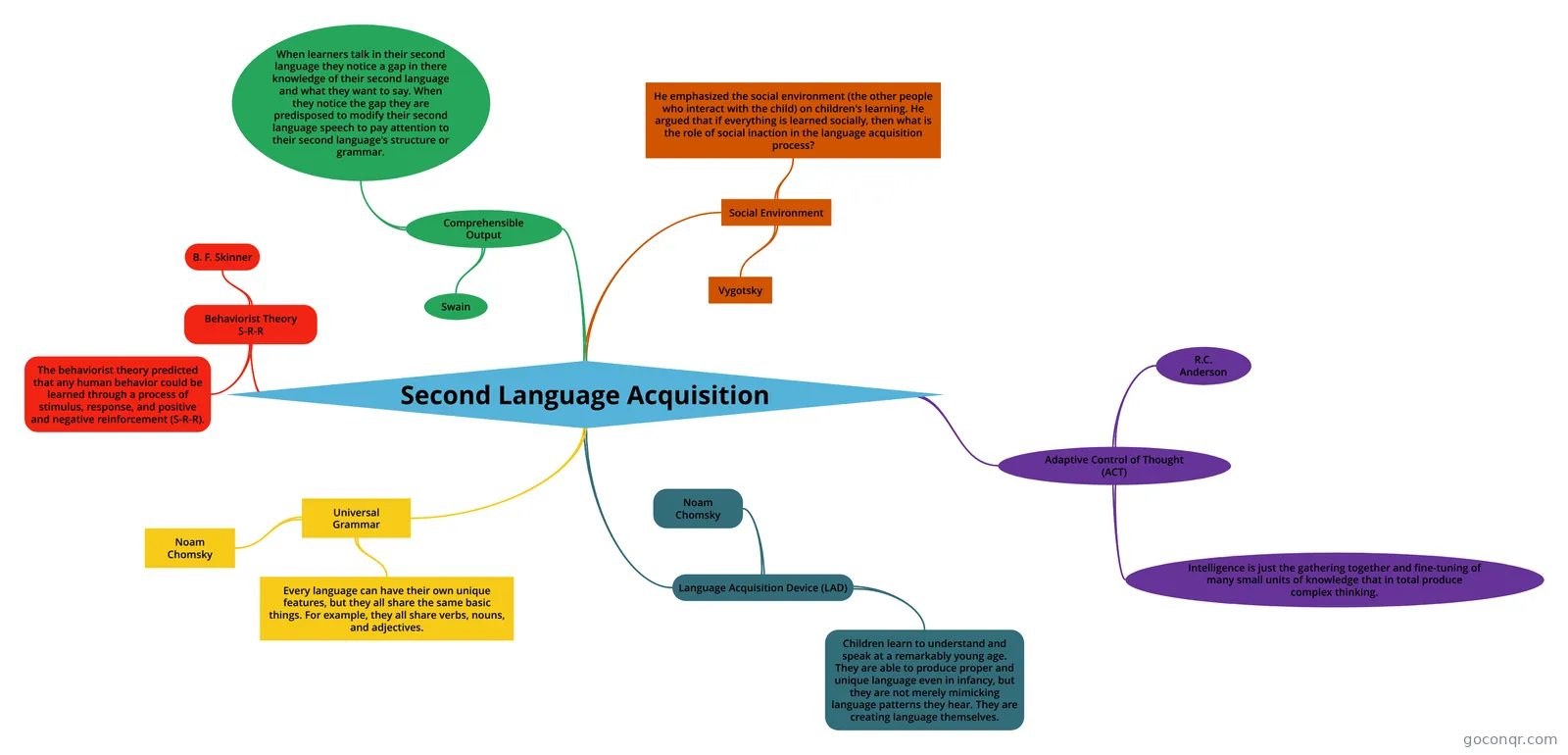 Mind map Second Language Acquisition Second Language Acquisition
-
Mind map SECOND LANGUAGE ACQUISITION MODELS
-
50 questionsApplied linguistic 2001 01. The view of first language acqusition (FLA) as represented in a model by Chomsky (1965) is the followin...
-
35 cardsSecond Language Acquisition What is LANGUAGE TRANSFER
Quizzes
-
50 questionsApplied Linguistics 2012 01. What is the main obstacle to learning a FL according to Behaviourist theories?
-
50 questionsApplied Linguistics 2014 01. A learner produces a response, often without observable stimuli, that is maintained by reinforcement. T...
-
50 questionsApplied linguistic 2001 01. The view of first language acqusition (FLA) as represented in a model by Chomsky (1965) is the followin...
-
2 questionsLanguage Acquisition Quiz on language acquisition
Mind maps
See all 30 mind maps-
SLA
-
SOCIAL CONTEXT OF SLA mind map
-
Second Language Acquisition Second Language Acquisition
-
SECOND LANGUAGE ACQUISITION MODELS
-
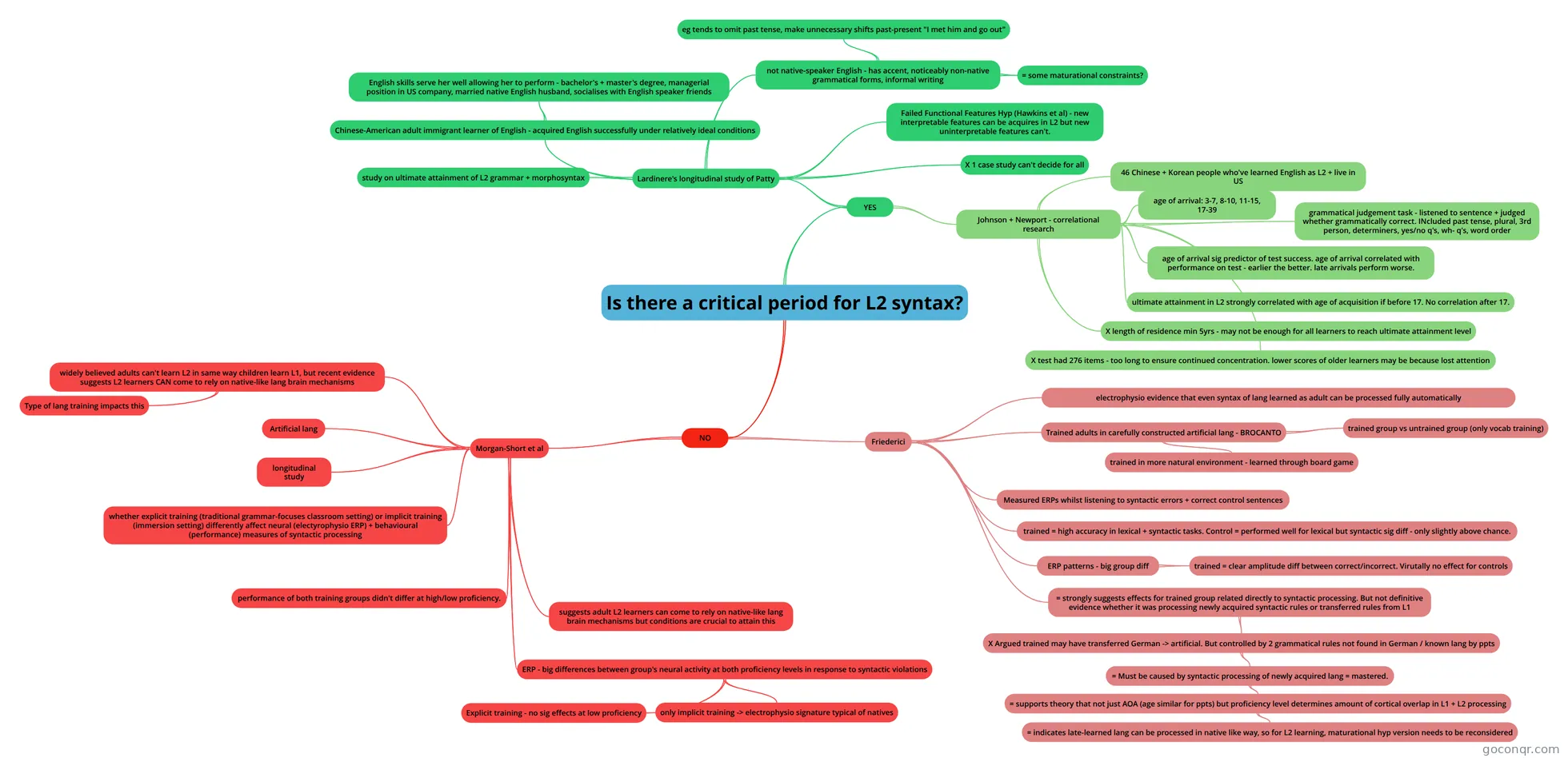 Is there a critical period for L2 syntax? crit period for syntax
-
Second Language Acquisition: Processes & Theories Mind map about the acquisition of language for second language learners
-
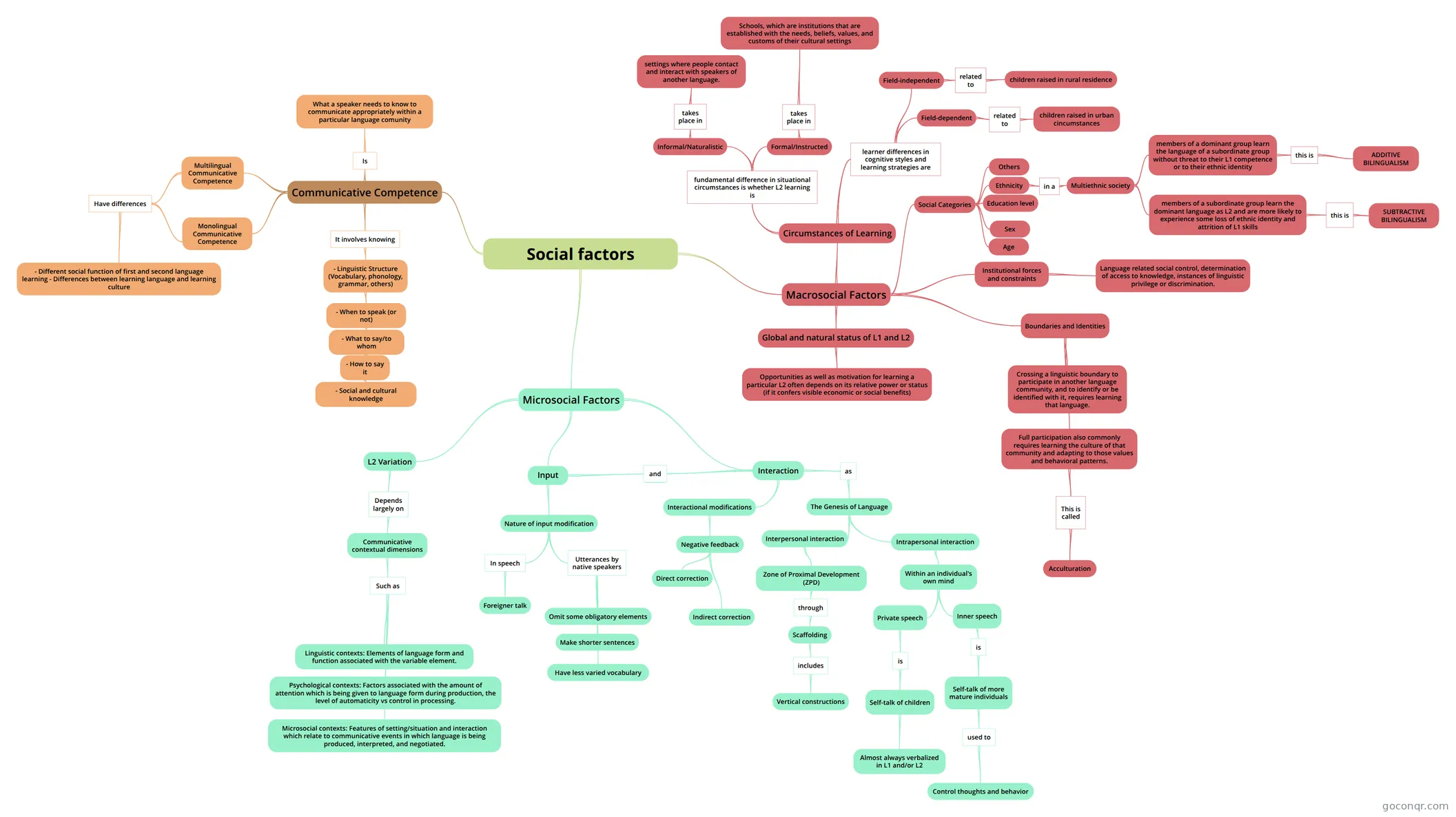 Social factors Theories
-
Noticing Hypothesis Homework: Read the following text and make a graphic organizer considering the main information related to ...
Flashcards
-
35 cardsSecond Language Acquisition What is LANGUAGE TRANSFER
-
7 cardsID in SLA: Cognitive Factors TESTS Explained -Intelligence: Multiple Intelligence -Aptitude: MLAT, LLAMA, HI-LAB
-
11 cardsSecond Language Acquisition - Age Definition of CRITICAL PERIOD HYPOTHESIS?
-
9 cardsFactors Affecting SLA a psycholinguistics topic
Notes
More Linguistics and philology topics
About Second Language Acquisition
GoConqr OriginalWhat the resources cover
Most of this unit is mind maps, and they follow the main questions in the field. The mind map SLA Approaches separates cognition-oriented, context-oriented and innatist theories, with the Input Hypothesis and Universal Grammar alongside. Second Language Acquisition adds Skinner's behaviourist stimulus-response-reinforcement idea, comprehensible output, the Language Acquisition Device and Adaptive Control of Thought.
Other maps look at particular topics. SOCIAL CONTEXT OF SLA covers communicative competence, microsocial and macrosocial factors, and input and interaction. SECOND LANGUAGE ACQUISITION MODELS includes Schumann's 1978 acculturation model, with social and psychological distance, language shock and cultural shock.
Where to start
- Begin with SLA THEORIES or The Study of Second Language Acquisition for the overall picture.
- Move to Behaviorist, Innatist and Interactionist, which take the main positions one at a time.
- Then choose a theme: age, with the maps on the critical period for phonology and syntax, individual differences, reading, or errors in Mistakes and Errors.
Using quizzes and maps together
Read a map first, then try a quiz. The Applied Linguistics quizzes from 2012 and 2014 ask, for example, about the main obstacle to learning a foreign language in behaviourist theories, and about learner responses maintained by reinforcement. If a question catches you out, go back to the matching map and check the branch.
The flashcard decks, such as the one on age in second language acquisition, suit short bursts of recall. The notes made from mind maps give a text version of the same material, which helps when you prefer reading to branching diagrams.
Where it fits
This unit sits in the strand Language, Mind and Acquisition, within Linguistics and philology. Teachers can pick maps and decks to set alongside their own lessons, since everything here was made by GoConqr users.
When you are ready, open a map that matches your current reading and see how much of it you can explain without looking.
Frequently asked questions
Which resource should I open first?
The mind maps called SLA THEORIES and The Study of Second Language Acquisition give a broad overview. After that, Behaviorist, Innatist and Interactionist take the main positions one by one, so you can compare how each explains learning a second language.
What do the quizzes cover?
The quizzes include Applied Linguistics 2012 and 2014, plus others on language acquisition. Questions touch on behaviourist theory, children's utterances getting longer, and reinforcement. They work well after reading a theory map, to see which ideas you can already explain.
Is there material on age and the critical period?
Yes. There are mind maps asking whether there is a critical period for phonology, for L2 syntax and for grammatical features, plus one on the role of age in L2 acquisition. There is also a flashcard deck on age and a note on the critical period.
Are the resources free to use?
Yes. Every resource on this page is free to open, study and take, with no account needed. They were made by GoConqr users, not by GoConqr itself. A free account also saves your quiz scores and lets you make your own materials.
Who is this page for?
It is for university students who want to revise theories, fill gaps or practise with quizzes and flashcards, and for teachers looking for ready-made maps and decks. All the resources are at university level.
What if I can't find the topic I need?
Try nearby titles first. Topics such as interlanguage, consciousness and noticing, contrastive linguistics or social factors may sit under a different map name. You can also build your own mind map or flashcards to fill the gap.