
Flowchart
Comparing and contrasting first and second language acquisition
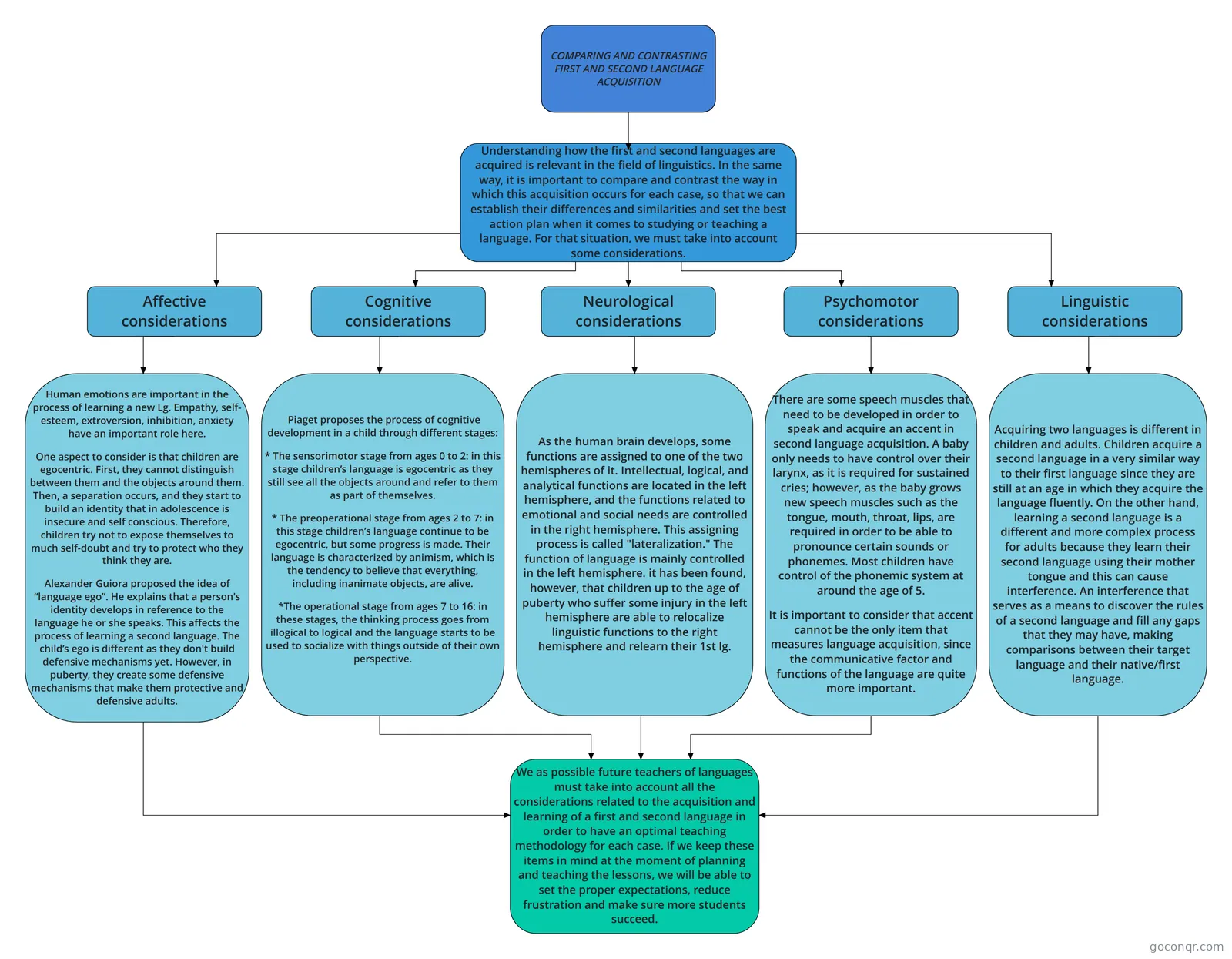
Flowchart: first and second language acquisition
Flowchart content
COMPARING AND CONTRASTING FIRST AND SECOND LANGUAGE ACQUISITION
Understanding how the first and second languages are acquired is relevant in the field of linguistics. In the same way, it is important to compare and contrast the way in which this acquisition occurs for each case, so that we can establish their differences and similarities and set the best action plan when it comes to studying or teaching a language. For that situation, we must take into account some considerations.
Neurological considerations
Cognitive considerations
Affective considerations
Psychomotor considerations
Linguistic considerations
There are some speech muscles that need to be developed in order to speak and acquire an accent in second language acquisition. A baby only needs to have control over their larynx, as it is required for sustained cries; however, as the baby grows new speech muscles such as the tongue, mouth, throat, lips, are required in order to be able to pronounce certain sounds or phonemes. Most children have control of the phonemic system at around the age of 5.
It is important to consider that accent cannot be the only item that measures language acquisition, since the communicative factor and functions of the language are quite more important.
Acquiring two languages is different in children and adults. Children acquire a second language in a very similar way to their first language since they are still at an age in which they acquire the language fluently. On the other hand, learning a second language is a different and more complex process for adults because they learn their second language using their mother tongue and this can cause interference. An interference that serves as a means to discover the rules of a second language and fill any gaps that they may have, making comparisons between their target language and their native/first language.
We as possible future teachers of languages must take into account all the considerations related to the acquisition and learning of a first and second language in order to have an optimal teaching methodology for each case. If we keep these items in mind at the moment of planning and teaching the lessons, we will be able to set the proper expectations, reduce frustration and make sure more students succeed.
As the human brain develops, some functions are assigned to one of the two hemispheres of it. Intellectual, logical, and analytical functions are located in the left hemisphere, and the functions related to emotional and social needs are controlled in the right hemisphere. This assigning process is called "lateralization." The function of language is mainly controlled in the left hemisphere. it has been found, however, that children up to the age of puberty who suffer some injury in the left hemisphere are able to relocalize linguistic functions to the right hemisphere and relearn their 1st lg.
Piaget proposes the process of cognitive development in a child through different stages:
* The sensorimotor stage from ages 0 to 2: in this stage children’s language is egocentric as they still see all the objects around and refer to them as part of themselves.
* The preoperational stage from ages 2 to 7: in this stage children’s language continue to be egocentric, but some progress is made. Their language is characterized by animism, which is the tendency to believe that everything, including inanimate objects, are alive.
*The operational stage from ages 7 to 16: in these stages, the thinking process goes from illogical to logical and the language starts to be used to socialize with things outside of their own perspective.
Human emotions are important in the process of learning a new Lg. Empathy, self-esteem, extroversion, inhibition, anxiety have an important role here.
One aspect to consider is that children are egocentric. First, they cannot distinguish between them and the objects around them. Then, a separation occurs, and they start to build an identity that in adolescence is insecure and self conscious. Therefore, children try not to expose themselves to much self-doubt and try to protect who they think they are.
Alexander Guiora proposed the idea of “language ego”. He explains that a person's identity develops in reference to the language he or she speaks. This affects the process of learning a second language. The child’s ego is different as they don't build defensive mechanisms yet. However, in puberty, they create some defensive mechanisms that make them protective and defensive adults.
Information
- Description
- Inglés Flowchart on Comparing and contrasting first and second language acquisition, created by Pablo Bonilla on 21/02/2022.
- Created by
- Pablo Bonilla
- Views
- 0
- History
-
- Created by Cesar David Loaiza Durango · Feb 20, 2022
- Copied by Pablo Bonilla · Feb 21, 2022
- Copied by Pablo Bonilla · Feb 21, 2022
- Rating
More on First and Second Language Acquisition Compared