
CHEM - S1 - Atomic Structure
Slides in this set (16)
-
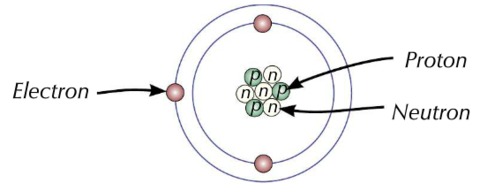
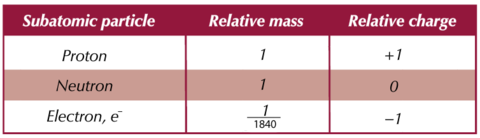
- Electrons take up most of the volume of the atom
- Most of the mass is concentrated in the nucleus
- The protons and neutrons are held together by a force called strong nuclear force.
- SNF is much stronger than the electrostatic forces of attraction that hold electrons and protons together in the atom.
-
-
1.2 Mass Number, Atomic Number and Isotopes
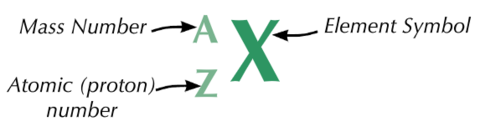
- Z --> The number of electrons in the outer shell of an atom determines the chemical properties of an element
- A --> Is the nucleons that are responsible for almost all of the mass of an atom because electrons weigh virtually nothing.
-
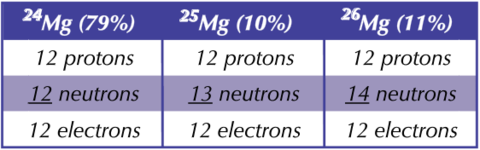
- Different isotopes of the same element react chemically in exactly the same way as they have the same electron configuration
- Atoms of different isotopes of the same element vary in mass number because of the different number of neutrons in their nuclei.
- Isotopes of an element do have slightly different physical properties, e.g. different densities and rates of diffusion. This is because physical properties tend to depend more on the mas of the atom.
- Caption: Atoms with the same number of protons but different number of neutrons.
-
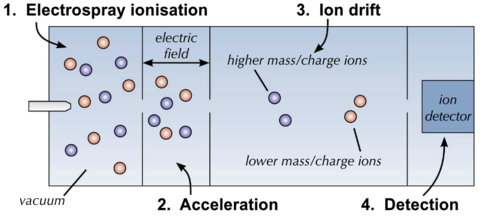
- Vacuum --> The whole apparatus is kept under a high vacuum to prevent the ions that are produced colliding with molecules from the air.
- Caption: Is the most useful instrument for the accurate determination of relative atomic mass (Ar)
-
- Ionisation --> The sample is dissolved in a solvent and forced through the electron gun. A high voltage is applied to it, causing the particles to lose an electron. The ionised particles are separated from the solvent, leaving a gas made up of positive ions.
- Acceleration --> The positive ions are accelerated by the electric field. The particles need to be positively charged to be accelerated by the electric field --> it gives the same kinetic energy to all ions. The ions with lower mass/charge ratio experience a greater acceleration.
- Ion Drift --> Ions leave the electric field with a constant speed and constant kinetic energy. They enter in the magnetic field and they drift through it at the same speed as they left the electric field. So the ions with lower/mass charge ratios will be drifting at higher speeds.
- Detection --> Ions with lower mass/charge reach the detector in less time than heavy ions. The detector detects the current created when the ions hit it and records how long they took to pass through the spectrometer. The data is used to calculate the mass/charge values needed to produce a mass spectrum.
-
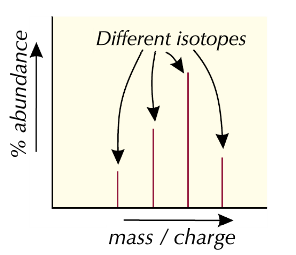
- Caption: High Resolution Mass --> Five decimal places
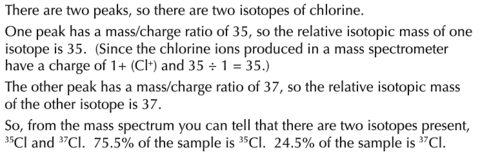
- Caption: Low Resolution Mass --> one decimal place
-
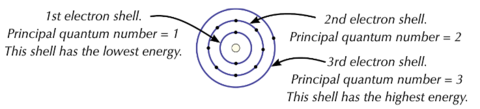
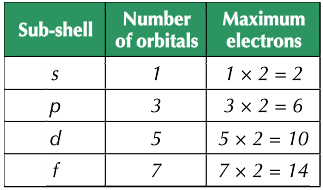
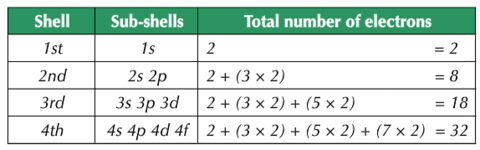
- Electrons move around the nucleus in certain regions of the atom called shell or energy levels
- Each shell is given a number called the principal quantum number
- The further a shell is from the nucleus, the higher its energy and the larger its principal quantum number.
-
-
Showing Electron Configuration
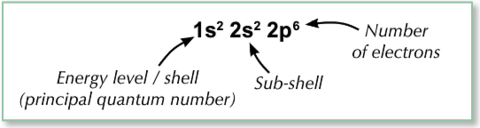
- Caption: 1. Sub-shell Notation
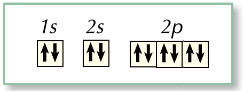
- Caption: 2. Arrows in boxes
-
Showing Electron Configuration
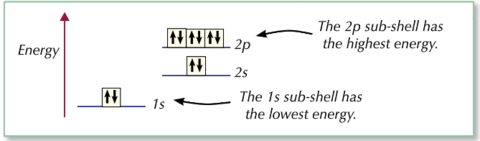
- Caption: 3. Energy Level Diagram
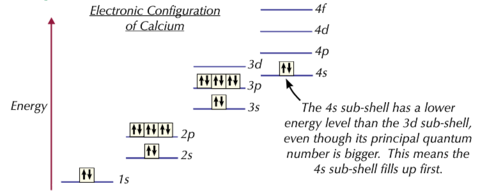
- Caption: Rule 1 --> Electron filled up the lowest energy sub-shells first
-
Showing Electron Configuration

- Caption: Rule 2 --> Electrons fill orbitals in a sub-shell singly before they start sharing

- Caption: Rule 3 --> For the configuration of ions from the s and p block of the periodic table, just add or remove the electrons to or from the highest energy occupied sub-shell
-
Electron Configuration of Transition Metals
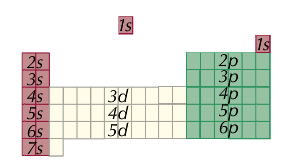
- Cr and Cu donate one of their 4s electrons to the 3d sub-shell. It's because they are happier with a more stable full or half-full d sub-shell.
- When they become ions, they lose their 4s electrons before their 3d electrons.
-

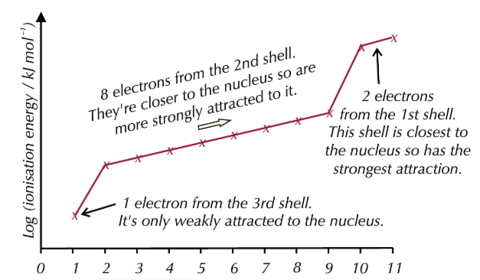
- 2nd ionisation energy --> Is the energy needed to remove an electron from each ion in 1 mole of gaseous 1+ ions
- Factors Affecting Ionisation Energy
- Nuclear Charge --> The more protons there are in the nucleus, the more positively charged the nucleus is and the stronger the attraction for the electrons.
- Distances From Nucleus --> Attraction falls off very rapidly with distance. An electron close to the nucleus will be much more strongly attracted than one further away.
- Shielding --> As the number of electrons between the outer electrons and the nucleus increases, the outer electrons feel less attraction to the nucleus. This lessening of pull of the nucleus thanks to the inner electrons shells is called shielding.
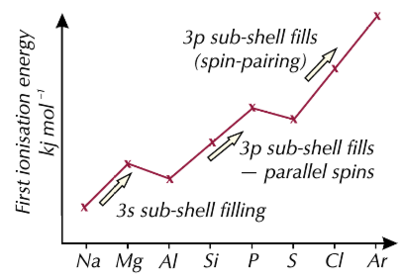
- Caption: 1st ionisation energy --> Is the energy needed to remove one electron from each atom in 1 mole of gaseous atoms to form 1 mole of gaseous 1+ ions
-
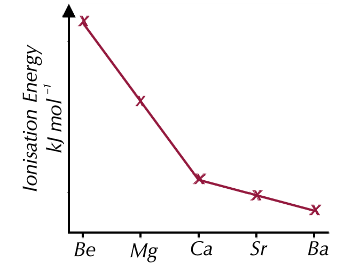
- Caption: First ionisation energy decreases down group 2
- Caption: First ionisation increases across a period
-
Ionisation Energies and Shell Structure
Information
- Description
- 1.1 - Fundamental Particles 1.2 - Mass Number, Atomic Number and Isotopes 1.3 - The arrangment of the electrons 1.4 - The Mass Spectrometer 1.5 - More About Electron Arrangements in Atoms 1.6 - Electron arrangments and ionisation energy
- Created by
- Ashly Galvez · Oct 2015
- Updated
- Sep 12, 2016
- Views
- 18
- Rating