
Notes
Current Electricity: Capacitance
Content of the notes (1)
Page 1
Capacitance
Scalar quantity
Unit = farad
Symbol = C
C = Q/V
Q = charge
V = voltage
Capacitor
An electric device capable of storing electric charge
In an electric circuit, electrons flow from the negative battery terminal to the right-hand plate of the capacitor, and then from the left-hand plate of the capacitor to the positive battery terminal
Parallel Plate Capacitor
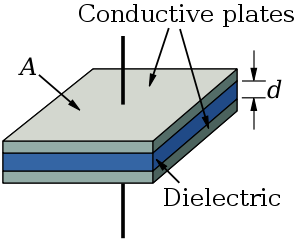
Pair of metal plates separated by a dielectric (thin sheet of insulated material)
Factors affecting capacitance:
Common area shared by the plates
Permittivity of medium between the plates
Distance between the plates
Capacitance of a parallel plate capacitor:
C = εA/d
ε = permittivity
A = common area
d = distance
Energy stored in a capacitor:
The work done by the battery to charge the capacitor
W = 1/2 CV²
Capacitors conduct A.C. but not D.C.
When connected to an A.C. supply, electron flow changes direction as the polarity changes.
In a D.C. circuit, the current flows in one direction. Once the capacitor is charge to the same voltage as the battery, no more current flows.
New Page
Information
- Description
- This note covers the topic of capacitance. It provides an overview of the formula for capacitance, parallel plate capacitors and the energy stored by capacitors. It is aimed at a leaving certificate student or someone who has an interest in learning more about capacitance.
- Created by
- tatemae.honne
- Views
- 180
- Tags
- History
-
- Created by alex.examtime9373 · Jan 21, 2014
- Copied by tatemae.honne · Jan 21, 2014
- Rating