
Quiz
Lecture 7: Media Planning
This quiz has question types that open in the usual player.
Questions in this quiz (37)
1Media Strategy is all about
- AScheduling and Selection
- BReach and Frequency
- CPulsing, Flighting and Continuity
- DAll of the above
2Media Scheduling Decisions look at [blank_start]how long and how often[blank_end] to advertise; whereas Media selection decisions look at [blank_start]where[blank_end] to advertise
- Ahow long and how often
- Bwhere
- Cwhere
- Dhow long and how often
3Media Scheduling deals with:
- Areach and frequency
- Bpulsing flighting and continuity
- Cscheduling and selection
- Dall of the above
4Purchase cycle is
- Athe time interval between purchases in the product category, for the average target audience member
- Bthe number of purchases made within a particular time frame
- Cthe time interval between how frequently people purchase an item from one consumer to the next
- Dall of the above
5Rossiter & Percy define reach as the number of target audience individuals exposed to the advertising in a purchase cycle
- ATrue
- BFalse
6Belch & Belch define reach as the number of target audience individuals exposed to the advertising in a purchase cycle
- ATrue
- BFalse
7Belch & Belch define reach as the number of different audience members exposed at least once to a media vehicle in a given period of time.
- ATrue
- BFalse
8Rossiter & Percy define reach as the number of different audience members exposed at least once to a media vehicle in a given period of time.
- ATrue
- BFalse
9When Rossiter & Percy say 'exposure to the advertising' they mean exposure to the media vehicle.
- ATrue
- BFalse
10How do you calculate frequency according to Rossiter and Percy?
- ACount the number of times a target audience member is exposed to the advertisement
- BCount the number of times the ad was viewed, and divide by the number of people reached
11How do you calculate frequency according to Belch and Belch?
- ACount the number of times the ad was viewed, and divide by the number of people reached
- BCount the number of times a target audience member is exposed to the advertisement
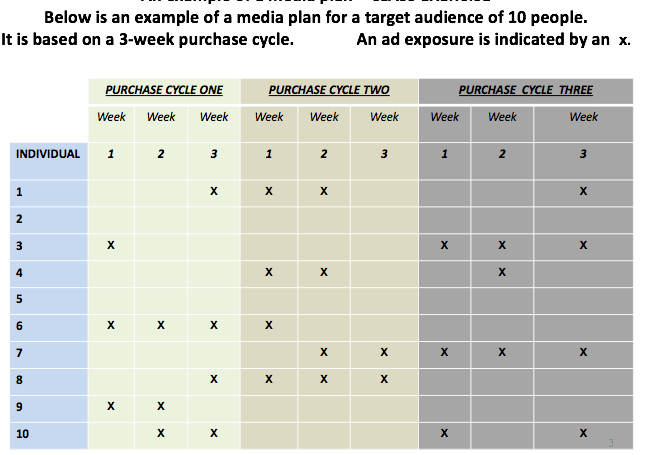
12What is the REACH of this plan according to Rossiter and Percy?
- A6
- B5
- C16
- D30
- E8/10 people or 80%
13What is the REACH of this plan according to Others (and Belch & Belch)?
- A6
- B5
- C16
- D30
- E8/10 people or 80%
14What is the minimum effective frequency (MEF)?
- AThe minimum number of ad exposure that will maximise the likelihood of the average target audience member purchasing the brand
- BThe minimum number of target audience individuals that will see the advertisement before purchasing
- CThe minimum number of sales needed to maximise ad exposure
15What is Effective Reach?
- AThe number of target audience individuals exposed to the ad at minimum effective frequency or higher
- BThe number of sales had per target audience member after being exposed to the ad
- CThe minimum number of ad exposures that will maximize the likelihood of the average target audience member purchasing the brand
16If MEF = 2 exposures per purchase cycle, what is the EFFECTIVE REACH for purchase cycle 1, 2 and 3
- A3, 4, 3
- B4, 3, 4
- C6, 5, 5
- D10, 10, 10
17What is the FREQUENCY according to Others (B&B) not Rossiter and Percy for Purchase cycle 1, 2 and 3
- A1.6, 2, 2
- B6, 5, 5
- C10, 10, 10
- D3, 4, 3
18Gross Rating Points (GRPs) refer to
- Athe total audience a media schedule may reach
- Bthe total number of people in the primary target audience the media buy will reach and the number of times it does
- Cthe total ratings a customer gives back after they buy a product
- Dnone of the above
19A Target Audience Rating Point is (TARP):
- Athe total number of people in the primary target audience the media buy will reach and the number of times it does
- Btotal audience a media schedule may reach
- Cthe average rating a target audience member will give the product after purchase
- DREACH x FREQUENCY
20If Reach is 100 and frequency is 5 what is GRP?
- A500
- B100
- C5
- D1000
- E25
21What are the three scheduling (or continuity) methods
- Acontinuity, flighting, pulsing
- Bexchange, value, activity
- Creminder, teaser and user-generated content
- Dscript, story board, approval
22[blank_start]Continuity[blank_end] is a continuous pattern of advertising, which may mean every day, every week, or every month.
[blank_start]Flighting[blank_end] is a less regular schedule, with intermittent periods of advertising and non-advertising.
[blank_start]Pulsing[blank_end] is where continuity is maintained, but at certain times promotional efforts are stepped up- AContinuity
- BFlighting
- CPulsing
- DFlighting
- EContinuity
- FPulsing
- GPulsing
- HContinuity
- IFlighting
23[blank_start]Media Planning[blank_end] is a series of decisions involved in delivering the promotional message to the prospective users of the product or brand.
[blank_start]Media objective[blank_end] is an objective formulated to organise a media plan.
[blank_start]Media strategy[blank_end] is a plan of action designed to attain the media objectives.
[blank_start]Medium[blank_end] is a general category of available delivery systems.- AMedia Planning
- BMedia objective
- CMedia strategy
- DMedium
24[blank_start]Media vehicle[blank_end] is a specific carrier within a medium category
[blank_start]Reach[blank_end] is the measure of the number of different audience members exposed at least once to a media vehicle in a given period of time
[blank_start]Coverage[blank_end] is the potential audience that might receive the message through a vehicle
[blank_start]Frequency[blank_end] is the number of times the receiver is exposed to the media vehicle in a specified period- AMedia vehicle
- BReach
- CCoverage
- DFrequency
25Media objectives should not be limited to those that can be accomplished through media strategies.
- ATrue
- BFalse
261. [blank_start]Analyse the Market[blank_end]
2. [blank_start]Establish Media Objectives[blank_end]
3. [blank_start]Develop Media Strategy[blank_end]
4. [blank_start]Implement Media Strategy[blank_end]
5. [blank_start]Evaluate Performance[blank_end]- AAnalyse the Market
- BEstablish Media Objectives
- CDevelop Media Strategy
- DImplement Media Strategy
- EEvaluate Performance
27What are the internal factors operating when picking the target market?
- ASize of the media budget
- BManagerial and administrative capabilities
- COrganization of the agency
- DThe economy (rising costs of media)
- EChanges in technology
- FCompetitive factors
28Wastes Coverage refers to Media coverage that reaches people who are not potential buyers and/or users
- ATrue
- BFalse
29[blank_start]Target Market Coverage[blank_end] : Matches the most appropriate media to a market with the goal of extending media coverage whilst minimising waste coverage
[blank_start]The Media Mix[blank_end] : Adds more versatility to the media strategies by increasing coverage, reach and frequency levels. It also improves the likelihood of achieving overall communications and marketing goals.
[blank_start]Creative aspects and mood[blank_end] : Requires media and creative departments to implement creativity through an appropriate medium and enhance the message.
[blank_start]Flexibility[blank_end] : an effective media strategy that deals with market opportunities, threats, availability of media and changes in media or media vehicles- ATarget Market Coverage
- BThe Media Mix
- CCreative aspects and mood
- DFlexibility
30Problems in Media Planning include
- Ainsufficient information, inconsistent terminologies, time pressures and difficulty measuring effectiveness
- Bless experience, objectivity and flexibility
- Cexposure, frequency and cost
- Dinsufficient imaging, saturation, time pressures and reach
31What are the factors determining frequency levels?
- AMedia Factors
- BMessage Factors
- CCreative factors
- DMarketing Factors
- ETarget Market Factors
- FDispositional Factors
- GEnvironmental Factors
32What is the Brand Development Index (BDI)?
- AFactors the rate of product usage by geographic area into the decision process
- BProvides information on the potential for development of the total product category and not specific brands
33What is the Category Development index (CDI)?
- AFactors the rate of product usage by geographic area into the decision process
- BProvides information on the potential for development of the total product category and not specific brands
34Relative cost is the cost required to place the message; whereas Absolute Cost is the relationship between the price paid for advertising and the size of audience delivered (used to compare media vehicles)
- ATrue
- BFalse
35What does this indicate in regards to BDI and CDI?
e.g. high BDI/low CDI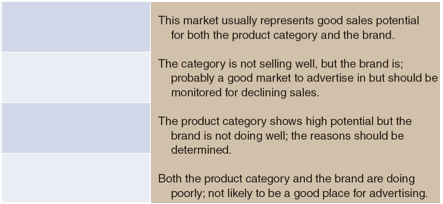
- AHigh BDI/high CDI
- Bhigh bdi/low cdi
- Clow bdi/high cdi
- Dlow bdi/low cdi
36Promoting certain international foods like edamame in traditional/small towns where interest in such foods is likely to be low would not make sense. It is better to advertise edamame in big cities instead which have a diverse population. This is an example of
- AGeographic Coverage
- BReach and Frequency
- CSituational Diversity
- DRecency Planning
37Recency Planning (Part of Reach versus Frequency Media Strategy)
- AFocuses on short interval reach at minimum frequency levels as close to the purchase decision as possible
- BHas a continuous schedule over a one week period rather than focusing on a four-week planning period for reach
- CTargets less to gain exposure to reach as many potential consumers as possible
- DAll of the above
Information
- Description
- Integrated Marketing Communications Quiz on Lecture 7: Media Planning, created by Sarah Bowe on 10/10/2017.
- Author
- Sarah Bowe
- Language
- English
- Views
- 776
- Tags
- Rating
- 5.0 out of 5 · 1 rating Rate this quiz