
Quiz
Unit 9 Material Changes Quiz
Create a free account to finish this quiz
Save your progress and see your final score.
Already have an account? Sign in
Questions in this quiz (25)
1Two liquids were mixed together in a test tube. Which one of these would NOT show that a chemical reaction had taken place?
- AA The tube got warm.
- BB Bubbles of gas were given off.
- CC A brightly coloured solid formed in the tube.
- DD One of the liquids floated on top of the other.
2Which of these changes is a chemical reaction?
- AA Melting some margarine in a pan
- BB Boiling a kettle of water
- CC Frying an egg
- DD Cooling a drink by putting an ice cube in it.
3 Which statement is true?
- AA All reactions need energy to start them off.
- BB Some reactions need energy to start them off.
- CC All reactions happen when two chemicals are mixed.
- DD All reactions happen very quickly.
4 A chemical reaction:
- AA always produces a gas.
- BB is always reversible.
- CC makes new substances.
- DD does not make new substances.
5 The substances that you get at the end of
The substances that you get at the end of a chemical reaction are called:- AA reactants.
- BB chemicals.
- CC products.
- DD gases.
6Hydrogen gas:
- AA burns with a squeaky pop.
- BB makes a glowing splint relight and burn brightly.
- CC puts a glowing splint out.
- DD turns universal indicator solution red.
7When a fuel burns there is:
- AA a reversible physical change.
- BB a reversible chemical change.
- CC an irreversible physical change.
- DD an irreversible chemical change.
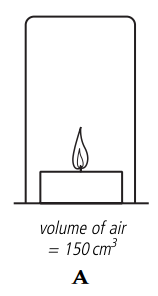
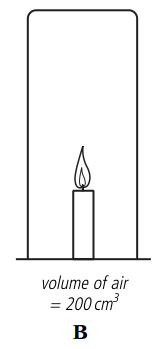
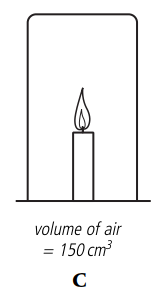
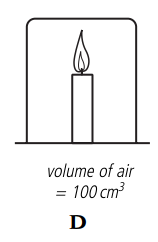
8Which of these candles will burn the longest?
- A
- B
- C
- D
- A
9A mixture is:
- AA just one substance, like pure salt.
- BB two or more things mixed together, like nuts and raisins.
- CC two things joined together, like flour and sugar in a baked cake.
- DD a lot of the same thing put together.
10Salt seems to disappear if you stir it into water. Which statement is true?
- AA The salt dissolves because it is insoluble.
- BB The salt dissolves because it is soluble.
- CC The salt melts because it is soluble.
- DD The salt melts because it is insoluble.
11 When you add salt to water:
- AA the salt is the solvent.
- BB the water is the solute.
- CC the salt is the solute.
- DD the water is the solution.
12 Filtering cannot be used to separate:
- AA sand from a mixture of sand and water.
- BB sugar from sugar solution.
- CC tea leaves from a pot of tea.
- DD leaves from a mixture of leaves and
pond water
13 Most water has chemicals dissolved in it because:
- AA it is pure.
- BB rain water has lots of chemicals dissolved in it.
- CC the water dissolves chemicals from rocks it passes through.
- DD the water dissolves chemicals from the pipes it flows through.
14A solid dissolved in water can be obtained by:
- AA evaporating the liquid.
- BB using a sieve.
- CC using a filter.
- DD freezing the liquid.
15Which sentence is not true?
- AA Rock salt is a mixture of rock and salt.
- BB Rock salt can be used to make pure salt to put on food.
- CC You can get salt from rock salt using a sieve.
- DD You can get salt from rock salt by dissolving, filtering and evaporating.
16Pure water can be made from inky water by:
- AA filtering it.
- BB evaporating it.
- CC distilling it.
- DD adding more water to it.
17 The two steps in distillation are:
.- AA filtering followed by evaporation.
- BB evaporation followed by condensation.
- CC condensation followed by filtering
- DD filtering followed by condensation
18 Distillation can not be used to separate:
- AA sand from sugar.
- BB petrol from crude oil.
- CC pure water from sea water.
- DD alcohol during the production of whisky.
19 Chromatography is:
- AA a way of separating different liquids from each other.
- BB a way of separating different dissolved colours from each other.
- CC a way to separate a liquid from a solid which doesn’t dissolve.
- DD a special way to draw a graph.
20Chromatography will only work if:
- AA a lot of each chemical is used.
- BB the special paper has been warmed before it is used.
- CC the special paper is moved during the experiment.
- DD the chemicals to be separated dissolve in the liquid used.
21The diagram shows a chromatogram.
Which two chemicals are the same?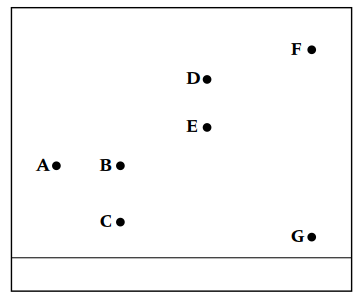
- AA A and B
- BB C and B
- CC D and F
- DD A and G
22A saturated solution:
- AA is always cold.
- BB has a lot of water in it.
- CC will not dissolve any more solvent.
- DD will not dissolve any more solute.
23You can tell if a solution is saturated because:
- AA it will be transparent.
- BB there will be bits of undissolved solid in it.
- CC it will be coloured.
- DD it will be hot.
24Only 20 g of a salt will dissolve in 100 g of water at room temperature.
If you use hot water instead:- AA less than 20 g will dissolve.
- BB only 20 g will dissolve.
- CC more than 20 g will dissolve.
- DD no salt will dissolve.
25The solubility of a substance is:
.- AA the mass of solute that will dissolve in 100 ml of water
- BB the mass of solvent that will dissolve in 100 ml of water.
- CC the volume of water that 100 g of solute will dissolve in.
- DD the volume of water that 100 g of solvent will dissolve in.
Information
- Description
- Quiz for KS3 Grade 7 Unit 9 Material Changes topic.
- Author
- Jeffrey Piggott
- Language
- English
- Views
- 906
- Tags
- Rating
- No ratings yet Rate this quiz