
Quiz
Compendium 7 - How do we get rid of toxic wastes?
This quiz has question types that open in the usual player.
Questions in this quiz (50)
1Select Four organs of the urinary system
- ABladder
- BKidneys
- CUreter
- DUrethra
- EVagina
- FEsophagus
2Select the Three main functions of the kidneys
- AFiltration - occurs in the renal corpuscle
- BTubular reabsorption - occurs in the PCT and DCT
- CTubular secretion - occurs in the DCT
- DRemoval of toxic waste
3Describe the location of the Kidneys
- Aposterior muscular wall of the abdominal cavity
- Banterior muscular wall of the abdominal cavity
4The left kidney is located slightly more superior than the right kidney due to the larger size of the liver on the right side of the body.
- ATrue
- BFalse
5The right kidney is located slightly more superior than the left kidney due to the larger size of the liver on the right side of the body.
- ATrue
- BFalse
6Identify the external structural layers of the Kidney:
- A• renal capsule - immediate lining covering the renal tissue
• adipose tissue - fat layer outside the renal capsule
• renal fascia - outer layer, anchors kidney and attaches it to surrounding tissue - B• renal capsule - outer layer, anchors kidney and attaches it to surrounding tissue
• adipose tissue - fat layer outside the renal capsule
• renal fascia - immediate lining covering the renal tissue
- A• renal capsule - immediate lining covering the renal tissue
7The nephron is the functional unit of the kidney, which forms urine. The Four parts of the nephron are:
- A• Distal convoluted tubule (DCT)
- B• Loop of Henle
- C• Proximal convoluted tubule (PCT)
- D• Renal corpuscle
- E• Renal bowmans capsule
8Describe the three processes necessary for urine formation.
- AFiltration - occurs in the renal corpuscle
- BTubular reabsorption - occurs in the PCT and DCT
- CTubular secretion - occurs in the DCT
- DTubular secretion - occurs in the PCT and DCT
9Describe the components that make up the urinary process
- AFiltration occurs in the renal corpuscle, which consists of the glomerulus and Bowman’s capsule.
Blood enters the glomerulus, and the fluid and solutes in the blood are pushed through the
glomerular capillary wall and enter the Bowman’s capsule, which is the first part of the tubule. This
solution is called filtrate and a small amount of it will eventually become urine. - BFiltration occurs in the renal capsule, which consists of the glomerulus and renal corpuscle.
Blood enters the glomerulus, and the fluid and solutes in the blood are pushed through the
glomerular capillary wall and enter the Bowman’s capsule, which is the first part of the tubule. This
solution is called filtrate and a small amount of it will eventually become urine.
- AFiltration occurs in the renal corpuscle, which consists of the glomerulus and Bowman’s capsule.
10Reabsorption from the filtrate is a two-step process. Referring to Figure 9.2, the two steps are:
[blank_start](1)[blank_end] Movement of the filtrate into the cells lining the nephron through the apical surface of the cell or
the apical membrane.
[blank_start](2)[blank_end] Then from these cells into the blood through the basal surface of the cell or basal membrane.- A(1)
- B(2)
- C(2)
- D(1)
11Which one of the following structures is known as the ‘functional unit of the kidney’?
- Aa. the renal corpuscle
- Bb. the glomerulus
- Cc. the nephron
- Dd. the renal pyramids
12Which one of the following structures is considered to be a part of the nephron?
- Aa. the glomerulus
- Bb. ureter
- Cc. collecting duct
- Dd. renal pelvis
13Which one of the following substances would you expect to find in the filtrate of a healthy
individual?- Aa. red blood cells
- Bb. sodium ions
- Cc. large proteins
- Dd. white blood cells
14Which one of the following substances would be normally re-absorbed into the kidney
tubules?- Aglucose
- Bammonia
- Clarge proteins
- Dred blood cells
15Which hormone promotes water retention in the body?
- Aaquaporin hormone
- Bthyrotropin hormone
- Coxytocin hormone
- Danti-diuretic hormone
16What is the name of the muscle found in the wall of the bladder?
- Acardiac
- Bskeletal
- Cfast twitch
- Ddetrusor
17What is the name of the reflex that controls urination?
- Asympathetic
- Bmicturition
- Cbaroreceptor
- Dparasympathetic
18Nephron Diagram:
1. [blank_start]Loop of Henle[blank_end]
2. [blank_start]Collecting duct[blank_end]
3. [blank_start]Proximal convoluted tubule[blank_end]
4. [blank_start]Distal convoluted tubule[blank_end]
5. [blank_start]Cortex of kidney[blank_end]
6. [blank_start]Medulla of kidney[blank_end]
The two parts of the renal corpuscle
are:
1. [blank_start]Glomerulus[blank_end]
2. [blank_start]Glomerular capsule[blank_end]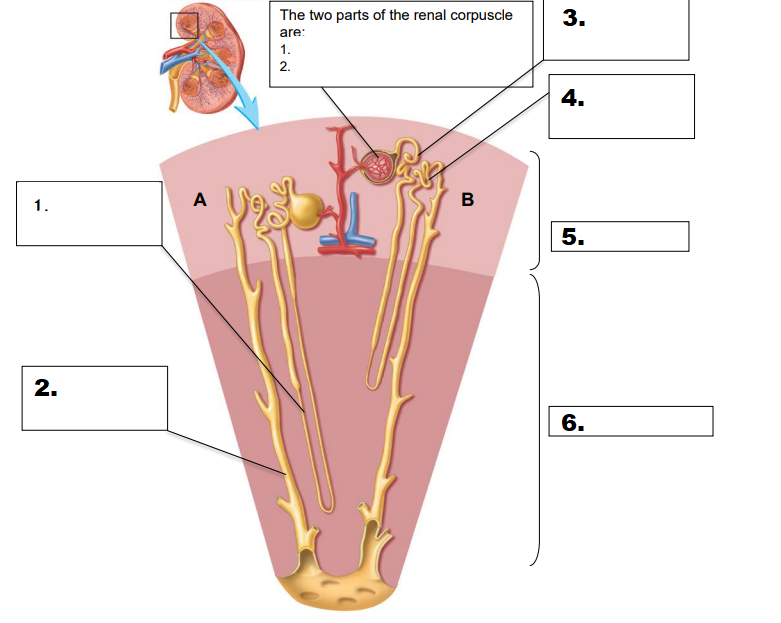
- ALoop of Henle
- BCollecting duct
- CProximal convoluted tubule
- DDistal convoluted tubule
- ECortex of kidney
- FMedulla of kidney
- GGlomerulus (1st)
- HGlomerular capsule (2nd)
19What type of nephron is nephron A?
- AJuxtamedullary
- BCortical
20What type of nephron is nephron B?
- ACortical
- BJuxtamedullary
21Juxtamedullary: There are two types of nephrons: Superficial cortical nephrons, which have their glomeruli in the outer cortex. They have shorter loops of Henle, which dip only into the outer medulla. Juxtamedullary nephrons, which have their glomeruli near the corticomedullary border.
- ATrue
- BFalse
22Creatinine: A chemical waste molecule that is generated from muscle metabolism.
- ATrue
- BFalse
23The nephron is the functional unit of the kidney, which forms urine. The parts of the nephron are:
• Renal corpuscle
• Proximal convoluted tubule (PCT)
• Loop of Henle
• Distal convoluted tubule (DCT)- ATrue
- BFalse
24Filtration occurs in the renal corpuscle, which consists of the [blank_start]glomerulus[blank_end] and [blank_start]Bowman’s capsule[blank_end].
- Aglomerulus
- Bloop of henle
- CBowman’s capsule
- Ddistal convoluted tubules
25Filtration:
Filtration occurs in the [blank_start]renal corpuscle[blank_end], which consists of the [blank_start]glomerulus[blank_end] and [blank_start]Bowman’s capsule[blank_end]. [blank_start]Blood[blank_end] enters the glomerulus, and the fluid and [blank_start]solutes[blank_end] in the blood are pushed through the glomerular [blank_start]capillary wall[blank_end] and enter the Bowman’s capsule, which is the first part of the [blank_start]tubule[blank_end]. This solution is called [blank_start]filtrate[blank_end] and a small amount of it will eventually become [blank_start]urine[blank_end].- Arenal corpuscle
- BBowman’s capsule
- CBlood
- Durine
- Esolutes
- Fcapillary wall
- Gtubule
- Hfiltrate
- Iglomerulus (1st)
26Tubular re-absorption:
Re-absorption is the return of water and solutes to the blood following filtration. The filtrate flows
through the proximal convoluted tubules, loop of Henle, distal convoluted tubules and then to the
collecting ducts. As the filtrate moves through the nephron, much of it is reabsorbed from the
nephron to the blood stream via processes such as diffusion, facilitated diffusion, active
transport, symport and osmosis.- ATrue
- BFalse
27Tubular secretion:
Tubular secretion is when substances are secreted into the filtrate from the blood. Tubular secretion can be active or passive. A good example of tubular secretion is H+ ions, and this plays an important role in the regulation of the pH of the blood.- ATrue
- BFalse
28Tubular secretion:
Tubular secretion is when substances are [blank_start]secreted[blank_end] into the filtrate from the [blank_start]blood[blank_end]. Tubular
[blank_start]secretion[blank_end] can be [blank_start]active[blank_end] or passive. A good example of tubular secretion is H+ ions, and this plays
an important role in the regulation of the [blank_start]pH[blank_end] of the blood.- Asecreted
- Bblood
- Csecretion
- Dactive
- EpH
29Sodium-potassium exchange pump is
- AActive
- BPassive
30Which molecule is moving with Na+ during co-transport (piggy backing)?
- AGlucose
- BFructose
31Anti Port - Which molecule is moving with Na+?
- ACa2+
- BK+
32Anti-port: Is Na+ and Ca2+ moving in the same direction or in opposite directions?
- AOpposite
- BSame direction
33Facilitated diffusion is the mechanism by which glucose moves out of the nephron cell in to the blood
- ATrue
- BFalse
34Describe the structure and function of the special carrier molecule
- AProtein imbedded in cell membrane with a central channel. It helps move molecules across
the cell membrane. - BLipid imbedded in cell membrane with a central channel. It helps move molecules across
the cell membrane.
- AProtein imbedded in cell membrane with a central channel. It helps move molecules across
35Name two molecules that move across the cell membrane via facilitated diffusion?
- AFructose
- BAmino acids
- CGlucose
36 Is facilitated diffusion moving the molecule up or down its concentration gradient?
- ADown its concentration gradient. From high to low concentration.
- BUp its concentration gradient. From low to high concentration.
37Is facilitated diffusion an active or passive process?
- ADiffusion is passive – it does not require energy (ATP).
- BDiffusion is active – it does require energy (ATP).
38Is glucose moving from the filtrate to the blood, or from the blood to the filtrate?
- AGlucose is moving from the filtrate to the blood. It is being reabsorbed into the body where it
will be used by cells to make ATP - BGlucose is moving from the blood to the filtrate. It is being reabsorbed into the body where it
will be used by cells to make ATP
- AGlucose is moving from the filtrate to the blood. It is being reabsorbed into the body where it
39The glomerular capsule is also known as the Bowman’s capsule
- ATrue
- BFalse
40The renal corpuscle consists of the glomerulus (a bed of capillaries) and the glomerular capsule.
- ATrue
- BFalse
41Renal corpuscle
The renal corpuscle consists of the [blank_start]glomerulus[blank_end] (a bed of capillaries) and the glomerular [blank_start]capsule[blank_end].
The glomerular capsule is also known as the [blank_start]Bowman’s capsule[blank_end]. Blood enters the [blank_start]renal corpuscle[blank_end]
(the first part of the nephron) via the [blank_start]afferent[blank_end] arteriole. When the blood passes through the bed of
capillaries in the renal corpuscle, fluid leaves the [blank_start]capillary[blank_end] and becomes [blank_start]filtrate[blank_end]. This is the first
stage of [blank_start]urine[blank_end] formation. This filtrate then enters into the glomerular capsule and flows directly into
the [blank_start]proximal convoluted tubule[blank_end], where tubular [blank_start]reabsorption[blank_end] begins. Blood that comes in via the
afferent arteriole leaves via the efferent arteriole to return to the body’s [blank_start]blood[blank_end] [blank_start]supply[blank_end]- Aglomerulus
- Bcapsule
- CBowman’s capsule
- Drenal corpuscle
- Eafferent
- Ffiltrate
- Gcapillary
- Hurine
- Iproximal convoluted tubule
- Jreabsorption
- Ksupply
- Lblood
42[blank_start]Fenestrae of capillaries[blank_end] - Holes in the endothelial cells of the glomerular capillaries
[blank_start]Basement membrane[blank_end] - Found in between the endothelial cells and the podocytes
[blank_start]Filtration slits[blank_end] - Spaces between the podocyte cell processes- AFenestrae of capillaries
- BBasement membrane
- CFiltration slits
43Fenestrae of capillaries - Window-like holes in the endothelial cells of the glomerular capillaries
- ATrue
- BFalse
44• The nephron higher in the cortex is called a [blank_start]cortical nephron[blank_end].
• The nephron that is lower in the cortex with a long Loop of Henle extending deep into the medulla is a [blank_start]juxtamedullary nephron (juxta = near)[blank_end].- Acortical nephron
- Bjuxtamedullary nephron (juxta = near)
45[blank_start]Proximal convoluted tubule[blank_end] : Main area for reabsorption of water (80%) 100% reabsorption of amino acids and sugars
[blank_start]Distal convoluted tubule[blank_end] : Controlled secretion of wastes, toxin, excess ions. Alters concentration of urine by varying water reabsorption
[blank_start]Loop of Henle[blank_end] : Reabsorbs ions and water.- AProximal convoluted tubule
- BDistal convoluted tubule
- CLoop of Henle
46The distal convoluted tubule is the last segment of the nephron. What is the name of the segment following the distal convoluted tubule?
- ACollecting duct
- BAdvancing duct
47The bladder is a hollow structure that stores urine. What volume of urine do you think the bladder usually holds?
- Aup to 1 L
- Bup to 1.5 L
48Carrier molecules are usually proteins bound to a non-protein group
- ATrue
- BFalse
49In the cell, examples of molecules that must use facilitated diffusion to move in and out of the cell membrane are glucose, sodium ions, and potassium ions. They pass using carrier proteins through the cell membrane without energy along the concentration gradient.
- ATrue
- BFalse
50Facilitated diffusion is a passive process
- ATrue
- BFalse
Information
- Description
- Compendium 7 - How do we get rid of toxic wastes?
- Author
- Jessica Bulley
- Language
- English
- Views
- 133
- Tags
- Rating
- No ratings yet Rate this quiz