
Quiz
BioMed II Exam 3
This quiz has question types that open in the usual player.
Questions in this quiz (49)
1Compare and Contrast Prokaryotes vs Eukaryotes
Prokaryotes are [blank_start]Unicellular[blank_end] and [blank_start]do not contain[blank_end] a Nucleus.
They store their genetic information in [blank_start]Circular[blank_end] DNA and [blank_start]have[blank_end] a Cell Wall.
Eukaryotes are [blank_start]Multicellular[blank_end] and [blank_start]contain[blank_end] a Nucleus.
They store their genetic information in [blank_start]Linear[blank_end] DNA and [blank_start]do not have[blank_end] a Cell Wall.- AUnicellular
- BMulticellular
- Cdo not contain
- Dcontain
- ECircular
- FLinear
- Ghave
- Hdo not have
- IMulticellular
- JUnicellular
- Kcontain
- Ldo not contain
- MLinear
- NCircular
- Odo not have
- Phave
2Label the parts of the Prokaryotic Cell.
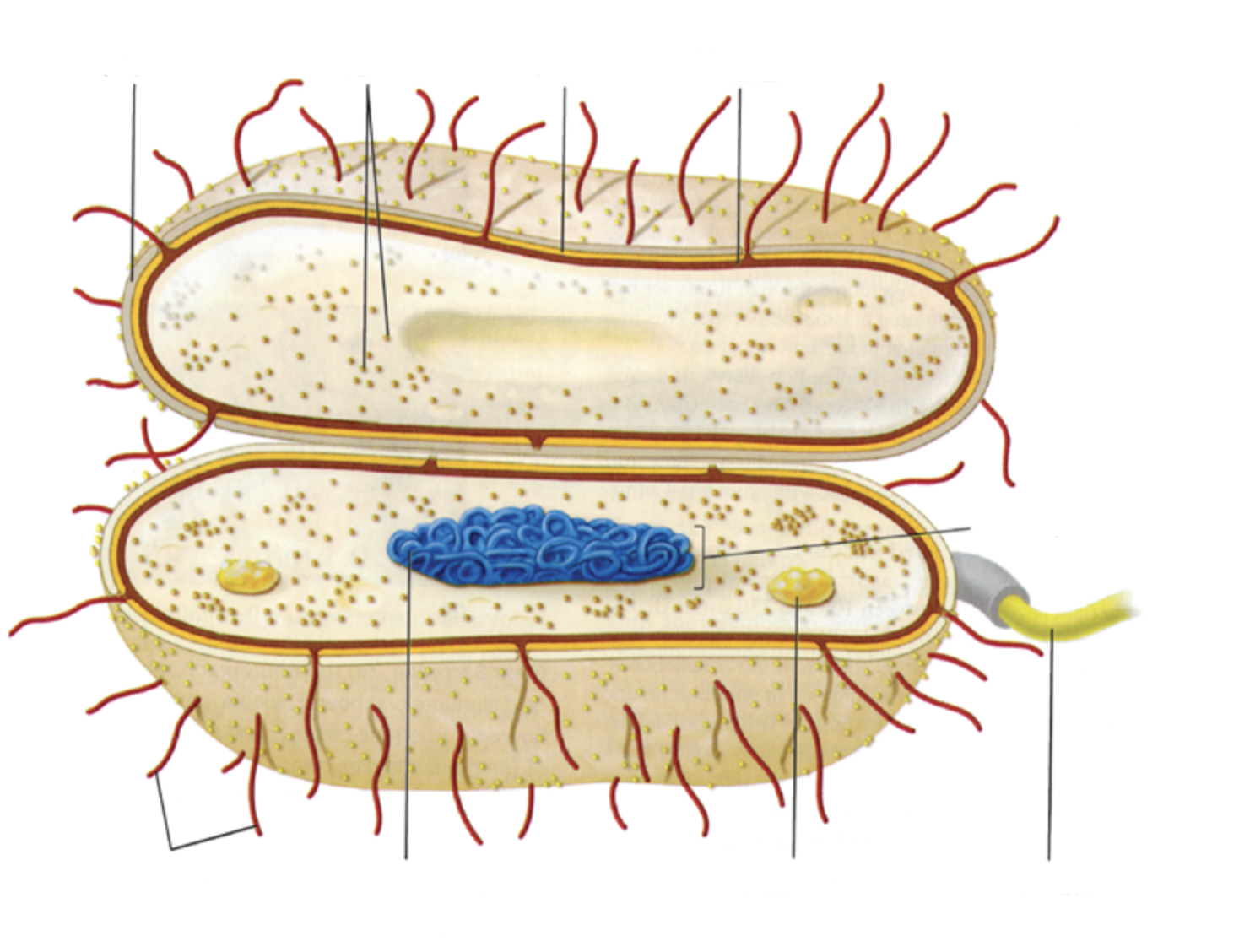
- ACapsule
- BRibosomes
- CCell Wall
- DPlasma Membrane
- ENucleiod
- FNucleus
- GFlagellum
- HChromosome (DNA)
- IFimbirae
3Which of these is a Gram Negative bacteria?
- AClostridium botulinum
- BShingella dysenteriae
- CStaphylococcus aureus
- DMycobacterium leprosae
- EEnterococcus faecalis
4Anaerobic bacteria differ from aerobic bacteria in which way?
- AAnaerobic bacteria lack and inner and outer cell membrane
- BAnaerobic bacteria have pyruvate ferredoxin oxidoreductase
- CAerobic bacteria lack catalase and SOD
- DAerobic Bacteria have a cell wall
5All of the following are host examples of host defenses that a microbe must bypass to initiate infection EXCEPT:
- AComplement
- BLimited Turbulance
- CPreexisting antibodies
- DIgA in mucosal secretions
- EMulti-layer keratinized epithelia
6Match the symbiotic type with its definition:
[blank_start]Mutualism[blank_end] --> Good for Bacteria and Host
[blank_start]Commensalism[blank_end] --> Good for Bacteria, no effect on the host
[blank_start]Parasitism[blank_end] --> Good for Bacteria but Bad for the host- AMutualism
- BCommensalism
- CParasitism
- DCommensalism
- EMutualism
- FParasitism
- GParasitism
- HMutualism
- ICommensalism
7[blank_start]Resident[blank_end] Bacteria have a permanent presence within us while [blank_start]Transient[blank_end] Bacteria have a short term presence.
- AResident
- BTransient
8Transient bacteria drive out residential bacteria.
- ATrue
- BFalse
9Our blood/body fluids/internal tissues are always sterile.
- ATrue
- BFalse
10Match the amount of bacteria present in the different areas of the GI tract.
[blank_start]Many[blank_end] Oral
[blank_start]Minimal[blank_end] Stomach
[blank_start]Minimal[blank_end] Small Intestines
[blank_start]Many[blank_end] Large Intestines
[blank_start]Many[blank_end] Colon- AMany
- BMinimal
- CMinimal
- DMany
- EMinimal
- FMany
- GMany
- HMinimal
- IMany
- JMinimal
11Which is more prevalent in the gut?
- AObligate Anaerobes
- BAerobes
12Fill in the correct type of bacteria with it’s definition.
[blank_start]Obligate Anaerobe[blank_end] --> Living in environments not containing oxygen
[blank_start]Facilitative Anaerobe[blank_end] --> Living with or without oxygen
[blank_start]Aerobe[blank_end] --> Living in oxygen containing environments- AObligate Anaerobe
- BFacilitative Anaerobe
- CAerobe
13Opportunistic infections happen when a bacteria begins to overgrow in a site that it is normally not abundant in due to conditions that make it favorable to do so.
- ATrue
- BFalse
14If the exclusionary effect becomes ineffective this can result in
- APost-antibiotic infections
- BPathogenic colonization prevention
- CInhibiting pathogenic overgrowth
- DNormal micro-biotic flora
15Nosocomial infections can be acquired from
- AHospitals
- BNursing Homes
- COffices
- DOutpatient Clinic
- EHome Care
- FOutpatient Pharmacy
16A lack of immune system priming results in
- AStrong immune system
- BWeak immune system
- CNonspecific antibodies
- DVery specific antibodies
- ELow serum Igs
- FHigh serum Igs
17Infections begins with [blank_start]Exposure[blank_end]
which leads to [blank_start]Entry[blank_end]
then [blank_start]Multiply and Spread[blank_end]
which can result in [blank_start]Injury[blank_end]- AExposure
- BEntry
- CMultiply and Spread
- DInjury
- EEntry
- FExposure
- GMultiply and Spread
- HInjury
- IMultiply and Spread
- JExposure
- KEntry
- LInjury
- MInjury
- NMultiply and Spread
- OExposure
- PEntry
18Which of these are ways pathogens can enter the body?
- AInhalation
- BIngestion
- CPenetration
- DSite to Site Transfer
19Which of the following would not be considered a nocosomal infection?
- ATransfer of a pathogenic bacteria from one patient to another by staff
- BAn infection acquired from a contaminated hot tub
- CInfection due to catheterization
- DDiarrhea that develops after prolonged antibiotic utilization
20Glycolipids and Glycoproteins can determine whether or not a bacteria attaches to an epithelial cell.
- ATrue
- BFalse
21Bacterial Adhesions are stronger than Bacterial Attachment Proteins.
- ATrue
- BFalse
22Bacteria multiply in the [blank_start]Submucosa[blank_end] before Invasion.
- ASubmucosa
23[blank_start]Direct Damage[blank_end] is caused by bacterial toxins destroying host cells and tissues while [blank_start]Indirect Damage[blank_end] is caused by the host inflammatory response.
- ADirect Damage
- BIndirect Damage
24Match the Bacterial Toxin with their definition.
[blank_start]Neurotoxin[blank_end] --> Target Nerves
[blank_start]Cytotoxin[blank_end] --> Target Cells
[blank_start]Exotoxin[blank_end] --> Secreted by Bacterial Cells
[blank_start]Endotoxin[blank_end] --> Part of a Gram - Bacterial Cell Membrane- ANeurotoxin
- BCytotoxin
- CExotoxin
- DEndotoxin
25The [blank_start]B[blank_end] Domain binds to the cell
The [blank_start]A[blank_end] Domain Catalyzes intracellular reactions.- AB
- BA
26Membrane Active Exotoxins have an indirect insertion into the host membrane that forms a pore causing cell leakage/lysis.
- ATrue
- BFalse
27Super Antigens bridge the gap between [blank_start]Antigen Presenting Cells[blank_end] and [blank_start]T Cells[blank_end] causing a massive release of [blank_start]Cytokines[blank_end]
- AAntigen Presenting Cells
- BT Cells
- CCytokines
28Endotoxins are ONLY associated with Gram - Cells
- ATrue
- BFalse
29PAMP stands for [blank_start]Pathogen Associated Molecular Pattern[blank_end]
PRR stands for [blank_start]Pathogen Recognition Receptor[blank_end]- APathogen Associated Molecular Pattern
- BPathogen Recognition Receptor
30Having a polysaccharide capsule can make it easier for bacteria to withstand attack from [blank_start]Phagocytosis[blank_end] and the [blank_start]Compliment Cascade[blank_end]
- APhagocytosis
- BCompliment Cascade
31PAMPs are located on our cells while PRRs are located on Bacterial cells
- ATrue
- BFalse
32Bacteria avoid attack from the immune system through
- ASlightly changing the proteins on the outside to avoid Compliment Cascade
- BPolysaccharide Capsule
- CAttaching and Destroying/Replicating in Phagocytes
- DSecreting Proteases to damage present antibodies (IgA IgG)
33Bacteremia means [blank_start]Bacteria in the blood[blank_end]
- ABacteria in the blood
34Localized infections mean the pathogen or the toxins being released are concentrated in one area or tissue. The Localized effects also stay in that general area.
- ATrue
- BFalse
35Systemic Infections are where the pathogen enters the blood or several tissues. This can contain Cytokines, secreted toxins and presence of bacteria, viruses, or pathogens in the blood.
- ATrue
- BFalse
36SIRS stands for [blank_start]Systemic Inflammatory Response Syndrome[blank_end].
- ASystemic Inflammatory Response Syndrome
37You must have at least two of which of these symptoms for SIRS?
- AAbnormal Temperature
- BLowered Heart Rate
- CRespiratory Distress
- DAbnormal WBC Counts
38Match the SIRS pro inflammatory cytokines with their function
TNF-Alpha --> [blank_start]Activates IL-1 and IL-6[blank_end]
IL-1 --> [blank_start]Cellular Damage[blank_end]
IL-6 --> [blank_start]Cellular Damage pt2[blank_end]
IL-8 --> ?
PAF --> [blank_start]Blood Clotting[blank_end]- AActivates IL-1 and IL-6
- BCellular Damage
- CBlood Clotting
- DCellular Damage
- EActivates IL-1 and IL-6
- FBlood Clotting
- GCellular Damage pt2
- HActivates IL-a and IL-6
- IBlood Clotting
- JBlood Clotting
- KActivates Il-1 and IL-6
- LCellular Damage
39In CARS [blank_start]IL-1Ra[blank_end] counteracts the pro inflammatory activity of [blank_start]IL-1[blank_end] in SIRS
- AIL-1Ra
- BIL-1
40When there is a SIRS response, and [blank_start]infection[blank_end] is what kicks off the cascade into Sepsis
- Ainfection
41DIC stands for [blank_start]Disseminated Intravascular Coagulation[blank_end]
- ADisseminated Intravascular Coagulation
42In MODS or [blank_start]Multiple Organ Dysfunction Syndrome[blank_end], multiple organs begin to fail and stop working properly.
- AMultiple Organ Dysfunction Syndrome
43The lungs are usually the first to fail in a syndrome called ARDS or [blank_start]Acute Respiratory Distress Syndrome[blank_end]
- AAcute Respiratory Distress Syndrome
44The kidneys are usually next to fail in ARF or [blank_start]acute renal failure[blank_end]
- Aacute renal failure
45The infections that are most common with SIRS to cause sepsis are (in order)
1 [blank_start]Respiratory Tract[blank_end]
2 [blank_start]Genitourinary Tract[blank_end]
3 [blank_start]Intra-Abdominal[blank_end]
4 [blank_start]Device Related[blank_end]
5 [blank_start]Wounds/Soft Tissue[blank_end]
6 [blank_start]Primary Bacterium[blank_end]- ARespiratory Tract
- BGenitourinary Tract
- CIntra-Abdominal
- DDevice Related
- EWounds/Soft Tissue
- FPrimary Bacterium
- GGenitourinary Tract
- HRespiratory Tract
- IIntra-Abdominal
- JDevice Related
- KWounds/Soft Tissue
- LPrimary Bacterium
- MIntra-Abdominal
- NRespiratory Tract
- OGenitourinary Tract
- PDevice Related
- QWounds/Soft Tissue
- RPrimary Bacterium
- SDevice Related
- TRespiratory Tract
- UGenitourinary Tract
- VIntra-Abdominal
- WWounds/Soft Tissue
- XPrimary Bacterium
- YWounds/Soft Tissue
- ZRespiratory Tract
- AAGenitourinary Tract
- ABInra-Abdominal
- ACDevice Related
- ADPrimary Bacterium
- AEPrimary Bacterium
- AFRespiratory Tract
- AGGenitourinary Tract
- AHIntra-Abdominal
- AIDevice Related
- AJWounds/Soft Tissue
46Pathogens commonly associated with sepsis in order
1 [blank_start]Gram Positive Aerobes[blank_end]
2 [blank_start]Gram Negative Aerobes[blank_end]
3 [blank_start]Anaerobes[blank_end]
4 [blank_start]Fungi[blank_end]
5 [blank_start]Polymicrobial[blank_end]- AGram Positive Aerobes
- BGram Negative Aerobes
- CAnaerobes
- DFungi
- EPolymicrobial
- FGram Negative Aerobes
- GGram Positive Aerobes
- HAnaerobes
- IFungi
- JPolymicrobial
- KAnaerobes
- LGram Positive Aerobes
- MGram Negative Aerobes
- NFungi
- OPolymicrobial
- PFungi
- QGram Positive Aerobes
- RGram Negative Aerobes
- SAnaerobes
- TPolymicrobial
- UPolymicrobial
- VGram Positive Aerobes
- WGram Negative Aerobes
- XAnaerobes
- YFungi
47The damage from Gram Positive Sepsis comes from the [blank_start]Peptidoglycan[blank_end], [blank_start]Pro-inflammatory cytokines[blank_end], and [blank_start]exotoxins[blank_end].
- APeptidoglycan
- BPro-inflammatory cytokines
- Cexotoxins
48Gram Negative Sepsis has stronger effects than Gram Negative but is less common.
- ATrue
- BFalse
49The bacteria causing Gram Positive Septic Shock are
[blank_start]Streptococcus pneumonia[blank_end]
[blank_start]Staphylococcus spp[blank_end]
[blank_start]Enterococci spp[blank_end]- AStreptococcus pneumonia
- BStaphylococcus spp
- CEnterococci spp
Information
- Description
- Lectures Medical Biology I II and III
- Author
- Monica Werner
- Language
- English
- Views
- 35
- Tags
- Rating
- No ratings yet Rate this quiz