
Quiz
CCNA 3 v5.03 Chapter 5
This quiz has question types that open in the usual player.
Questions in this quiz (23)
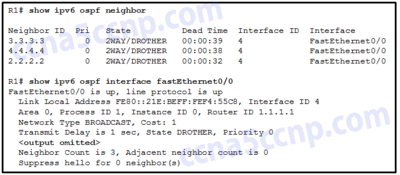
1Refer to the exhibit. What three conclusions can be drawn from the displayed output? (Choose three.)
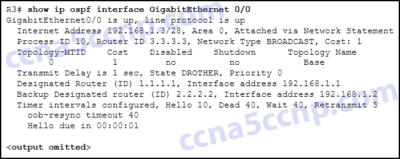
- AThe DR can be reached through the GigabitEthernet 0/0 interface.
- BThis interface is using the default priority.
- CThe BDR has three neighbors.
- DThe router ID on the DR router is 3.3.3.3
- EThe router ID values were not the criteria used to select the DR and the BDR.
- FThere have been 9 seconds since the last hello packet sent
2Refer to the exhibit. Which conclusion can be drawn from this OSPF multiaccess network?
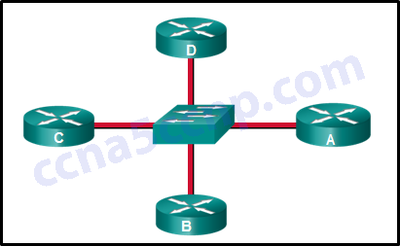
- AWhen a DR is elected all other non-DR routers become DROTHER.
- BAll DROTHER routers will send LSAs to the DR and BDR to multicast 224.0.0.5.
- CIf the DR stops producing Hello packets, a BDR will be elected, and then it promotes itself to assume the role of DR.
- DWith an election of the DR, the number of adjacencies is reduced from 6 to 3.
3When checking a routing table, a network technician notices the following entry:
O*E2 0.0.0.0/0 [110/1] via 192.168.16.3, 00:20:22, Serial0/0/0
What information can be gathered from this output?- AThis route is a propagated default route.
- BThe route is located two hops away.
- CThe metric for this route is 110.
- DThe edge of the OSPF area 0 is the interface that is addressed 192.168.16.3.
4Which command will a network engineer issue to verify the configured hello and dead timer intervals on a point-to-point WAN link between two routers that are running OSPFv2?
- Ashow ip ospf neighbor
- Bshow ip ospf interface serial 0/0/0
- Cshow ipv6 ospf interface serial 0/0/0
- Dshow ip ospf interface fastethernet 0/1
5A network engineer suspects that OSPFv3 routers are not forming neighbor adjacencies because there are interface timer mismatches. Which two commands can be issued on the interface of each OSFPv3 router to resolve all timer mismatches? (Choose two.)
- Ano ipv6 ospf hello-interval
- Bno ipv6 ospf dead-interval
- Cip ospf hello-interval 10
- Dip ospf dead-interval 40
- Eno ipv6 ospf cost 10
- Fno ipv6 router ospf 10
6Refer to the exhibit. What kind of OSPF authentication has been configured on this interface?
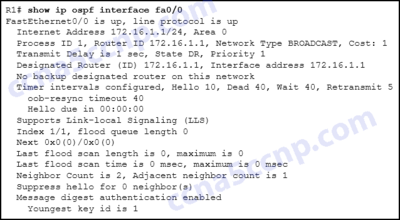
- Asimple
- Bnull
- Cplain text
- DMD5
7Which two pieces of information are used by the OSPF MD5 algorithm to generate a signature? (Choose two.)
- Asecret key
- BOSPF message
- COSPF router ID
- Drouter hostname
- Einterface IP address
8What is a recommended method of authentication for OSPFv3?
- AMD5 authentication
- BIPsec to secure routing updates
- Cthe passive-interface command
- Da VPN tunnel between each OSPF neighbor adjacency
9A network engineer is troubleshooting convergence and adjacency issues in an OSPFv2 network and has noted that some expected network route entries are not displayed in the routing table. Which two commands will provide additional information about the state of router adjacencies, timer intervals, and the area ID? (Choose two.)
- Ashow ip protocols
- Bshow ip ospf interface
- Cshow ip route ospf
- Dshow ip ospf neighbor
- Eshow running-configuration
10When OSPFv2 neighbors are establishing adjacencies, in which state do they elect a DR and BDR router?
- AExchange state
- BInit state
- CTwo-Way state
- DLoading state
11A network engineer is troubleshooting an OSPFv2 network and discovers that two routers connected by a point-to-point WAN serial link are not establishing an adjacency. The OSPF routing process, network commands and area ID are all confirmed as correct, and the interfaces are not passive. Testing shows that the cabling is correct, that the link is up, and pings between the interfaces are successful. What is most likely the problem?
- AThe subnet masks on the two connected serial interfaces do not match.
- BA clock rate has not been set on the DCE interface of the serial link.
- CThe OSPFv2 process IDs on each router do not match.
- DA DR election has not taken place.
12A network engineer is troubleshooting OSPFv2 routing issues on two connected routers. Which two requirements to form an adjacency need to be verified? (Choose two.)
- AVerify that one of the interfaces that connects the two routers is active and the other passive.
- BVerify that one of the routers is the DR or BDR and the other router a DRother.
- CVerify that the interfaces that connect the two routers are in the same subnet.
- DVerify that the interfaces that connect the two routers are in the same area.
- EVerify that both routers are using the same OSPFv2 process ID.
13Which command is used to verify that OSPF is enabled and also provides a list of the networks that are being advertised by the network?
- Ashow ip protocols
- Bshow ip ospf interface
- Cshow ip interface brief
- Dshow ip route ospf
14A fully converged five router OSPF network has been running successfully for several weeks. All configurations have been saved and no static routes are used. If one router loses power and reboots, what information will be in its routing table after the configuration file is loaded but before OSPF has converged?
- AAll routes for the entire network will be present.
- BDirectly connected networks that are operational will be in the routing table.
- CBecause the SPF algorithm has not completed all calculations, no routes will be in the table.
- DA summary route for all previously learned routes will automatically appear in the routing table until all LSPs have been received by the router.
15Refer to the exhibit. R1 and R2 are connected to the same LAN segment and are configured to run OSPFv3. They are not forming a neighbor adjacency. What is the cause of the problem?
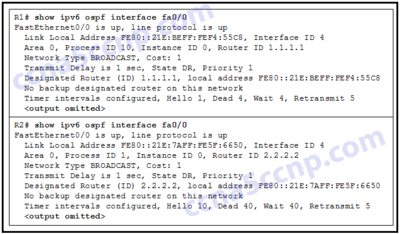
- AThe IPv6 addresses of R1 and R2 are not in the same subnet.
- BThe OSPFv3 process IDs of R1 and R2 are different.
- CThe timer intervals of R1 and R2 do not match.
- DThe priority value of both R1 and R2 is 1.
16Refer to the exhibit. Four routers are connected to an Ethernet LAN segment and are configured to run OSPFv3. However, none of the routers are receiving routing updates. What is the cause of the problem?
- AThe routers are using IPv4 addresses for router IDs.
- BAll of the routers have an OSPFv3 interface priority of 0.
- CThe network type has been set to BROADCAST instead of NBMA.
- DThe routers are using IPv6 link local addresses to communicate.
17Refer to the exhibit. These two routers are configured to run OSPFv3 but they are not forming a neighbor adjacency. What is the cause of the problem?

- AThe routers have the same priority.
- BThe routers have both been elected as the DR.
- CThe routers are configured with the same router ID.
- DThe routers do not have global IPv6 addresses that are configured on the Fa0/0 interfaces.
18During verification or troubleshooting of the OPSFv3 configuration on a router, which three parameters are displayed by the show ipv6 ospf interface command? (Choose three.)
- Athe hello and dead intervals
- Bthe global unicast IPv6 address of the interface
- Cthe metric of the route that is attached to the interface
- Dthe OSPFv3 area that the interface is in
- Ethe process ID that is assigned to the interface
- Fthe number of interfaces in the area
19Refer to the exhibit. Fill in the blank. Do not use abbreviations.
The command [blank_start]show ipv6 route[blank_end] can be issued on router R2 to verify the propagation of a static default route from R1 to R2.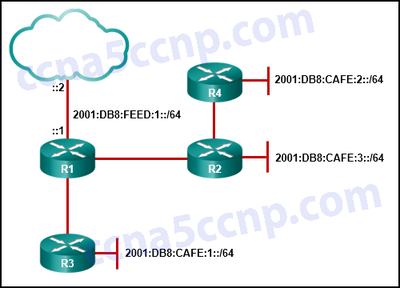
- Ashow ipv6 route
20Fill in the blank. Do not use abbreviations.
When IPv4 and OSPFv2 are being used, the command [blank_start]show ip ospf neighbor[blank_end] is used to verify that a router has formed an adjacency with its neighboring routers.- Ashow ip ospf neighbor
21Match each OSPF state to its function. (Not all options are used.)
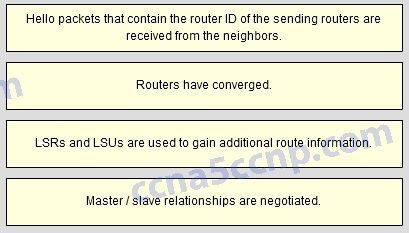
- A_ Full State _
- B_ Loading state _
- C_ ExStart state _
22Match each OSPF election criterion to its sequential order for the OSPF DR and BDR election process. (Not all options are used.)
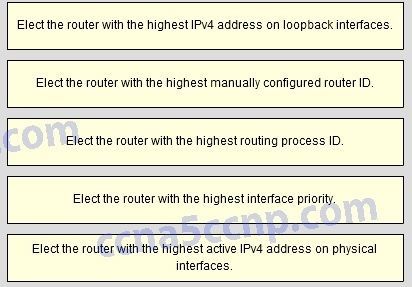
- A_ third _
- B_ second _
- C_ first _
- D_ fourth _
23The PT initialization was skipped. You will not be able to view the PT activity.
Open the PT Activity. Perform the tasks in the activity instructions and then answer the question.
Which task has to be performed on Router 1 for it to establish an OSPF adjacency with Router 2?- AIssue the clear ip ospf process command.
- BRemove the passive interface command from interface FastEthernet 0/0.
- CAdd the network 10.0.1.0 0.0.0.255 area 0 command to the OSPF process.
- DChange the subnet mask of interface FastEthernet 0/0 to 255.255.255.0.
Information
- Description
- sophomore CCNA 3 Quiz on CCNA 3 v5.03 Chapter 5, created by Christina Evans on 28/06/2016.
- Author
- Christina Evans
- Language
- English
- Views
- 138
- Tags
- Rating
- No ratings yet Rate this quiz