
Quiz
Explanatory Talk
This quiz has question types that open in the usual player.
Questions in this quiz (100)
1Attribution research aims to find out:
- AWhat causes specific behaviours
- BWhat causes specific ideologies
- CWhat causes society to develop a collective identity
2According to the attribution theory, when real world events occur what are we, as individuals, likely to do first?
- AFind out what caused it
- BFind out how it happened to begin with
- CFind out if society was to blame
3Does research suggest that we are always rational in our decisions?
- AYes
- BNo
4The general aggression model (Anderson & Bushman, 2002), suggests that our ________ affects how we decide to act in potentially aggressive situations.
- AArousal levels
- BPrevious experiences
- CMood
5The rational choice theory states that we are always rational. Is this statement true or false?
- ATrue
- BFalse
6Which way does the situation have to balance for us to act prosocially in situations that require it, according to Darley and Latané (1968)?
- APros outweigh cons
- BCons outweigh pros
- CNeither, they can be balanced
- DThey did not investigate this
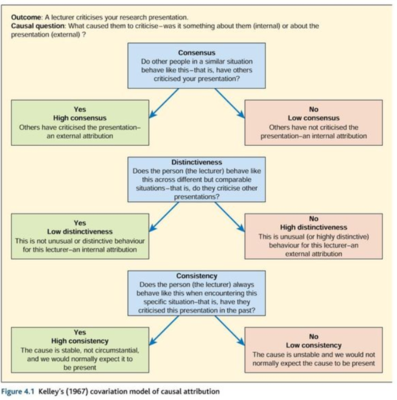
7Kelley's (1967) covariation model relies on three components. They are:
- AConsensus, distinctiveness, and consistency
- BConsensus, disparity, and consistency
- CCovariation, distinctiveness, and consensus
- DNone of the above
8Kelley furthered his work on the covariation model with the configuration model (1972), citing that there need to be multiple [blank_start]sufficient[blank_end] and [blank_start]necessary[blank_end] causes when we attribute causality to behaviour in a situation.
- Asufficient
- Bnecessary
9Internal attribution refers to when causality is:
- AWithin the person themselves
- BWithin the event itself
- CWithin society itself
10External attribution refers to when causality is:
- AOutside of the person themselves
- BOutside of the event itself
- COutside of social circumstances
11Where we attribute cause has ________ impact on how we respond to it. For example, if you had heard about a murder, how would you feel?
- AA major
- BVery little
12One major criticism of Kelley's (1967) covariation model is that it is:
- AOverly scientific and analytical, not representative of casual thinking
- BUnable to casually explain the role of society
- COutdated, and needs to be updated to reflect modern environmental factors
13Actor-observer difference is when:
- AIndividuals overemphasize external factors and underemphasize internal factors
- BIndividuals overemphasize internal factors and underemphasize external factors
14Fundamental attribution error refers to:

- AAn uncharacteristic overemphasis on internal factors
- BAn uncharacteristic overemphasis on external factors
15Internal/external distinction refers to whether or not a situation was in an individual's control. However, there are some questioning whether or not it is really relevant. They argue that:

- AIt's more about the responsibility of that person or situation, rather than the victim of it. The intention is more important
- BIt's more about the self-victimisation aspect of the situation, than who is responsible for its causation
- CThey did not argue any of it
16An example of the validity of internal/external attribution is when someone turns up late. Would one care about where to locate the causation, or whether it was intentional of them to be late in the first place?

- ATheir intentions, and if they meant to be late
- BWhere causation is localised
17An issue with internal/external attribution is how they are:
- AHighly unrealistic
- BIncredibly outdated
18Is internal-external attribution representative of everyday thinking?
- AYes
- BNo
19Does internal-external attribution have significant ecological validity?
- AYes
- BNo
20Are the experiments that seek to support attribution research realistic or unusual?
- AVery realistic
- BHighly unusual
21Do findings from studies show experiment-specific effects (eg, Actor-Observer differences) where levels are changed if participants receive empathetic instructions (Regan & Totten, 1975)?
- AYes
- BNo
22Are the findings from attribution research culturally-specific or widely generalisable? For example, would attribution bias or self-serving bias be the same in India as it would be in the United Kingdom?
- AYes, the findings are widely generalisable
- BNo, the findings are culturally-specific
23Ichheiser (1943) argued that:
- AAttributions are fresh and private mental cognitions that are unique to individuals in their minds
- BAttributions are actually ideological - in other words, ready-made and culturally-available - assumptions that circulate around society ("ideologies") that become presuppositions
24Has there been criticism levelled at attribution research to suggest that it has been overemphasising the roles of underlying cognition and not delving into actionable causes?
- AYes
- BNo
25Potter (1966) argued that attribution research can move away from cognition and look into actionable circumstances (eg, agreeing, disputing, exonerating, and blaming). What is this called?
- AExplanatory talk
- BDiscursive talk
- CAttributional talk
26With explanatory talk, we can:
- AUnderstand how people communicate and use attributions in social interactions
- BUnderstand how people communicate and attribute causes to either themselves or others
- CUnderstand how people communicate and form ideological ideas that circulate around society
27Action orientation refers to:
- AWhat talk does
- BWhat talk says
- CWhat talk can do
28By using action orientation, we can:
- AObserve how people do things in talk (eg, exonerate, blame)
- BObserve how we form these things in talk
- CObserve how we can late stop ourselves from doing certain things
29Is the discursive approach relevant to real-world situations?
- AYes
- BNo
30Do laboratory studies from discourse analysis extend to real-world situations as well?
- AYes
- BNo
31Verbs are:
- ADoing certain types of work (eg, exonerate, blame, diffuse) in talk
- BAction words
32Dickerson (2012) argues that we need context to avoid wrongful attributions. Can we question the utility (or usefulness) of decontextualised, 'stripped-down' stimulus sentences?
- AYes, because they lack the context inherent in real talk
- BNo, because we have enough already to make presuppositions
33Weiner (et al., 1987) analysed various types of account-giving literature. Which was the most successful?
- AExternal, uncontrollable, and uninentional accounts
- BInternal, controllable, and intentional accounts
34Can external, uncontrollable, and unintentional accounts (Weiner, et al., 1987) still fail?
- AYes, because not all are realistic (eg, "I'm being chased by aliens with ray guns")
- BNo, because all of them can be believed by anyone
35Discursive approaches focus on:
- AReal-world, contextualised accounts of explanatory talk
- BFictional, hypothetical accounts of explanatory talk
36Cognitivist research understands attribution to be a language that unproblematically represents - or is a clear window to - an underlying cognitive reality (eg, hidden motives). What is this understood as?
- ADiscursive psychology
- BCognitivist psychology
- CAttributional psychology
- DConversational psychology
37Discursive approaches to psychology are:
- AConstructionist
- BPerceptual
- CCognitive
- DBiological
38With discursive psychology and conversational analysis, psychology can:
- AObserve the versions of the world that people construct, and what these do or achieve
- BObserve the versions of ourselves that we construct, and how this affects our mental cognitions
- CObserve how society constructs our realities, and what they can achieve
39Can descriptions help to execute blame or diffuse presuppositions? For example, a cross-examiner in a courtroom with a rape victim who is trying to attribute blame through his descriptive language (eg, "You were talking an awful lot to him").
- AYes because, although the language is descriptive, the implications are heavily accusatory
- BNo, because there is little to suggest that anyone is being accusatory
40In political talk, there are politicians that use a term that appeals to commonplace stances but remains vague in its meaning. What is it called?
- ANational interest
- BNational commonplace
- CNational stance
41This type of psychology emphasises what the talk is doing and the importance of sequential context in conversations and why it is there. What is this called?
- AConversational analysis
- BUtterance analysis
- CSequential analysis
42________ ________ is less concerned with developing a critique of the cognitivist approach of social psychology, and psychology in general.
- AConversation analysis
- BDiscursive analysis
43________ ________ maes use of methods (eg, conversation alaysis) and other methods such as rhetorical analysis to further its own critical agenda.
- AConversation analysis
- BDiscursive analysis
44Antaki (1994) argued that there are places in interactions - either self-developed or done by others - where one has to justify or explain an interaction. What are these called?
- AExplanation slots
- BDiscursive slots
- CConversational slots
45Do slots according to Antaki (1994) need to be observable by everyone?
- AYes
- BNo
46Can these slots explained by Antaki (1994) be developed by the speaker themselves as well as those that they are conversing with?
- AYes
- BNo
47According to Antaki (1994), these slots are:
- ARandom, and can appear at any time
- BSequentially relevant, and interactionally occasioned
48________ ________ uses explanation slots that can be engineered by one speaker for another, or by one speaker for themselves. The talk is interactionally-occasioned and sequentially-relevant. Problematic (or "dispreferred") actions have a distinct conversational design compared to socially-preferred actions (eg, accepting an invitation). There are also normative features of account-giving, which have interactional and social advantages (eg, preventing a "spiral of accounting").
- AConversation analysis
- BDiscourse psychology
49________ ________ involves commonplace phrases that can be flexibly deployed in explanatory talk to achieve various interactional outcomes (eg, exoneration, blame). Descriptions are never neutral, and there is almost always evidence from real talk that they construct events or the world in certain ways to achieve goals or outcomes (eg, implying a negative tone with descriptive language).
- ADiscursive psychology
- BConversation analysis
50In this realm, there are risks that the slots Antaki (1994) talks about have a mechanistic view that is not entirely realistic. Additionally, explanations may not be fine-grained enough to describe real-world interactions, and need to be more descriptive. Are these from within the discursive paradigm or outside of it?
- AWithin the discursive paradigm
- BOutside of the discursive paradigm
51In this realm, critics argue that if we focus on only interactional concerns in real-world talk, then we could be ignoring the ideological issues that exist as well (eg, governmental hierarchies, socioeconomic differences, victim-blaming cultures). Is this in or outside the discursive paradigm realm? Furthermore, they also argue that we could be abandoning the cognitive aspect entirely, and therefore, being overly-narrow when it is unnecessary.
- AInside of it
- BOutside of it
52Exonerating explanations are:
- AExplanations of accounts for why we, or others, might not approve of
- BExplanations of accounts for why we, or others may approve of
53According to the correspondent interference theory (Jones & Davis, 1965), we attempt to:
- ACorrespond behaviour with the features of a person
- BCorrespond preferences with the feature of a person
54Hedonic relevance refers to:
- AThe positive or negative impact that a behaviour to be explained has on a person deciding where attribution must go
- BThe positive or negative impact that a behaviour to be disputed or exonerated has on a person deciding on possible attribution
55For Jones and Davis (1965), personalism refers to:
- AOur likelihood in understanding a complaint directed at us as correspondent to a disposition in the person
- BOur likelihood in understanding a complaint directed at others to be relevant to society
56________ ________ ________ refers to the ways in which many causes are anticipated to be needed to explain an unusual or difficult to achieve phenomenon.
- AMultiple necessary causes
- BMultiple sufficient causes
57________ ________ ________ refers to the ways in which any one number of possible causes are anticipated as being adequate or sufficient to explain a regular or easy to achieve phenomenon.
- AMultiple necessary causes
- BMultiple sufficient causes
58Jacobson, McDonald, Follette and Berley (1985) noted that where negative behaviour by one's partner was:
- AAttributed to the partner and relationship distress compared to positives
- BAttributed to themselves and their own faults compared to the positives
59Research (Fincham, Beach & Nelson, 1987; Fincham, Beach & Baucom, 1987; Fincham & O'Leary, 1983) has highlighted that distressed couples who are in marital therapy attributed hypothetical causes as:
- ANegative and global
- BPositive and global
60According to McArthur (1972), could people "underutilise" areas of Kelley's (1967) covariation model?
- AYes, they can
- BNo, it's automatic
61In the Jones and Harris (1967) study, it was found that participants:
- AAttributed attitudes towards whichever speech was being written (eg, pro-Castro writers were pro-Castro)
- BAttributes attitudes away from whichever speech was being written (eg, pro-Castro writers were anti-Castro)
62Fundamental attribution error is largely about:
- AThe over and underestimation of situational factors in attribution
- BThe accuracy of attributions concerning situational factors
63According to Rholes and Pryor (1982), is it more about the person rather than the situation?
- AYes
- BNo
64For Lerner (1980) are we more motivated to hold certain beliefs, particularly for blame, when bad things happen to people (eg, murder)?
- AYes
- BNo
65Has research (eg, Nisbett & Ross, 1980; Miller, 1984) found there to be cultural differences for attribution and beliefs regarding fundamental attribution error?
- AYes
- BNo
66Has research (Block & Funder, 1986; Funder, 1987; Hewstone, 1989) found there to be demand characteristics in fundamental attribution error studies?
- AYes
- BNo
67Has research (Choi, et al., 1999) found there to be a cultural variation of internal attributions?
- AYes
- BNo
68According to the Storms (1973) study, did participants tend to explain their own behaviour with more emphasis on situational factors?
- AYes, they did
- BNo, they did not
69According to the Storms (1973) study, did reorienting visuals change participants' attributions?
- AYes, it did
- BNo, it did not
70For Regan and Totten (1975), empathetic attribution refers to when we feel:
- AEmpathy for another person
- BEmpathy for ourselves
71Regan and Totten (1975) found that participants who received empathetic orientation were:
- AMore likely to provide situational attributions rather than dispositional
- BNo attributions at all
72Did the Malle (et al., 2007) meta-analysis yield high or low effect sizes?
- AHigh effect sizes
- BLow effect sizes
73For Malle (et al., 2007), it's about:
- AInternal-external attribution
- BReason-causal history
74Self-serving bias refers to:
- AWhen we tend to explain our success as internal, and failures as external
- BWhen we tend to explain our success as external, and our failures as internal
75Are there cultural variations in self-serving bias?
- AYes, there are
- BNo, there are not
76Intergroup bias is the idea that:
- AWe attribute success of our own group (eg, football team to skill) differently to others (eg, rival time to poor officiating)
- BWe attribute both success and failure towards societal values
77Could, according to Hewstone (1989), intergroup biases be also down to stereotypes?
- AYes
- BNo
78Did Deaux (1976) find British stereotypes of men and women, at the time, to be extremely sexist?
- AYes
- BNo
79Social representations, broadly, refer to:
- ASocially shared understandings that may change over time or differ for certain groups
- BIndividually shared understandings that stay rigid and hierarchical for generations
80Did Moscovici (1976) find students using the word "complex" to be large among school pupils and students?
- AYes
- BNo
81Attribution semantics refer to:
- AHow verbal descriptions can have causal implications (meanings)
- BHow verbal descriptions can be used for societal gains
82According to the Ferstl (et al., 2011) findings, did participants respond differently with male and female noun phrases?
- AYes
- BNo
83According to the Ferstl (et al., 2011) findings, were negative verbs attributed to males and positives to females?
- AYes
- BNo
84Noun phrase positioning and attribution tends to be on which side for English speakers (eg, "Alan called for Jane")?
- ALeft (NP1)
- BRight (NP2)
85Has research suggested that different noun phrase positioning can elicit different causal implications?
- AYes
- BNo
86Stripped-down stimulus refers to experiments where participants:
- AAre given context in their sentences
- BAre not given any context in their sentences
87For Edwards and Potter (1992, 1993), do we attribute the cause of telephoning itself to the person who engages in the physical action of making a telephone call?
- AYes
- BNo
88Did Edwards and Potter (1992, 1993) argue that finding out situational responsibility alters attribution?
- AYes
- BNo
89Is blame typically an NP1 verb or an NP2 verb?
- ANP1
- BNP2
90Do we, according to Edwards and Potter (1992, 1993) want to know why we are being told stimulus sentences and what it is doing?
- AYes, we do
- BNo, we do not
91The conversation model (Garfinkel, 1967) refers to:
- AHow requests for explanations can shape the responses that they elicit
- BHow requests for explanations are cognitively based
92Do all of our conversational utterances, according to Grice (1975) need to be informative, clear, relevant, and true?
- AYes
- BNo
93Do requests or explanations, according to Pomerantz (1984) and Dickerson (2001) always happen?
- AYes
- BNo
94Is explaining behaviour noted by Antaki (1994) as "sanctionable behaviour"?
- AYes
- BNo
95Is there a difference between excuses and good-reason giving justifications for behaviour according to research (Scott & Lyman, 1968; Semin & Manstead, 1983)?
- AYes
- BNo
96Excuses deny agency, and justifications accept responsibility (Shaw, Wild & Colquitt, 2003). Is this statement true or false?
- ATrue
- BFalse
97Did Shaw (et al., 2003) find excuses to be more effective than justifications?
- AYes
- BNo
98For Weiner (et al., 1987), communicated accounts versus real reasons refers to:
- AThe distinction between reasons for why someone could not attend coffee with a suspicious stranger and the real reason why
- BThe distinction between what society wants and what you want
99Did LeCouteur and Oxland (2011) note that the ways in which the categories in talk work to minimise or account for violent behaviour that the interviewee was or had been engaged in?
- AYes
- BNo
100Can discursive research be seen as not focusing more on other factors that could affect interactional work?
- AYes
- BNo
Information
- Description
- social saved (Finished ) Quiz on Explanatory Talk, created by murat sertay on 15/08/2016.
- Author
- murat sertay
- Language
- English
- Views
- 10
- Tags
- Rating
- No ratings yet Rate this quiz
More on Social Cognition and Attribution