
Flashcards
B&B - TB10 - Tutorial

Cards in this deck (20)
- 1Task 1. What is the monkey's task?- Move lever from centre on the outside where the light is on the the circle to receive a food reward.
- 2Task 1. What does each dot in each raster plot represent?- A single action potential = A single neuron firing.
- 3Task 1. What do the rows in each plot mean?- A single movement/trial that the monkey made.
- 4Task 1. What do the subplots (arranged in a circle) refer to?- A raster plot to infer or predict movement based on neural activity.
- The subplots refer to the neurons that are displaying activity for each direction. - 5Task 1. Which direction of movement generates the highest firing rate? This is known as the cell's "preferred direction".- 270 degrees.
- Moving towards.
- Maximum firing rate. - 6Task 1. What happens when the hand is moved in the opposite direction?- Neural firing rate decreases.
- 7Task 2. What is the difference in this figure?- Moving the lever inwards and that is why you see the opposite firing rate.

- 8Task 2. It is the same cell but does it have the same preferred direction?- It is preferring the inward motion towards the monkey.
- 9Task 2. Does the cell's firing rate change before or after the movement?- The cell's firing rate changes before the movement.
- 10What is this cell's preferred firing rate?180 degrees.

- 11Tuning Curve.- Shows how the firing rate relates to the direction of movement.
- Tuning curves can apply to sensory, motor, or more abstract "cognitive" variables.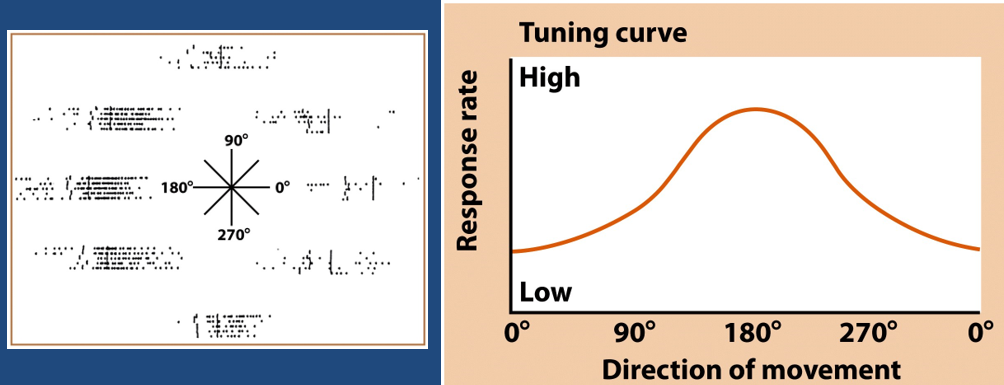
- 12If the cell fires at it's maximum rate, which direction does the hand move?180 degrees.
Peak of curve is maximum firing rate. - 13If cell fires at its maximum rate, which direction does the hand move?0 degrees.
Opposite to 180 degrees. - 14Which direction does the hand move when the cell fires at half its maximum rate?- Ambiguous, can't tell if it is 90 degrees, or 20 degrees, which are different directions.
- This is why you can't use a single cell.
- Need populations of cells. - 15Populations and direction vectors.- Using populations of cells and population vectors.
- Direction vectors are the arrows.
- Use direction vectors to look at the direction of the preferred values.
- 16Single neurons, firing of multiple cells, and population codes.- A single neuron does not provide all the information needed to predict the arm's movement - it is ambiguous.
- By looking at firing of multiple cells (a population) with different preferred values we can reduce ambiguity.
- This allows scientists to decode the planned action from the population activity and it demonstrates that planned/intended actions have a distributed representation using a population code.
- 17Georgopoulous and Colleagues- Carried out key early work on population coding.
- From early 80s onwards.
- This work has led directly to recent innovations in Brain-Machine interfaces and Neural Prostheses (e.g. by Schwarz and colleagues). - 18Neural Prostheses/Brain Machine Interfaces.- Work done by using this science.
- Help paralysed people regain movement by using their own thoughts.
- 19Pros of animal testing within this topic:- 3R's = keep the experiments ethical.
- Got through an ethics board (strict criteria) so must be the best it can be for the animal.
- Accelerating medical advancement.
- Significant medical advancement - benefits you may gain from experiment may change someone's life.
- Benefits may out way the cost from a human perspective.
- Successful animal testing may lead to more humans volunteering for first lot of human trials.
- If it was your loved one, you'd want to do whatever you could to help. - 20Cons of animal testing within this topic:- Still weighing one life as more important than another.
- If study is approved but don't find anything, the animals life has been wasted.
- Animals can't give consent.
- Animals may be feeling pain, but can't tell us.
Information
- Description
- Principles of neural representation.
- Created by
- Bethan Williams
- Views
- 4
- Rating
More on Computational Neuroscience and Neuron Models