
Flashcards
Single choice
Cards in this deck (146)
- 1Compaction ist eine Lösung für das Problem external fragmentationTRUE
- 2Eine Seitentabelle hilft beim Übersetzten von physischen Adressen in virtuelle AdressenFALSE
- 3Der Hauptvorteil einer zweistufigen Seitentabelle gegenüber einer einstufigen ist, dass die zweistufige nicht vollständig im Hauptspeicher gehalten werden muss(TRUE ?)
The primary advantage of multilevel page tables: the amount of memory needed for the page table is not dictated by the size of the address space, but by the amount of memory that the process is using. - 4Eine Inode ist ein Eintrag in einem Unix Dateisystem, der einer Datei eindeutig zugeordnet istTRUE
- 5Jeder Thread hat seinen eigenen (virtuellen) RegistersatzTRUE
- 6Einen Deadlock kann man auch durch inkorrekte Verwendung von Semaphoren erzeugenTRUE
- 7Der Kernel-Mode ist ein Modus des BetriebssystemsFALSE
(der CPU) - 8In der Intel-Architektur enthält das CR3-Register die Startadresse der Segmenttabelle/
- 9Relocation can be implemented using base/limit registersTRUE
- 10Virtual Memory can be implemented using software onlyFALSE
- 11The used bit and the dirty bit cannot both be set to 1FALSE
- 12The ELF format is a format for storing Exended Long FilesFALSE
- 13Adding more memory to a computer will make it seem to "run faster"TRUE
- 14There is no such thing as "address space layout randomization"FALSE
- 15Thrashing in a virtual memory system is caused by too many processes not having their working set resident in memoryTRUE
- 16The return value of a successful exec()-system call is always > 0FALSE
A successful exec()-system call never returns - 17Global variables are not shared accross multiple threads belonging to the same processFALSE
- 18Starvation is the case when a thread can never aquire a lock on a critical sectionTRUE
- 19A smaller page size leads to more TLB missesFALSE
- 20Whenever a thread reference a part of the virtual address space that is not currently loaded in the primary memory, the OS suspends execution and loads the missing information from another portion of primary memory(FALSE ?)
- 21A thread should always be able to distinguish between being temporarily blocked and deadlockedFALSE
- 22Early in his career, Elvis Presley was told: "Stick with driving a truck, because you'll never make it as a singer"TRUE
- 23It is possible for multithreading to improve the performance of an application in a single CPU systemTRUE
- 24In general, there are more inodes than directories on a linux-file-systemTRUE
- 25The use of a TLB eliminates the need for keeping a page table in memoryFALSE
- 26Disabling Interrupts is no solution for ensuring mutual exclusion in user spaceTRUE
- 27The term "monitor" has nothing to do with operating systems beyond the fact that it is used to display stuff on itFALSE
- 28To wait on something inside monitor, condition variables are availableTRUE
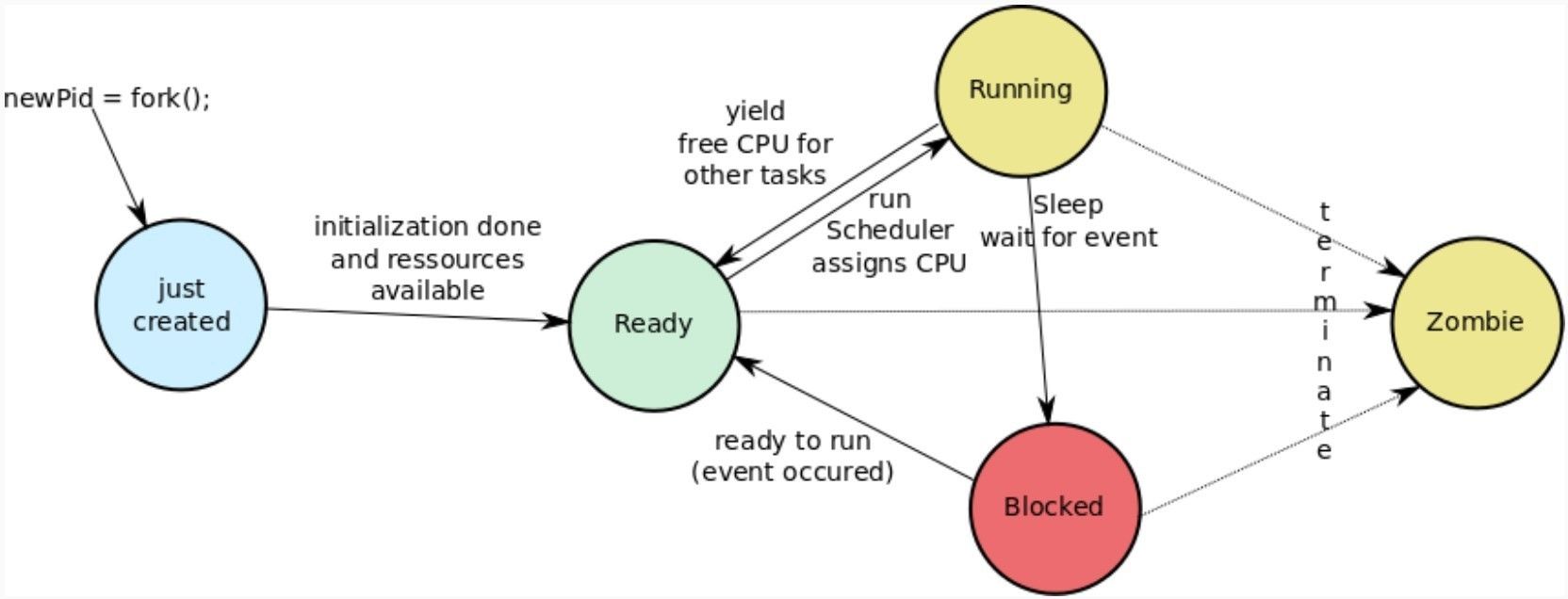
- 29The state of a thread changes from READY to RUNNING when the thread has been ready long enoughFALSE
- 30The state of a thread never changes from READY to BLOCKEDTRUE
- 31A MIPS processor does not use page tablesTRUE
Software-filled TLB instead of page tables - 32When using the page-tables method: if linear address A is higher than linear address B, the physical address of A is not necessarily higher than the physical address of BTRUE
- 33When threads are implemented in kernel space, we do not need to switch the memory configuration when switching between two threads of the same processTRUE
- 34Ensuring mutal exclusion in critical sections is a way to get rid of the race condition problemTRUE
- 35With the Test-and-Set-Lock-instruction one can implement an atomic operation/
- 36Copy On Write is a principle that speeds up the process creationTRUE
- 37The OS resets the used bit (to 0)TRUE
- 38An operation that cannot be interrupted is called atomicTRUE
- 39It takes more effort to create a new thread than to create a new processFALSE
- 40A memory management unit is responsible for managing the user space memoryFALSE
- 41CPU utilization tends to be higher when there are more processes in memoryTRUE
- 42"Safe state" means that it is unlikely a deadlock will occurFALSE
- 43A virtual address consists of a page frame number, a page table number and a page sizeFALSE
- 44In contrast to a single-level page table, multilevel page tables result in slower page table lookupsTRUE
- 45Multilevel page tables allow processes to share regions of memory while single-level page tables do notFALSE
- 46Page-based virtual memory is subject to external fragmentationFALSE
External fragmentation is the various free spaced holes that are generated in either your memory or disk space. - 47In a conventional paging system, a page table entry (PTE) will not contain an illegal-page bitTRUE
- 48The page number in the 24-bit address 0xABCDEF with an 512-byte page size is 0xABCFALSE
- 49Semaphore operations need to be atomic to guarantee mutal exclusionTRUE
- 50A TLB miss will cause a page fault to occurFALSE
- 51A process executes faster when running in kernel mode than when running in user modeFALSE
- 52Because of page-base virtual memory, operating systems never need to worry about allocating contiguous pagesTRUE
- 53Switching among threads in the same process is more efficient than switching among processes(TRUE ?)
- 54A clock page replacement algorithm tries to approximate a Least Recently Used (LRU) algorithmTRUE
- 55Adding more memory to a computer will make it seem to "run faster"TRUE
- 56With paging the operating system can place any page of any process to any page frame in physical memoryTRUE
- 57The page table is set up by the MMUFALSE
- 58The dirty bit is set by the operating systemFALSE
by the hardware - 59Using mutual exclusion ensures that the system avoids deadlock(FALSE ?)
- 60The MMU resets the used bit (to 0)(FALSE ?)
- 61The POSIX execv() system call creates a new process(FALSE ?)
The exec() family of functions replaces the current process image with a new process image. - 62The operating system can (more or less) freely decide where in the virtual address space the stacl(s) are locatedTRUE
- 63There is no such thing as "address space layout randomization"FALSE
- 64There is no such thing as "address space layout duplication"TRUE
- 65With 64 bit addresses, only 48 bits are supported in current hardwareTRUE
- 66Each page table needs to have within it a reference to each page frame in the systemFALSE
- 67The base/limit register method provides relocation and protection(TRUE ?)
- 68The present bit is set by the MMUFALSE
- 69The accessed bit and the dirty bit cannot both be set to 1FALSE
- 70Single-level page tables allow processes to share regions of memory while multilevel page tables do notFALSE
- 71Multilevel page tables are used because they allow to translate multiple levels of addresses in parallelFALSE
- 72In a conventional paging system, a page table entry (PTE) will not contain the age of the pageTRUE
- 73Page-based virtual memory is subject to internal fragmentationTRUE
- 74When a thread can never acquire a lock on a critical section we call that "starviation"TRUE
- 75For a machine with 32-bit addresses, the use of a two level page table allows for a larger virtual address space than a single level page tableFALSE
- 76Two-phase locking is a mechanism that prevents deadlock in database systemsTRUE
- 77Ignoring the deadlock-problem is a reasonable approach for a general purpose operating systemTRUE
- 78Potential deadlock involving preemtable resources can be solved by reallocationTRUE
- 79When a process supports EPT (Extended Page Table), it is able to handle the guest- and the host page table simultaneouslyTRUE
- 80When a VMM does binary translation, it continuously reads program code before it is executed, looks for relevant commands and changes them on the fly(TRUE ?)
- 81The Virtual-Machine-Concept was invented around 2003FALSE
- 82On a classical UNIX-System, an inode contains all the information on a fileFALSE
- 83The inode link-count indicates how often a file is referenced within the file-systemTRUE
A link count telling how many hard links point to the inode - 84A logical journal writes only metadata into the journalTRUE
- 85The cow-concept is also used in file-systemsTRUE
- 86A critical section is a piece of code which, when concurrently executed by multiple threads, may produce results that depend on the order these threads are executedTRUE
- 87When a user program is running, the CPU will be in supervisor mode since it is supervising the programFALSE
- 88A successful exec()-system call never returnsTRUE
- 89All threads of a process share single address spaceTRUE
- 90A critical section is any piece of code that is protected by a mutexFALSE
- 91The TWELVE format is a format for storing binary programmsFALSE
- 92User Mode and Kernel (or Supervisor) Mode are two modes of operation of a processorTRUE
- 93Since there is only one operating system running, there are no concurrency issues in operating system codeFALSE
- 94One cannot implement monitors using semaphoresFALSE
(One can not implement semaphores using monitors = TRUE) - 95A smaller page size leads to smaller page tablesFALSE
- 96Get the cosine of a number is best implemented as a system callFALSE
- 97Semaphore are a good method to prevent deadlocksFALSE
- 98The dirty bit is set by the MMUFALSE
- 99A memory management unit translates virtual to physical addressesTRUE
- 100The MMU resets the accessed bit when the page has not been accessed for a whileFALSE
- 101Address space layout randomization is meant to improve securityTRUE
Address space layout randomization (ASLR) is a memory-protection process for operating systems (OSes) that guards against buffer-overflow attacks by randomizing the location where system executables are loaded into memory. - 102Each file in NTFS is represented by a variable-depth tree of extents(TRUE ?)
- 103In a COW file system, if we update a block, we write it and all the blocks on the path from it to the root to new locationsTRUE
- 104FFS places data to optimize for the common case where a file's data blocks and meta data and different files from the same directory are accessed togetherTRUE
- 105The FAT file system lacks support for modern reliability technologyTRUE
lack of modern reliability techniques - 106One cannot implement semaphores using monitorsTRUE
- 1073072 cannot be a valid page sizeTRUE
- 10832 cannot be a valid page sizeFALSE
- 109A logical address of 0xA3213456 on a 32-bit page-based virtual memory system with 4KB pages has the offset 0x3456FALSE
4KB pages - 12 bit offset -> offset would be 0x456 - 110A monitor is one solution to solve the mutual exclusion problemTRUE
- 111A program containing a race condition will always result in data corruption or some other incorrect behaviorFALSE
- 112A program containing a race condition will never result in data corruption or some other incorrect behaviorFALSE
- 113A program containing a race condition will sometimes result in data corruption or some other incorrect behaviorTRUE
- 114A race condition occurs when the outcome of processes is dependent on the exact order of execution among them.TRUE
- 115A race condition occurs when a process cannot make progress because another one is blocking itFALSE
- 116The working set model is used to compute the average number of frames a job will need in order to run smoothly without causing thrashingFALSE
- 117The FAT file system does not support hard linksTRUE
No hard links - 118When the link count in an inode becomes 0, the file can be deletedTRUE
Inode link-count 0:
- no more reference within file system
- file can be deleted - 119In NTFS, the MFT contains at least one nonresident data attribute for each fileFALSE
- 120In NTFS, a file may have multiple file name attributesTRUE
NTFS: File name and file number of parent directory may have multiple file name attributes (hard link) - 121COW file systems never overwrite existing data or metadataTRUE
- 122COW file systems perform better, because they gain from converting small random writes to large sequential onesTRUE
- 123A ZFS file-system is limited to one physical deviceFALSE
- 124Google, Amazon etc. estimate they lose 5%-10% of their customers if their response time increases by 100 millisecondsTRUE
- 125If tasks are equal in size, round robin schedule will have very good average response time(FALSE ?)
- 126A user-level process cannot modify its own page table entriesTRUE
- 127By manipulating the assignment of tasks to priority queues, an MFQ scheduler can achieve a balance between responsiveness, low overhead and fairnessTRUE
- 128The scheduler is the part of the operating system that determines the priority of each process(FALSE ?)
- 129A TLB is needed for correct execution of a programFALSE
- 130Each physical page belongs to only one processFALSE
- 131Every interrupt changes the CPU from user mode to kernel modeTRUE
- 132The VFS layer handles journalling for Very Large File SystemsFALSE
virtual file system layer - interface allowing to use different file systems - 133Shortest Job First (SJF) or Shortest Completion Time First (SCTF) schedule is difficult to build on real operating systemsTRUE
SJF Downsides: impossible to implement - 134The operating system has to reset the accessed bit when the page has not been accessed for a whileFALSE
- 135The kernel is mapped into each user-level application process address space in order for applications to access the kernel's data convenientlyFALSE
- 136In 32-bit x86 with paging turned on a machine instruction auch as "mov 0x02000000, %eax" could potentially involve three accesses to memory(TRUE ?)
- 137On x86, upon a TLB miss, the kernel traverses the 2-level page table to fill in the virtual to physical access mapping in the TLBFALSE
- 138Reading a random location in a big file is usually faster in an inode-based file-system than in a FAT file systemTRUE
FAT: Poor random access -> need to traverse FAT - 139For better sequential read/write performance, a file system should try to allocate consecutive blocks to a file(TRUE ?)
- 140A guest OS kernel can't access the code and data of the VMM (such as the shadow page table)(TRUE ?)
- 141A hard link is indistinguishable from the original file itselfTRUE
A hard link to a file is indistinguishable from the original name for the file; there's no particular link that is more the "real name" for the file than any other. - 142COW file systems overwrite metadata onlyFALSE
- 143System calls do not change the Fpriviledge-level of the processorFALSE
- 144In practice, all 64 bits are used with IA-64 addressingFALSE
- 145A physical address space is at least as large as a virtual address spaceFALSE
- 146A smaller page size leads to larger page tablesTRUE