
Flashcards
Unit 1 Review - Kinematics Ap Physics 1
Cards in this deck (53)
- 1Frame of ReferenceA framework that is used for the observation and mathematical description of physical phenomena and the formulation of physical laws.
- 21. Dynamics 2. Kinematics1. explains the causes of motion
2. Describes motion - 3DistanceHow far an object moves/total ground it covers (scalar quantity)
- 4Scalar QuantityDefined by magnitude or volume
- 5Displacement(x) Distance and direction with respect to the origin
- 6Vector QuantityRequires magnitude and direction
- 7Average SpeedDistance per time
- 8Equation for speedS=(d/t)
- 9Average Velocity (v)Displacement per time
- 10Change in Displacement Formula∆x=(xf)-(x0)
- 11Equation for VelocityV=((∆x)/t)
- 12Constant Displacement∆x=0, v=0
- 13Constant VelocityLinear relationship where x changes with respect to time. Positive velocity moves forward, up, or right. Negative velocity moves backward, down, or left.
- 14Displacement Formula∆x=v*t
- 15Acceleration (a)A change in velocity over a time interval.
- 16When is an object speeding up?When velocity and acceleration have the same sign.
- 17When is an object slowing down?When velocity and acceleration have opposite signs.
- 18Equation for Accelerationa=((∆v)/t)
- 19Equation for Change in Velocity∆v=(vf)-(v0)
- 20Constant AccelerationThe velocity changes regularly with respect to time. Since the velocity is changing, the slope must change, causing for a curved line (parabolic relationship).
- 21What does the slope of a velocity graph tell you?The acceleration of that object.
*remember that you can solve by using the units to figure out the relationship
(velocity vs time graph: v=m/s t=s thus, acceleration is v/t = m/s^2) - 22What does the area under the curve of a velocity graph tell you?The displacement of an object.
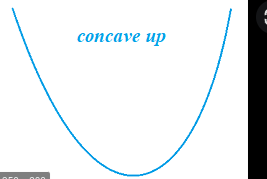
- 23A graph that is concave up has (...) accelerationPositive
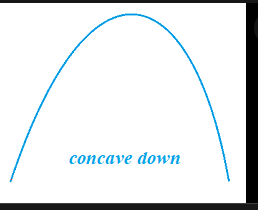
- 24A graph that is concave down has (...) accelerationNegative
- 25What equation uses... V0 ∆x 1/2 Vf t∆x=.5((v0)+(vf))t
- 26What equation uses... V0 t a t^2 ∆x .5∆x=((v0)t) + .5at^2
- 27What equation uses... a Vf t V0Vf=(v0) + at
- 28What equation uses... V0^2 2 Vf^2 ∆x aVf^2=(v0^2)+2a∆x
- 29Free FallObject acts under the influence of gravity alone. Assumes air resistance is negligible. Gravity is a constant force.
- 30What is the acceleration due to gravity?g=-9.8 m/s^2
- 31For free fall, what can you do to the equations to constant acceleration?Substitute -9.8 in for a. Substitute ∆y in for ∆x (height).
- 32What is always important to remember of the x and y planes?They are independent of each other.
- 33Horizontal Component (x)Constant Velocity
- 34Vertical Component (y)Constant acceleration due to the force of gravity
- 35Why is the path of a projectile always a parabola?∆x remains constant (constant velocity) while ∆y changes exponentially (due to acceleration)
- 36Constant Velocity Trigonometric EquationVx=(V0)*cos(Θ)
- 37Initial Velocity Trigonometric EquationV0y=(V0)*sin(Θ)
- 38X-MotionConstant velocity. Definition of Velocity Equation: ∆x=(Vx)t
- 39Y-MotionConstant acceleration due to gravity. Free fall equations.
- 40What is the only similar thing between the x and y planes?time
- 41Range (∆x)Horizontal displacement. It is dependent on the launch velocity and angle (Vx)
- 42What angle allows for maximum range?45º
- 43Complimentary AnglesSum of two angles is 90º.
- 44Velocitydisplacement over time
dis/time - 45AccelerationChange in velocity / Time
a = Δv/Δt
simple ex.: a= Vf-Vi/t - 46Horizontal Variables
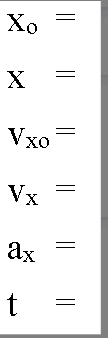
- 47Horizontal Kinematic Equations
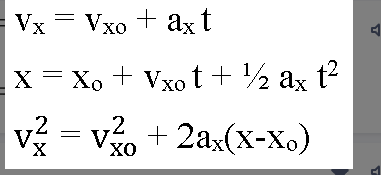
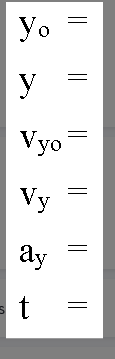
- 48Vertical Variables
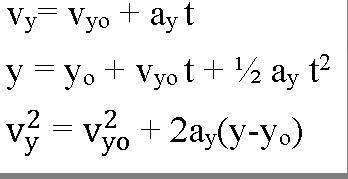
- 49Vertical Kinematic Equations
- 50ProjectileAn object that is thrown or launched (up or down or onto)
- 51ParabolaThe shape of a projectile's trajectory
- 52TrajectoryThe path an object follows
- 53YOU GOT THIS !!!!- https://www.youtube.com/watch?v=3BE33aceKvE&list=PLzTqBfZ51K25epbid3AD8QsEneV39aiZJ&index=11
- https://www.albert.io/ap-physics-1/overview
http://wsapphysics.weebly.com/quizlet.html
Information
- Description
- Kinematics of unit 1 -terms -formulas - simple examples - simple diagrams - key reminders to remember - extra yt video resources
- Created by
- Mia Parker
- Views
- 12
- Tags
- Rating