
Flashcards
Nanotechnology
Cards in this deck (31)
- 1What is nanoscale science and physics?The science/physics of phenomena occurring at a scale of 1 to 100nm.
- 2What is nanotechnology?The understanding and control of matter at dimensions of 1-100nm.
- 3What is the nano length scale between?Atomic and bulk behaviour
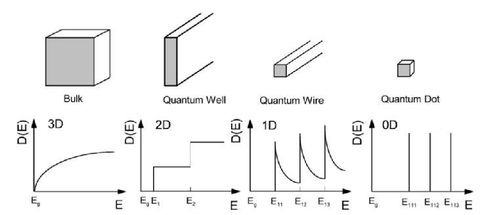
- 4What is a quantum dot?3D confinement
- 5What is a quantum wire?2D confinement
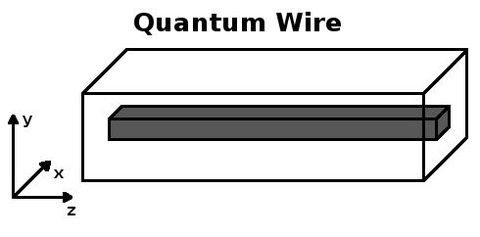
- 6What is a quantum well?1D confinement
- 7Draw picture and D(E) graph for quantum dot, wire and well.
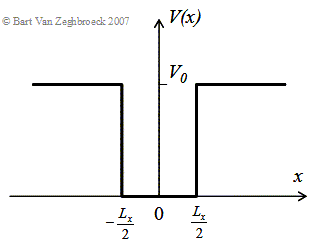
- 8What can be determined by the particle in a box model?New electronic and optical properties determined by size, shape and composition.
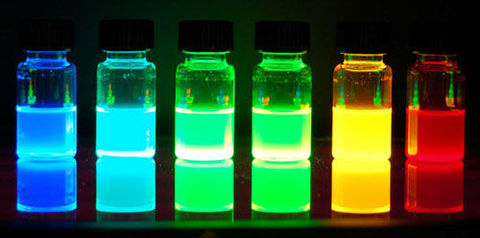
The size of the box must be similar to the de Broglie wavelength of the particle. - 9What are colloidal quantum dots?The photoluminescence of the quantum dot (CdTe nanocrystal) is exclusively determined by the size.
This makes then tunable absorbers/emitters in imaging.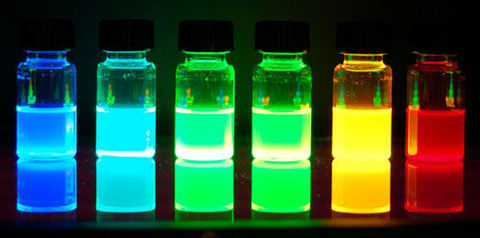
- 10Semiconductor nanowires can be used as...heterojunction solar cells, as are a good interconnector
- 11Semiconductor quantum well can be used in...laser diodes, due to it's 2D structure with tuneable optical and electronic properties.
- 12What are metal nanoparticles?-They exhibit collective oscillations of conduction band electrons
-"plasmons"
-large enhancement and localisation of EM fields at optical frequencies
-applications in spectroscopy and microscopy - 13Why are nanostructures different from the bulk?-quantum confinement
-large surface-to-volume ratio
-small size - 14Why are nanostructures different from the bulk? Quantum Confinement...QC reduces the number of vibrational electronic states to discrete levels, this causes band gap widening and changes in optical, electronic and electrical properties.
- 15Why are nanostructures different from the bulk? Large surface-to-volume ratios...enhanced chemical reactivity
lower melting points - 16Why are nanostructures different from the bulk? small size..Structural relaxations
more likely to be defect free resulting in enhanced mechanical properties -> stronger materials
improved electrical properties-> better conductivity
Particle comparable to bloch length in magnetic materials
single domain per particle - 17How many atoms are there in a 5nm diameter nanocrystal? Assume lattice constant (d)=0.5nm cubic latticeSphere volume= pi/6 d cubed
=1/2 125 nm3
unit cell is 125E-3 nm3
Divide
500 atoms - 18What is driving nanotechnology?Science ie curiousity
Technological Imperatives ie sustainable energy
Revolutionary Promises ie targeted medicine - 19What is Moore's Law?Number of transistors on a chip doubles every 18-24 months.
Will reach molecular scale by 2020, when quantum effects will become important.
Leakage Currents & Heating. - 20Electrostatic InteractionsOccurs between atomic and molecular ions
Is responsible for binding in ionic solids (NaCl)
Mediated by coulomb interaction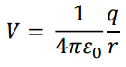
- 21Covalent BondsDirecting bonding between atoms mediated by valence electrons
H2+ ion - 22Van-der-waals ForceThe residual attractive of repulsive forces between molecules that do no arise from covalent bonding of electrostatic interaction.
Molecules with permanent dipole moments
Hydrogen Bonding - 23Dipole-DipoleThe potential for interaction between two permanent dipoles
This allows rotation and averaging over Boltzmann distribution
Hydrogen Bonds are dipole-dipole interactions - 24Permanent dipole-induced dipole interactionThe Debye Force
Permanent dipole induces dipole in polarisable molecule and interacts with it - 25Induced dipole-induced dipole interactionThe London Dispersion Force
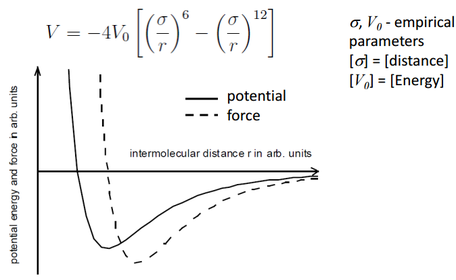
In nearby polarizable molecules, electron densities show correlations that induce dipoles which interact - 26Describe and draw the Lennard-Jonas potenial.This combines the vdw force with short-range Pauli repulsion
- 27Metallic BondingConduction band electrons in metals are delocalised between ionic cores.
This shields core repulsion and provides attractive potential.
Cu - 28What is the density of states?The number of available states per energy interval.
- 29Give two examples of what D(E) defines:the metallic conductivity and the specific heat.
- 30What is electron transport?In a free electron gas, electrons are accelerated by the electric and magnetic fields according to the lorentz field.
- 31What happens in transport through a single channel?There is no scattering, so the conductivity will be quantised.
Information
- Description
- Masters Physics Flashcards on Nanotechnology, created by emmalmillar on 11/12/2015.
- Created by
- emmalmillar
- Views
- 122
- Rating