
Flashcards
WJEC Statistics 1 - Key Facts
Cards in this deck (38)
- 1What does it mean if events A and B are mutually exclusive? Also, \(P(A\cap B)=?\)Events A and B cannot happen at the same time. \[P(A\cap B)=0\]
- 2What does it mean if events A and B are independent? Also, \(P(A\cap B)=?\)If A happens, this does not affect the probability of B happening (and vice versa). \[P(A\cap B)=P(A) \times P(B)\]
- 3\[P(A|B)=?\] (there is a rearranged version of this given in the formulae book)\[P(A|B)=\frac{P(A\cap B)}{P(B)}\]
- 4If events A and B are independent, then \(P(A|B)=?\)\[P(A|B)=P(A)\]
- 5If events A and B are independent, then \(P(B|A)=?\)\[P(B|A)=P(B)\]
- 6The addition law for events A and B is \[P(A\cup B)=?\] (given in formulae book)\[P(A\cup B)=P(A)+P(B)-P(A\cap B)\]
- 7\[P(A')=?\]\[P(A')=1-P(A)\] \(A'\) is called the complement of \(A\) and \(P(A')\) is the probability of \(A\) not happening
- 8For events A and B that are NOT independent, \[P(A\cap B)=?\]\[\begin{align*}
P(A\cap B)&=P(A)\times P(B|A)\\
& =P(B)\times P(A|B)
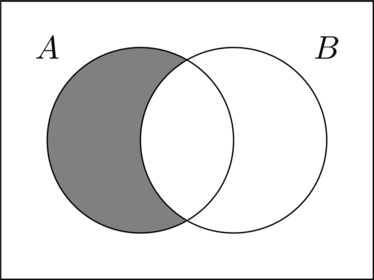
\end{align*}\] - 9Describe this shaded area using set notation\[A\cap B'\] or \[B'\cap A\]
- 10What is a sample space?The set of all the possible outcomes of a random experiment
- 11How many unordered samples of size \(r\) can be taken from a collection of \(n\) objects?\[nCr=\binom{n}{r}=\frac{n!}{r!(n-r)!}\] make sure you know how to get your calculator to do this
- 12For any discrete random variable \(X\),\[\text{E}(aX + b) = ?\]\[\text{E}(aX + b) = a\text{E}(X) + b\]
- 13For any discrete random variable \(X\),\[\text{Var}(aX + b) = ?\]\[\text{Var}(aX + b) = a^2 \text{Var}(X)\]
- 14For a discrete random variable \(X\) taking values \(x_i\) with probabilities \(p_i\), \[\text{E}(X)=?\] (given in formulae book)\[\text{E}(X)=\sum x_i p_i \]
- 15For a discrete random variable \(X\) taking values \(x_i\) with probabilities \(p_i\), \[\text{Var}(X)=?\] (given in formulae book)\[\begin{align*}
\text{Var}(X)&=\sum x_i^2 p_i -\mu^2\\
&=\text{E}(X^2)-(\text{E}(X))^2
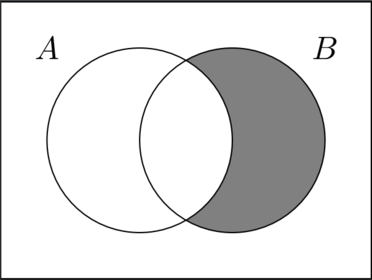
\end{align*}\] - 16Describe this shaded area using set notation\[A'\cap B\] or \[B\cap A'\]
- 17Give the formula for the expected value of a function \(g(X)\) of a discrete random variable (given in formulae book)\[E[g(X)]=\sum g(x) P(X=x)\]
- 18\[X \sim B(n,p)\] \(\text{E}(X)=?\) (given in formulae book)For the binomial distribution \(X \sim B(n,p)\), \(\text{E}(X)=np\)
- 19\[X \sim B(n,p)\] \(\text{Var}(X)=?\) (given in formulae book)For the binomial distribution \(X \sim B(n,p)\), \(\text{Var}(X)=npq=np(1-p)\)
- 20\[X \sim Po(\lambda)\] \(\text{E}(X)=?\) (given in formulae book)For the Poisson distribution \(X \sim Po(\lambda)\), \(\text{E}(X)=\lambda\)
- 21\[X \sim Po(\lambda)\] \(\text{Var}(X)=?\) (given in formulae book)For the Poisson distribution \(X \sim Po(\lambda)\), \(\text{Var}(X)=\lambda\)
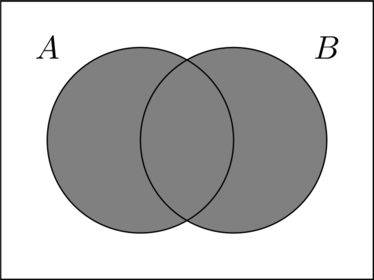
- 22Describe this shaded area using set notation\[A \cup B\] or \[B \cup A\]
- 23How would you use the Binomial or Poisson tables to find \(P(X=n)\)?\[P(X=n)=P(X\leq n)-P(X\leq n-1)\]
- 24How would you use the Binomial or Poisson tables to find \(P(X>n)\)?\[P(X>n)=1-P(X\leq n)\]
- 25How would you use the Binomial or Poisson tables to find \(P(X\geq n)\)?\[P(X\geq n)=1-P(X\leq n-1)\]
- 26How would you use the Binomial or Poisson tables to find \(P(X\[P(X
- 27For a continuous probability distribution, how are \(f(x)\) and \(F(x)\) related?\[f(x)=F'(x)\] \[F(x)=P(X\leq x)=\int _{-\infty} ^x f(t) \, \text{d}t\]
- 28If \(q\) is the lower quartile of a continuous random variable \(X\) with cumulative distribution function \(F\), then \[F(q)=?\]\[F(q)=P(X\leq q)=0.25\]
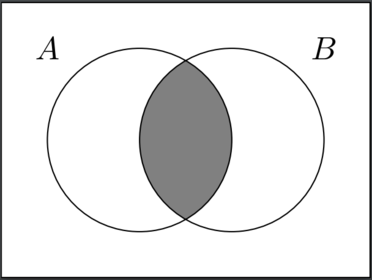
- 29Describe this shaded area using set notation\[A \cap B\]
- 30If \(m\) is the median of a continuous random variable \(X\) with cumulative distribution function \(F\), then \[F(m)=?\]\[F(m)=P(X\leq m)=0.5\]
- 31If \(Q\) is the upper quartile of a continuous random variable \(X\) with cumulative distribution function \(F\), then \[F(Q)=?\]\[F(Q)=P(X\leq Q)=0.75\]
- 32Give the formula for the expected value of a function \(g(X)\) of a continuous random variable (given in formulae book)\[E[g(X)]=\int g(x) f(x) \, \text{d}x\]
- 33For a binomial distribution \(X\sim B(n,p)\), what is the formula for \(P(X=x)\)? (given in formulae book)\[\binom{n}{x}p^x(1-p)^{n-x}\]
- 34For a Poisson distribution \(X\sim Po(\lambda)\), what is the formula for \(P(X=x)\)? (given in formulae book)\[e^{-\lambda}\frac{\lambda^x}{x!}\]
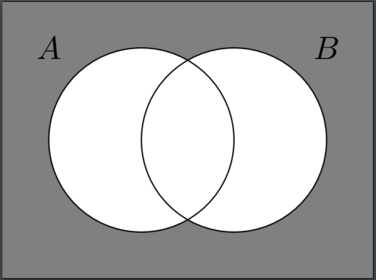
- 35Describe this shaded area using set notation in two ways\[A'\cap B'\] or \[(A\cup B)'\]
- 36How is variance related to standard deviation?\[\text{variance}=(\text{stand. dev.})^2\] OR \[\text{stand. dev.}=\sqrt{\text{Variance}}\]
- 37\[X\sim B(n,p)\] What values can \(X\) take?\[0, 1, 2, ..., n\]
- 38\[X\sim Po(\lambda)\] What values can \(X\) take?\[0, 1, 2, ...\]
(There is no maximum)
Information
- Description
- Key facts and formulae which must be known for the WJEC Statistics 1 examination.
- Created by
- Daniel Cox · Jun 2016
- Updated
- May 10, 2017
- Views
- 142
- Tags
- Rating