
Flashcards
2.5 - Enzymes
Cards in this deck (24)
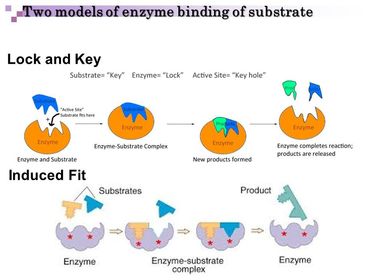
- 1What is an enzyme?A globular protein that increases the rate of biochemical reactions by lowering the activation energy threshold (i.e. a biological catalyst)
- 2What is an activation site?A region on the surface of an enzyme to which substrates bind and which catalyses the reaction.
- 3What is a substrate?Reaction in a biochemical reaction.
- 4Describe 3 examples of enzymes?Amylose: substrate = starch, product = glucose
Protease: substrate: plypeptides, product = amino acids
Lipase: substrate = triglycerides, product = glycerol & (3) fatty acids - 5What suffix is commonly applied to enzymes?Ase
- 6State the functions of polar regions of amino acids on the active site of the enzyme?The polarity of ‘R’ groups plays a role in the tertiary structure of globular proteins
Plays a role in shaping enzymes and their active site
Attracting substrates to the active site - 7Explain enzyme-substrate specificity and fit model of enzyme activity.
- 8What is meant by the term collision in enzyme catalysis?The coming together of a substrate molecule and an active site is known as a collision
- 9Explain why not all collisions between enzymes and substrates result in catalysis?The substrate may be at any angle to the active site when the collision occurs
Successful collisions are ones in which the substrate and active site happen to be correctly aligned to allow binding to take place - 10Why is the presence of water critical for most enzyme reactions?Most enzyme reactions occur when the substrates are dissolved in water.
All molecules dissolved in water are in random motion, with each molecule moving separately. - 11Why do enzymes tend to move more slowly than substrates?If not immobilised the enzyme can move too, however enzymes tend to be larger than the substrate(s) and therefore move more slowly
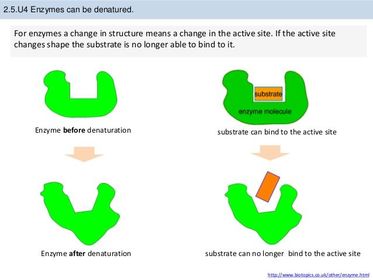
Enzymes are bigger than the substrate(s) - 12Explain how denaturation of an enzyme affects its ability to catalyse reactions?
- 13What effect does temperature have on the rate of an enzyme-controlled experiment?Increasing the temperature will increase the speed and motion of both enzyme and substrate
Higher kinetic energy will result in more frequent collisions between enzyme and substrate - 14Lower and optimal temperature on the rate of reactionLow temperatures result in insufficient thermal energy for the activation of a given enzyme-catalysed reaction to being achieved
At an optimal temperature (may differ for different enzymes), the rate of enzyme activity will be at its peak - 15What does a too hot temperature do to the rate of reaction?Higher temperatures = stability to decrease, as the thermal energy disrupts the hydrogen bonds holding the enzyme together.
This causes the enzyme (particularly the active site) to lose its shape, resulting in a loss of enzyme activity (denaturation) - 16What effect does pH have on the rate of an enzyme-controlled experiment?Alter the charge & shape of the enzyme.
Enzymes have an optimum pH and moving outside of this range will always result in a diminished rate of reaction
Different enzymes may have different optimum pH ranges - 17What effect does changing the shape or charge have on the enzyme?Changing the shape or charge of the active site will diminish its ability to bind to the substrate, halting enzyme function
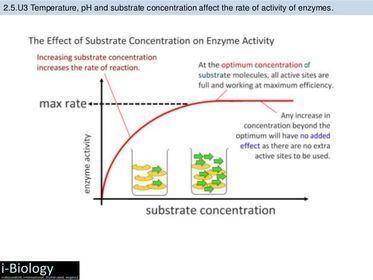
- 18What effect does substrate concentration have on the rate of an enzyme-controlled experiment?
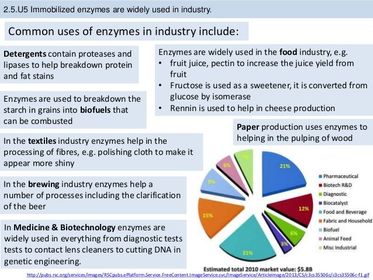
- 19List 8 commonly used enzymes in the industry?
- 20List 3 ways in which enzymes can be immobilised.Aggregations of enzymes bonded together
Attached to surfaces, e.g. glass
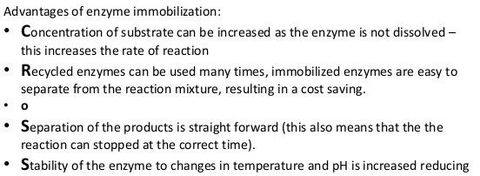
Entrapped in gels, e.g. alginate gel beads - 21What are the advantages of immobilising enzymes?
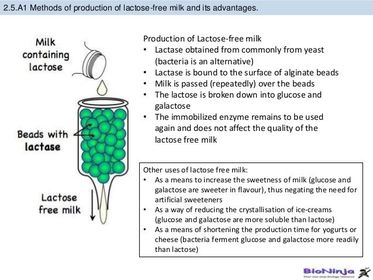
- 22List 3 commercial reasons that lactose free milk is produced.As a means to increase the sweetness of milk (glucose and galactose are sweeter in flavour)
As a way of reducing the crystallisation of ice-creams (glucose and galactose are more soluble than lactose)
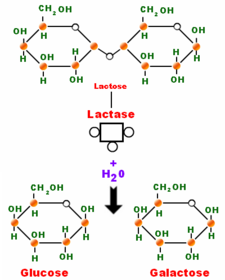
As a means of shortening the production time for yoghurts or cheese - 23Lactose structure C12H22O11
- 24Outline the process by which lactose-free milk is produced? immobilised enzymes
Information
- Description
- Like attracts like. Not endless you are Freud, then you are a mess.
- Created by
- CiNa Hicks
- Views
- 159
- Rating