
Flashcards
CISSP Cryptography and Symmetric Key Algorithms
Cards in this deck (34)
- 1What kind of cipher is the Caesar cipher?It is a substitution cipher
- 2What are the four fundamental goals of cryptography?confidentiality,
integrity,
authentication,
and nonrepudiation
but not all cryptosystems are intended to achieve all four goals - 3What is the purpose of confidentiality?To ensure that data remains private while at rest or in transit
- 4How may a cryptosystem enforce confidentiality?Through use of symmetric keys (shared secret key) or asymmetric keys (individual combinations of public and private keys for each user)
- 5What is the purpose of integrity?Ensures that data is not altered without authorization
- 6How to enforce integrity?Through the use of digital signatures
- 7What is the purpose of authentication?To verify the claimed identity of system users
- 8How is authentication enforced?Through use of a challenge-response authentication protocol
- 9What is the purpose of nonrepudiation?Nonrepudiation provides assurance to the recipient that the message was originated by the sender and not an imposter. It also prevents the sender from denying that they sent the message (aka repudiating the message).
- 10How is nonrepudiation enforced?Through the use of asymmetric cryptosystems
- 11What is the Kerchoff principle?That a cryptographic system must remain secure even if everything is known about it except for the key
- 12What is the difference between a private key and public key system?In a private key system all participants share a secret key,
in the public key system each participant has their own pair of keys (one public and one private) - 13What are the logical operations that can be performed in boolean mathematics?AND, OR, NOT, EXCLUSIVE OR,
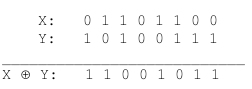
MODULO - 14What is the importance of the Exclusive OR (XOR) function and how is it performed?XOR is the most commonly used in cryptographic applications.
The XOR (⊕) returns a true value when only one of the input values is true. - 15How is the modulo function performed?The modulo function is also very important in cryptography. The modulo function (%) returns the remainder value after a division is performed.
- 16What is a one-way function?A one-way function is a mathematical operation where it is significantly easier to operate in one direction but is near impossible to compute in the inverse direction.
- 17What is nonce?Nonce (number used once) is a random number that acts as a placeholder variable in mathematical functions.
The nonce must be unique each time it is used and it is intended to prevent unauthorized replay or reproduction. - 18What is initialization vector (IV)?It is a nonce used for data encryption. It is used only once in any session to avoid repetition of sequences in encrypted text.
It is a random bit string that is the same length as the block size and is XORed with the message. It is used to create unique ciphertext every time the same message is encrypted using the same key. - 19What is zero-knowledge proof?Is a method by which one method can prove to another party that a statement is true without conveying any information other than the statement is true.
- 20What is a transposition cipher?Transposition ciphers use an encryption algorithm to rearrange the letters of a plaintext message to form the ciphertext message.
- 21What is a one-time pad?One-time pads is a powerful type of substitution cipher. They use a different substitution alphabet for each letter of the plaintext message.
- 22What is a running key ciphers (aka book cipher)?A type of polyalphabetic substitution cipher in which a text is used to produce a very long keystream
- 23How does symmetric key algorithms work?A shared secret encryption key
- 24Symmetric key weaknesses:the need for a secure method of exchanging key,
does not implement nonrepudiation,
difficult for large groups to communicate using symmetric key cryptography,
not scalable as each possible combination of users must share a private key,
keys must be discarded as each time a participant leaves the group and then regenerated - 25Symmetric key strengthsymmetric key cryptography operates at high speed, often 1000x faster than asymmetric key algorithms
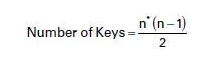
- 26Formula to calculate the total number of keys required to completely connect n parties using symmetric cryptography
- 27Major strengths of asymmetric key cryptographyvery scalable as adding new users will only require adding one key pair each, regeneration only required if a user's private key if it is compromised,
provides integrity, authentication and nonrepudiation,
key distribution is simple - 28Common hashing algorithmsMessage Digest 2 (MD2),
Message Digest 5 (MD5),
Secure Hash Algorithm
(SHA-0, SHA-1, SHA-2),
Hashed Message Authentication Code (HMAC) - 29Common symmetric cryptosystemsData Encryption Standard (DES),
Triple DES (3DES),
International Data Encryption Algorithm (IDEA),
Blowfish,
Skipjack,
Advanced Encryption Standard (AES) - 30What is DES?Published by the US government as a standard cryptosystem. Flaws in the algorithm caused it to no longer be considered secure.
- 31How does DES work?It is a 64-bit block cipher that has 5 modes of operation. The key used is 56 bits long (actually 64-bit but only 56 contain key info, the other 8 has verification info about the key).
DES uses a long series of XOR operations to generate the ciphertext in 16 passes. - 32What are the 5 modes of operation in DES?Electronic Codebook mode (ECB),
Cipher Block Chaining ode (CBC),
Cipher Feedback mode (CFB),
Output Feedback mode (OFB),
Counter mode (CTR) - 33What is Zero-knowledge proof?A benefit of cryptography where one entity can prove knowledge of a fact to a third party without revealing the fact itself to that third party.
- 34NonceA nonce is a random number or variable only used once