
Flashcards
Advanced computing technologies
Cards in this deck (49)
- 1What is the Grid?A computational grid is a hardware and software infrastructure that provides dependable, consistent, pervasive and inexpensive access to high-end computational facilities.
- 2What is the purpose of the Grid?Resource sharing and coordinated problem solving in dynamic, multi-institutional virtual organisation.
- 3How does the Grid work?- "On-demand" access to ubiquitous distributed computing
- Transparent access to multi-petabyte distributed data bases
- Easy to plug resources into
- Complexity of the infrastructure is hidden
(analogy to electric grid system) - 4Give one application on the Grid.Globus Project - Research on Grid technologies
BlueGrid (IBM) - Grid testbed linking IBM laboratories
Earth System Grid (ESG) - large climate datasets for the climate research
GridLab - grid technologies and applications - 5Grid - challenging technical requirements- Dynamic formation and management of virtual organisation.
- Online negotiation of access to service: who, what, why, when, how
- Establishment of applications and systems able to deliver multiple qualities of service
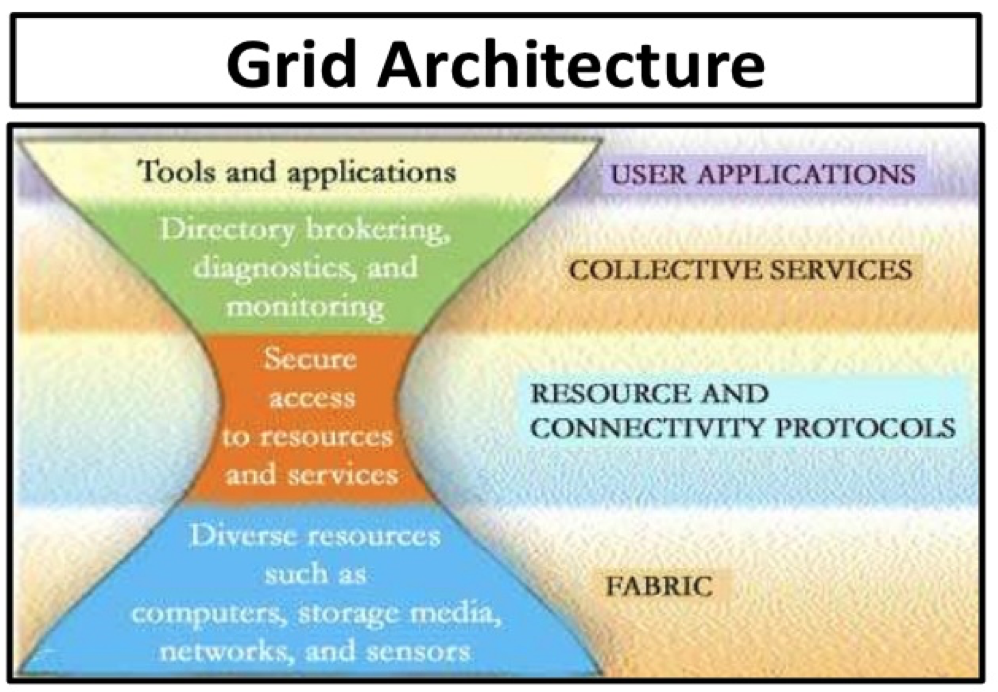
- Autonomic management of infrastructure elements - 6Grid structure
- 7What is the Virtual Organisation in terms of Grid concept?Concern not only about the file sharing, but rather direct access to computers, software, data and other resources, as is required by a range of collaborative problem-solving and resource- brokering strategies emerging in industry, science, and engineering. Institutions defined by such sharing rules form can be call Virtual Organisation.
- 8Discuss the benefits of the Grid infrastructure and outline the application areas.Geographically distributed problem solving and resource sharing.
Army, weather forecasting - can join the grid on demand no matter on the location.
Unlike clusters, each node of Grid computers is set to perform variety task. - 9Discuss how a user submits a task to the Grid platform.Users job is first submitted to its broker and the broker then schedules the parametric tasks according to the user's scheduling policy. Before scheduling the tasks, the broker dynamically gets a list of available resources from the global directory entity.
- 10List the different types of resources available on the Grid platform.The computing environments comprise heterogeneous resources (PCs, workstations, clusters, and supercomputers), fabric management systems (single system image OS, queuing systems, etc.) and policies, and applications (scientific, engineering, and commercial) with varied requirements (CPU, input/output (I/O), memory and/or network intensive)
- 11Give two applications suitable for the Grid and explain briefly why.?
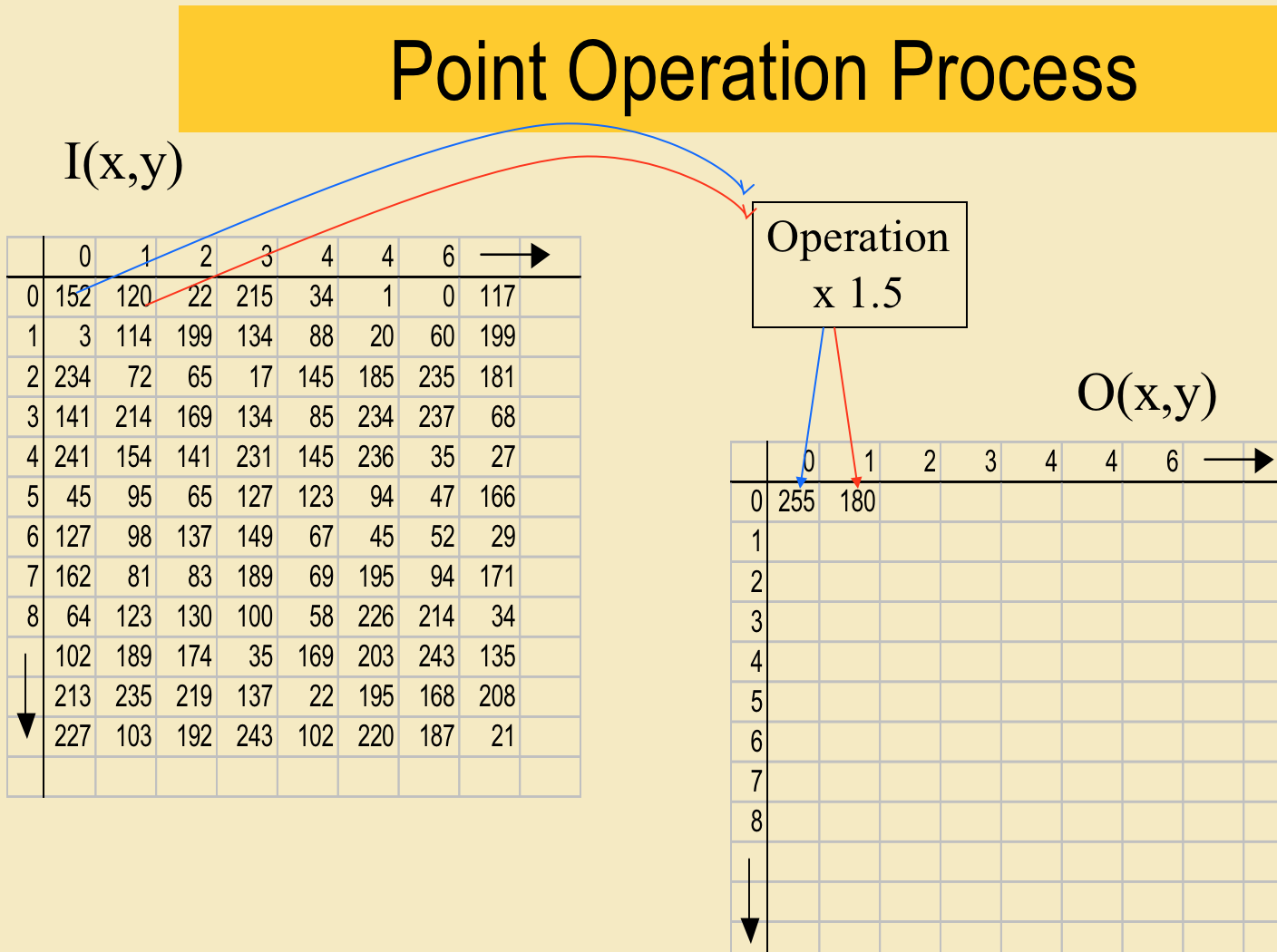
- 12Explain point operations and the process of applying point operations in image processing.- Primarily used to change the perceived or viewed optical densities or colours and the perceived or viewed image contrast
- Operates on individual pixels and does not take into account any neighbouring pixel values
- Starting at the top left of the image, to calculate the new (output) pixel value and place this at the same spatial location in a new (output) matrix of the same dimension as the original image, then then moves to the pixel to the right . - 13Give an example of applying a point operation on an image size 5 x 5. Your example should contain the input and output images as well as the point operation.O(x,y) = M . I(x,y) where M is the mapping function or operation, O is output img and I is inout img
- 14Discuss the characteristics and use of a “low pass filter” in image processing.- Generally smooth or blur the edges of an image
- Called “Low Pass” as these filters have little or no effect on low frequency area, large smooth objects, in the image.
- Amount of smoothing / blurring will
a) depend on values in the filter
b) generally increase blurring as filter size increase - 15Discuss the characteristics and use of a “high pass filter” in image processing.- Enhance or “sharpen” of the edges in an image or detect the edges in the image
- Called “High Pass” as these filters have an effect on the high frequency areas ie. edges or boundaries in the image.
- Amount of enhancement will depend on values in the filter and filter size
-Enhancement / detection will depend on the sum value of the filter - 16Draw a diagram to illustrate the simple stenographic system showing its basic components (1).
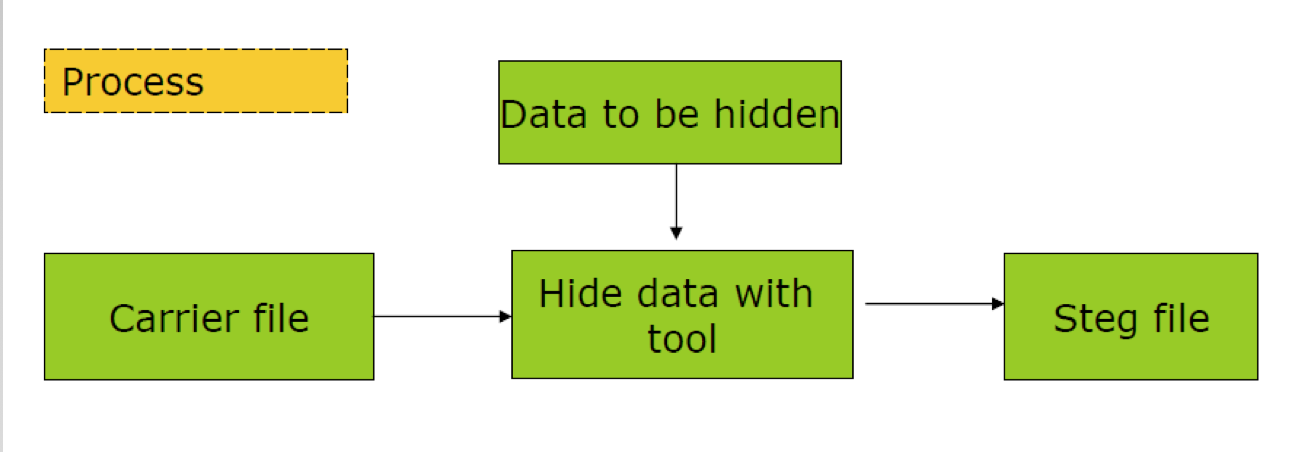
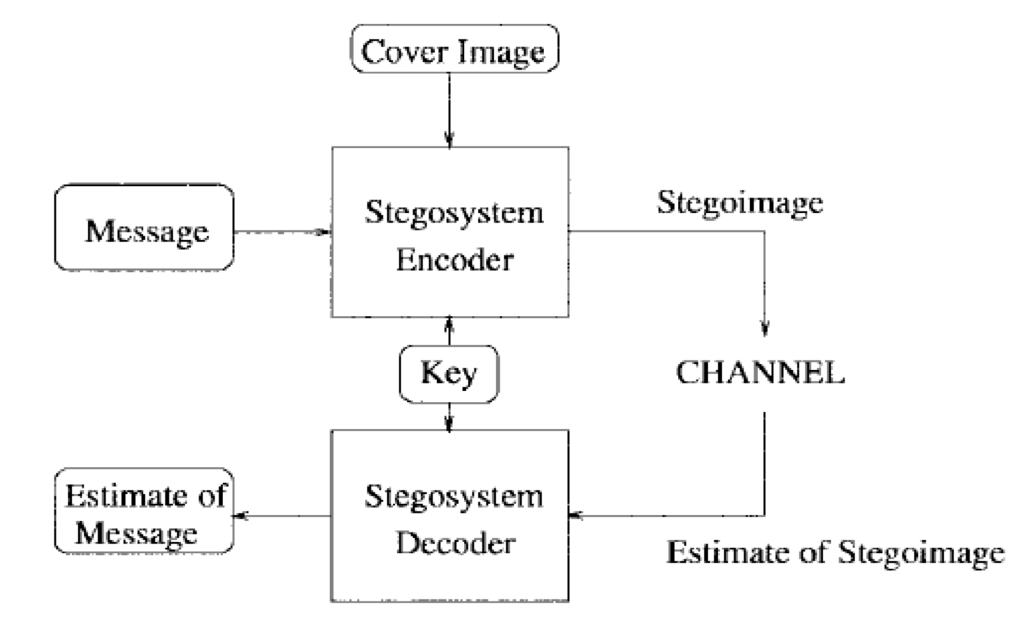
- 17Steganography - definitionSteganography is the science that aimed at communicating secret data in an appropriate multimedia carrier, such as: images, texts and audio.
- 18Draw a diagram to illustrate the simple stenographic system showing its basic components (2).
- 19Difference between cryptography and steganography.In cryptography the message is encrypted, visible, but not readable.
In steganography the message is embedded, readable, but not visible. - 20DBMS, OLAP, Data Mining
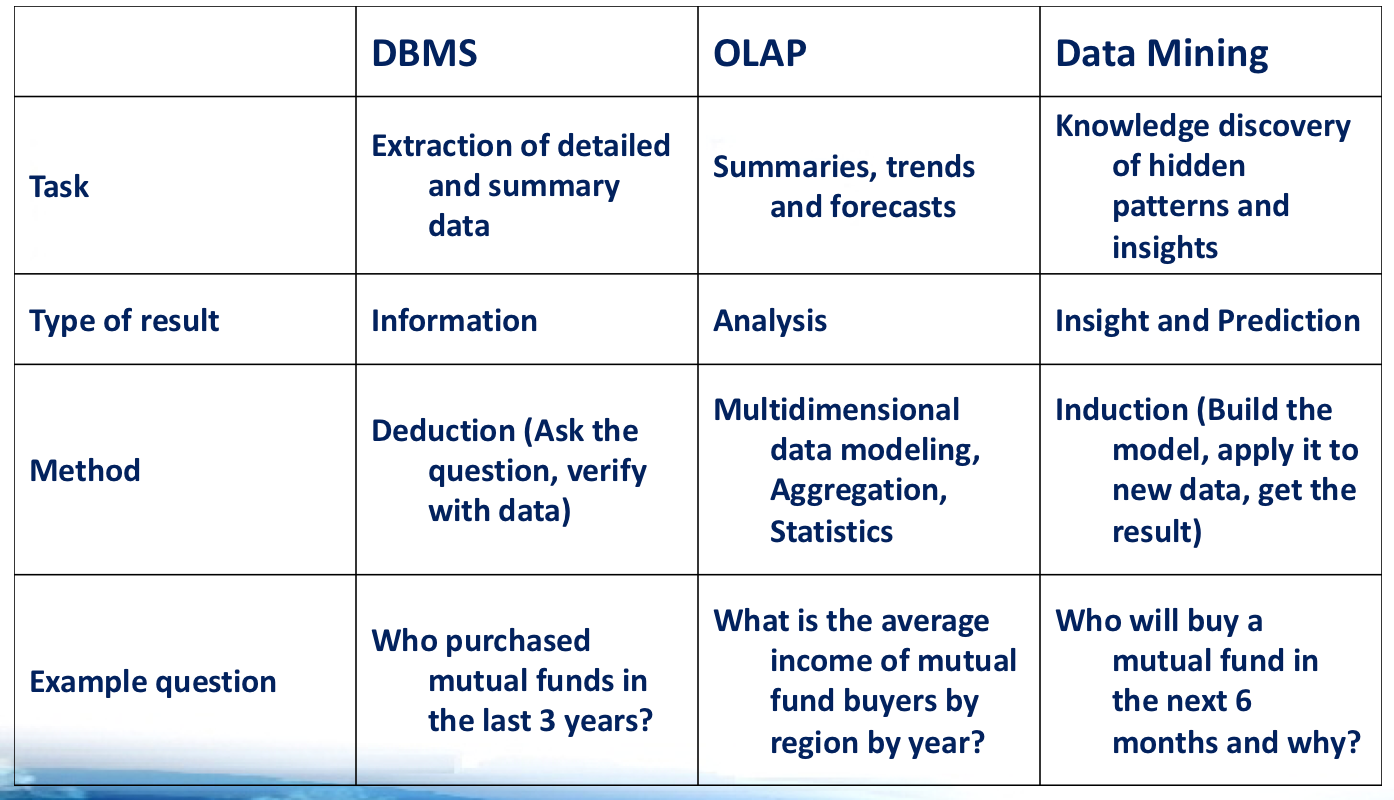
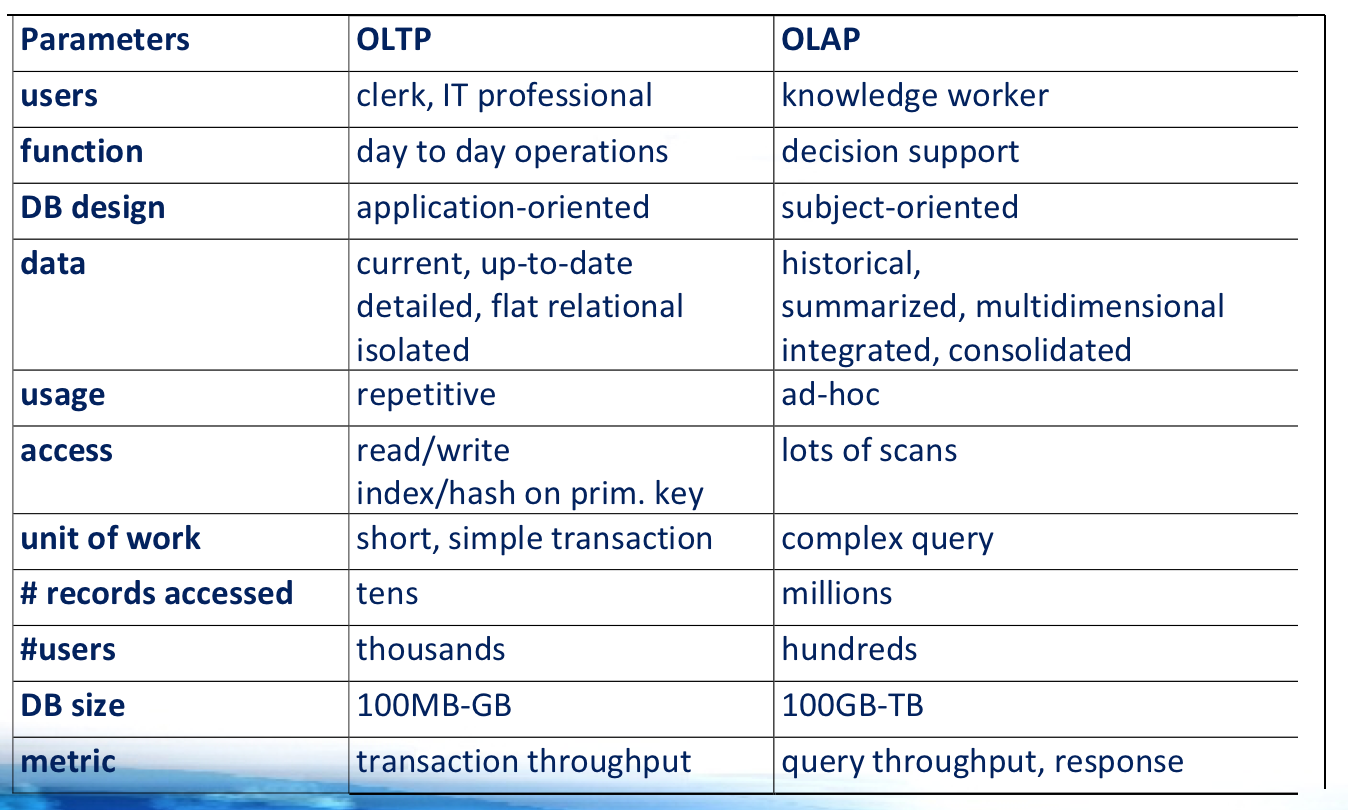
- 21Compare and contrast the following Data Management processing techniques. Support your answer with suitable examples. - OLTP (On-line Transaction Processing) - OLAP (On-line Analytical Processing)- OLTP (on-line transaction processing)
Major task of traditional relational DBMS
Day-to-day operations: purchasing, inventory, banking, manufacturing, payroll, registration, accounting, etc. (DBMS: Database Management System)
- OLAP (on-line analytical processing)
Major task of data warehouse system
Data analysis and decision making - 22Compare and contrast the following Data Management processing techniques. Support your answer with suitable examples. - OLTP (On-line Transaction Processing) - OLAP (On-line Analytical Processing) (Table)
- 23Discuss the differences between ‘Data Warehouse’ and ‘Big Data’.A data warehouse is typically a dedicated data base system for decision making that is separate from the production data base(s) used operationally.
- Big data refers to data sets whose size is beyond the ability of typical database software tools to capture, store, manage and analyze. - 24Big Data toolsHadoop, Spark, Shark, Pig
- 25Name the three attributes used in Big Data and briefly explain each of them.Volume - the amount of data
Velocity - the speed of incoming data
Variety - different types of data
Veracity - truthfulness of data - 26What is meant by the term ‘Big Data Analytics’? Using a simple business scenario, give an example of a business problem that can be solved by it.Fundamentally, big data analytics is a workflow that distills terabytes of low-value data (e.g., every tweet) down to, in some cases, a single bit of high-value data (Should Company X acquire Company Y?).
- 27Purpose Data Mining (KDD)Extraction of interesting (non-trivial, implicit, previously unknown and potentially useful) information or patterns from data in large databases.
- 28Data warehouse attributes- Integrated data - allows the miner to easily and quickly look across the range of data
- Detailed and summarised data
- Historical data
- Metadata - 29Applications of AI- Expert Systems
- Natural Language Processing
- Speech recognition
- Computer Vision
- Robotics
- Automatic Programming - 30Expert system- An Expert System is a computer program designed to act as an expert in a particular domain (area of expertise). Designed to assist experts, not to replace them.
- An expert system is a computer system that emulates, or acts in all respects, with the decision-making capabilities of a human expert. - 31AI methodologies- Rule-based systems
- Knowledge-Based systems
- Neural Networks
- Fuzzy Logic
- Intelligent Systems
- Case-Based Reasoning - 32Compare and contrast neural network computing and conventional computing.- Artificial neural networks attempt to replicate the connectivity and functioning of biological neural networks (i.e. the human brain). Theory is that replicating the brain’s structure, the artificial network will, in turn, possess the ability to learn.
- The Ability to learn, Flexibility to handle any type of problem. - 33Choose one example of an application of an Expert system that support Rule-based methodology and discuss its benefits.- contains information obtained from a human expert, and represents that information in the form of rules, such as IF–THEN. The rule can then be used to perform operations on data to inference in order to reach appropriate conclusion.
- tutoring system, DNA histogram interpre- tation, sensor control(aquaculture) - 34Types of expert systems- Rule-based systems
- Knowledge-based systems
- Neural networks
- Fuzzy expert systems
- Object-oriented methodology
- Case-based reasoning
- Modelling and their applications
- System architecture
- Intelligence agents
- Ontology
-Database methodology - 35Explain why an Intelligent System can fail.- Not widely used or tested
- Limited to relatively narrow problems
- Cannot readily deal with “mixed” knowledge
- Possibility of error
- Cannot refine own knowledge base
- Difficult to maintain - 36Basic functions of an Expert System
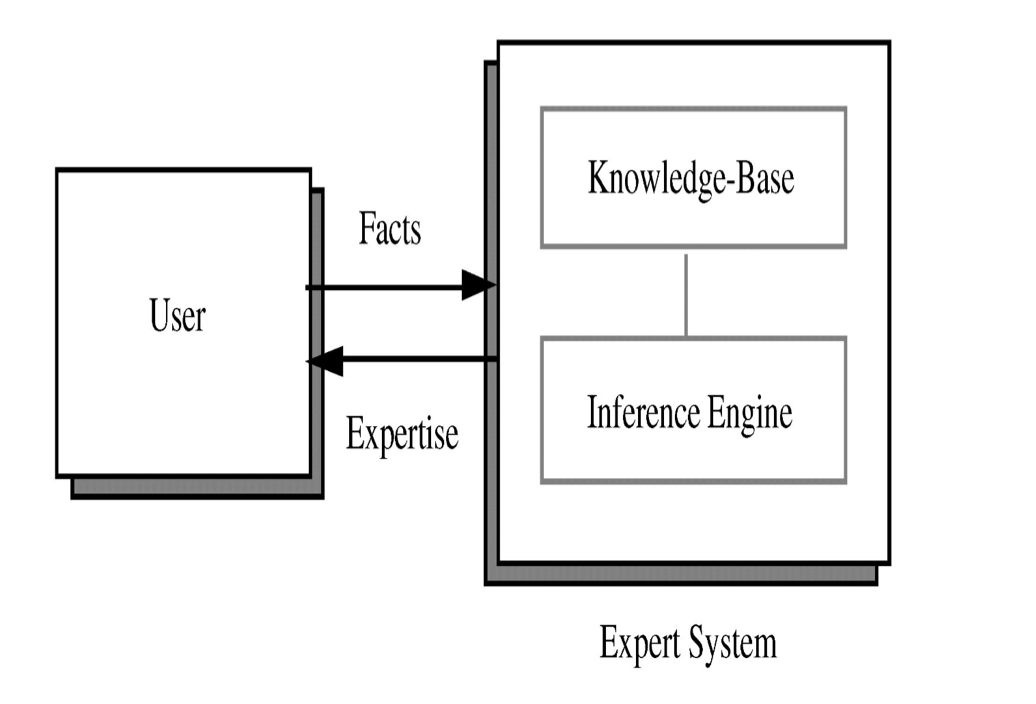
- 37Expert systems - general methods of inferencing- Forward chaining (data-driven)– reasoning from facts to the conclusions resulting from those facts – best for prognosis, monitoring, and control.
- Backward chaining (query driven)– reasoning in reverse from a hypothesis, a potential conclusion to be proved to the facts that support the hypothesis – best for diagnosis problems. - 38Components of an expert systems
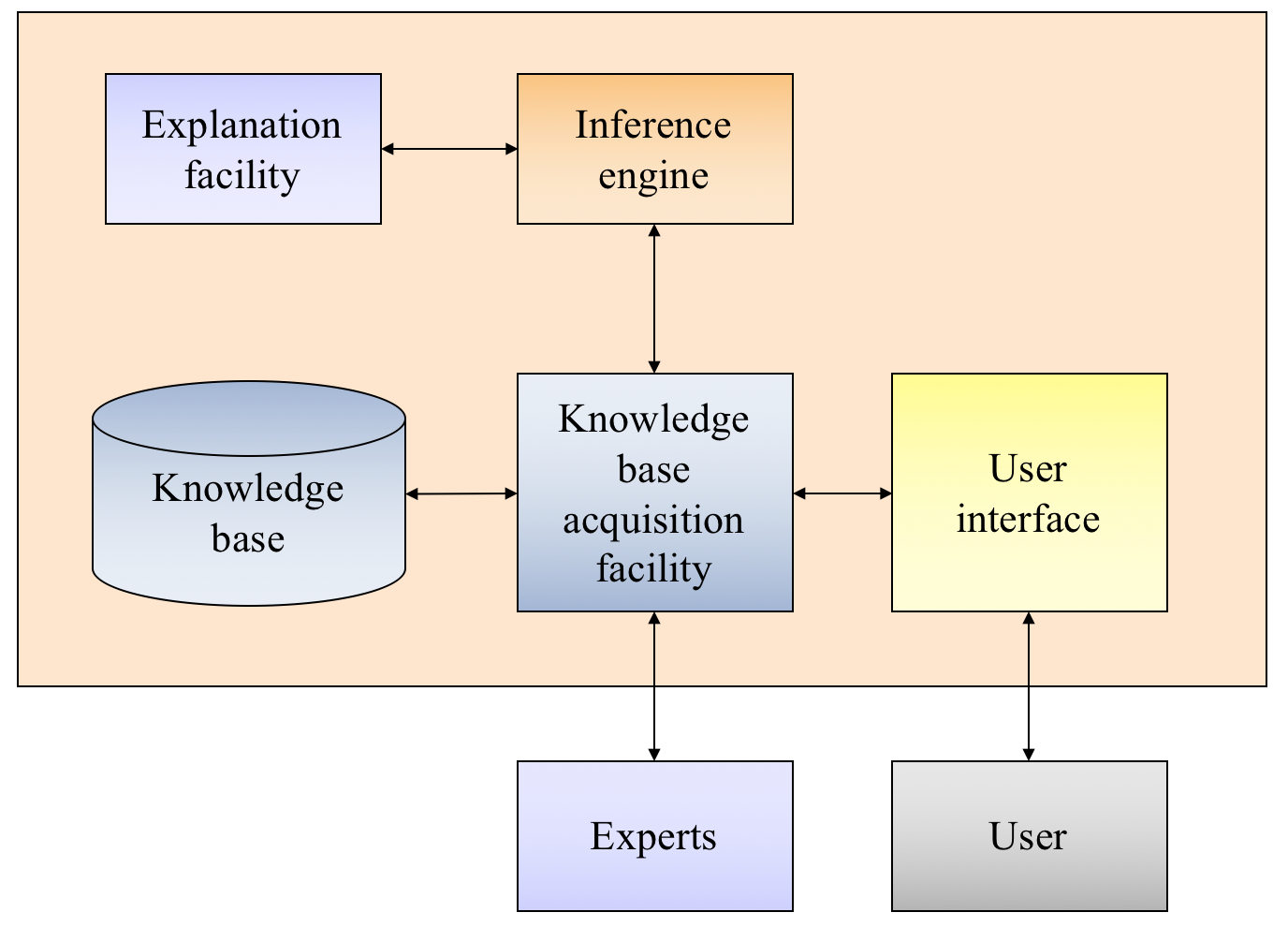
- 39Explain the following term, giving example its importance in a computational environment: ClustersClusters are usually deployed to improve performance and availability over that of a single computer, while typically being much more cost-effective than single computers of comparable speed or availability.
- 40Explain the following term, giving example its importance in a computational environment: Steganography- Communicating secret data in an appropriate multimedia carrier, such as: images, texts and audio.
- The stego-image can be monitored by unintended viewers who will notice only the transmittal of the innocuous image. - 41Explain the following term, giving example its importance in a computational environment: NLP- Enable people and computers to communicate in a natural (humanly) language(such as, English) rather than in a computer language.
- Aim is to allow computers to understand human speech. So that they can hear our voices and recognise the words we are speaking. - 42Explain the following term, giving example its importance in a computational environment: Data CleaningEnsure consistency in naming conventions, encoding structures, attribute measures, etc. among different data sources
E.g., Hotel price: currency, tax, breakfast covered, etc. in data mining. - 43Explain the following term, giving example its importance in a computational environment: OLAP- Approach for analysis of data warehouses
- Major task of data warehouse system
- Summaries, trends and forecasts
- Data analysis and decision making - 44What is a Distributed System?A type of system in which different components that form the application can be located on different computers connected via a network, giving the perception of single large system in operation
- 45Examples of Distributed System.- Local Area Network and Intranet
- Database Management System
- Internet/World-Wide Web - 46MiddlewareResource management, data access, resource discovery, access to computation, coscheduling, data replication
- 47Clipping in Image processingClipping results from an operation (any) on an image where the pixel value that result from the operation exceeds the limits of the bit depth of the image
- 48Supervised x Unsupervised Neural Networks examples- Supervised neural networks - Multi-layer perceptron, Elman recurrent network
- Unsupervised network – Self-organising map, Hopfield network, Wake-sleep algorithm, deep learning, associative networks etc - 49Data WarehouseA data warehouse is a subject-oriented, integrated, time-variant, and nonvolatile collection of data in support of management’s decision-making process.”