
Flashcards
Cloud - Test 1 (B)
Cards in this deck (10)
- 1What are the 3 architecture tiers for Web Application Deployment?->Client Tier
->Application Tier
->Data Tier - 2Give some reasons for having more than one application server instance1. A single server might not be sufficient to handle all client requests;
2. A single server is a single point of failure: if it fails the service becomes unavailable;
3. A single server may be too far from some clients: latency
too high - 3Enumerate some Web Application Services->Azure Web App Service
->Google App Engine
->AWS Elastic Beanstalk - 4Describe the Staging approach for version deployment1. Keep the old version running;
2. Deploy the new version to a staging slot (using Azure terminology) – instances are created but requests from
client keep being processed by the old version;
3. (Optionally) warm-up application;
4. Hotswap from the old to the new version, by start forwarding client requests to the new version. - 5Describe the A/B deployment approach1. Have two versions running at the same time;
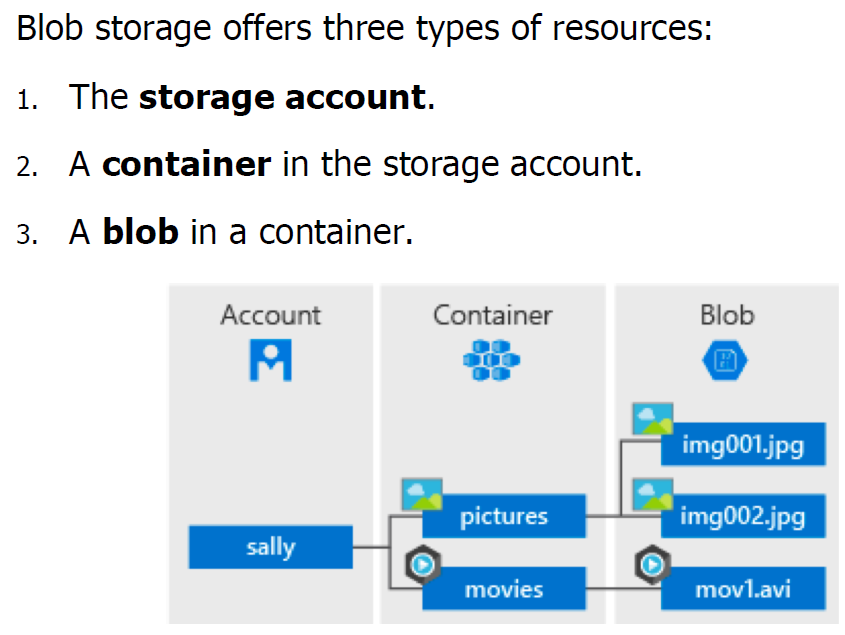
2. Forward a small percentage of requests to the new version. - 6DATA MODEL (AZURE BLOB STORAGE)
- 7Describe the 3 Azure access TiersHot: Optimized for frequent access of objects. Storage costs are higher.
New storage accounts are created in the hot tier by default
Cool: Optimized for storing large amounts of data that is infrequently
accessed and stored for at least 30 days. Accessing data may be
more expensive than accessing data in the hot tier
Archive: Optimized for data that can tolerate several hours of retrieval
latency and will remain in the Archive tier for at least 180 days - 8Describe the 4 azure redundancy levelsLocally-redundant storage (LRS): Data is replicated synchronously three times within the primary region.
Zone-redundant storage (ZRS): Replication for scenarios
requiring high availability. Data is replicated synchronously
across three Azure availability zones in the primary region.
Geo-redundant storage (GRS): Cross-regional replication to protect against regional outages. Data is replicated
synchronously three times in the primary region, then replicated asynchronously to the secondary region. For read
access to data in the secondary region, enable read-access geo-redundant storage (RA-GRS).
Geo-zone-redundant storage (GZRS) (preview):
Replication for scenarios requiring both high availability and maximum durability. Data is replicated synchronously across
three Azure availability zones in the primary region, then replicated asynchronously to the secondary region. For read access to data in the secondary region, enable read-access
geo-zone-redundant storage (RA-GZRS). - 9Main Azure Blob security features->Data is stored using AES
->AD
->Communication always uses secure channels
->Role-Based Access Control - 10Main Azure Blob concurrency features-> Default is last-writer-wins policy
-> Optimistic Conditional Update:A client can specify some condition that must hold for an update to be accepter – e.g. that the current version of an
object is some version previously observed.
->Pessimistic Concurrency:A client can lock a block for exclusive access. (for a lease time)
Information
- Description
- Flashcards on Cloud - Test 1 (B), created by Bruno Ramos on 24/10/2019.
- Created by
- Bruno Ramos
- Views
- 1
- Rating