
Flashcards
The Thorax: Respiratory System, Upper Respiratory Tract
Cards in this deck (78)
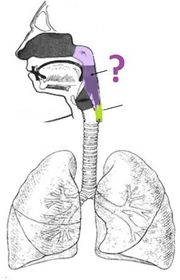
- 1—pharynx
- 2—oesophagus
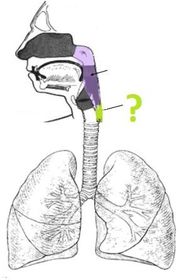
- 3—larynx
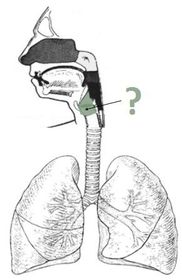
- 4Describe the structure of the tracheaMade of 15-20 C-shaped rings of cartilage. The ends of the rings where there is no cartilage is completed by the trachealis muscle. The only complete ring of cartilage of the trachea is the cricoid cartilage, which separates it from the larynx superiorly.
- 5Why is the space within the upper respiratory tract termed 'dead space'?Because no gas exchange occurs here.
- 6Which parts of the upper respiratory tract contain smooth muscle?Trachea and bronchial tree.
- 7What is a URTI, and what usually causes it?Upper respiratory tract infection; usually viral infection.
- 8What does the upper respiratory tract refer to?The tract above the level of the vocal cords, although there is no generally agreed definition.
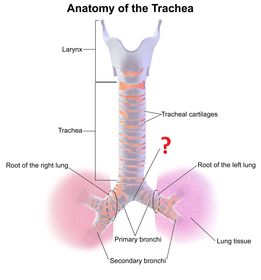
- 9—Carina
- 10Why can a URTI spread to the ears?Because there is a tube connecting the ear to the pharynx where infection can spread.
- 11Name the three parts of the pharynxNasopharynx
Oropharynx
Laryngopharynx - 12What are the consequences of viral URTIs?- Secondary bacterial infections
- Inflammation of nose, ear, throat
- Subsequent infection of LRT; bronchitis - 13Name the epithelium which lines the upper part of the respiratory tract (nasal cavities to bronchi)?Pseudostratified ciliated columnar epithelium
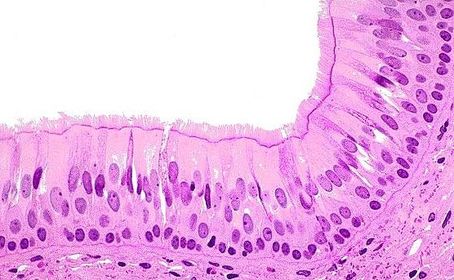
- 14What are goblet cells, and what is the advantage of them being present within the respiratory epithelium of the upper tract?Goblet cells are mucus-secreting cells; this mucus protects the airway by trapping foreign particles.
- 15Apart from goblet cells, what other cells lining the URT aid protection of the airway by trapping foreign particles?Submucosal glands which secret mucus and serum.
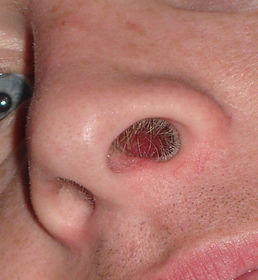
- 16What are vibrissae?Hairs lining the openings of the nasal cavities (vestibule) which trap large air-borne particles.
- 17What do serous glands secrete?Antibiotic enzymes
- 18Why are the cilia known as the 'mucocilary escalator'?Because they waft the fluid of the nasal cavities, trachea and bronchi towards the pharynx where it can be swallowed.
- 19If viruses and bacteria manage to bypass the upper respiratory tract protective mechanisms and reach the alveoli, how are they dealth with?- They are phagocytosed and destroyed by macrophages.
- Macrophage presents antigens to awaiting B and T cells which then produce more antibodies to activate the macrophage.
- Macrophage also releases factors initiating an inflammatory response. - 20Which immune cells secrete a substance which can cause restriction of the airways?Mast cells release histamine.
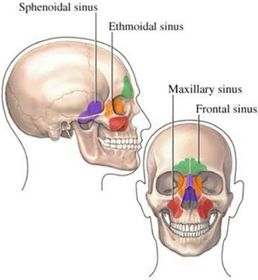
- 21What are the paranasal sinuses, and how many are there?Group of 4 air-filled spaces that surround the nasal cavities.
- 22Name the paranasal sinuses.
- 23The paranasal sinuses are present at birth, true or false?False; they develop soon after.
- 24List the 5 functions of the paranasal sinus.1 - Decrease weight of bones on the face
2 - Increase resonance of voice
3 - Provide buffer against blow to face
4 - Insulate sensitive structures, e.g. dental roots and eyes, from rapid temperature fluctuations in the nasal cavity.
5 - Humidify and heat inhaled air - 25Describe the position of the frontal sinusLocated in the frontal bone of the forehead just above the eyes.
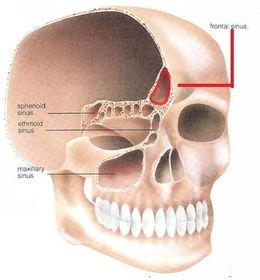
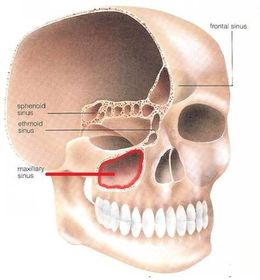
- 26Describe the position of the maxillary sinuses.In the cheekbones on each side of the nose.
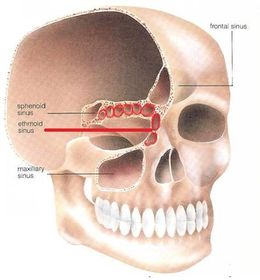
- 27Describe the position of the ethmoid sinusesJust above the nasal cavity
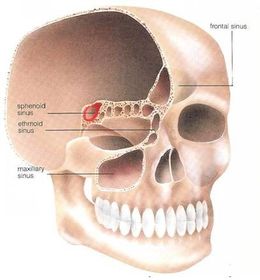
- 28Describe the position of the sphenoidal sinuses.Within body of sphenoid bone, behind ethmoid sinuses.
- 29What is sinusitis?Infection of the nose which has spread to the sinuses.
- 30What is the consequence of sinusitis?Inflamed mucous membranes become swollen and close the openings, preventing exit of infected material. Painful build up of pressure = dizziness, runny nose. Maxillary sinus infection can also cause tooth-ache due to their close proximity.
- 31How are sinus disorders treated?Rest, liquid diet, serious infection may require surgical intervention to drain infected material.
- 32From where the the nerve fibres of the lung (pulmonary plexus) arise from?Vagus and sympathetic nerves.
- 33Visceral pain in the thorax is transmitted through sympathetic nerves arising from where on the spinal cord?T1-T4
- 34Give examples of EFFERENT fibres of the pulmonary plexusPhrenic and other somatic nerves, (recurrent laryngeal), vagal efferents
- 35Give examples of AFFERENT fibres of the pulmonary plexusipsilateral vagus nerve
- 36What is referred to as the 'cough center'?Medulla oblongata, which contains afferent fibres separate from those that control breathing.
- 37What initiates the cough reflex?Stimulation of sensory nerves/receptors in the lining of the upper respiratory tract
- 38What 3 changes occur in the thorax in inspiration during the cough reflex?- The glottis opens
- Bronchioles enlarge
- Lungs expand - 39When the lungs are fully stretched and ready to recoil (height of inspiration) during the cough reflex, what happens next?- Glottis closes
- Chest contracts with inspiration
- Intrathoracic pressure increases
- Glottis gives way = rapid air flow during expiration - 40The causes of coughing have been divided into two categories; name these.Intrinsic and extrinsic irritation
- 41What is extrinsic irritation?Stimulation of the cough reflex arising from outside the lungs.
- 42Give the most common examples of intrinsic irritation- Pharyngitis
- Tuberculosis
- Tracheobronchitis; whooping cough, influenza
- Pneumonia
- Asthma
- Carcinoma - 43Give the most common examples of extrinsic irritation- Large heart from congestive heart failure of single chamber enlargement = compression of bronchus/laryngeal nerve = cough
- Pericarditis
- Aortic aneurysms
- Large lymph node (Hodgkin)
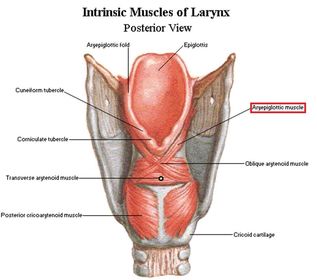
- Trauma - 44What acts as the sphincter of the airway, and name the muscle involved?Larynx, aryepiglottic muscle
- 45What happens to the epiglottis during swallowing?It rises to hit the posterior tongue to protect the layngeal inlet.
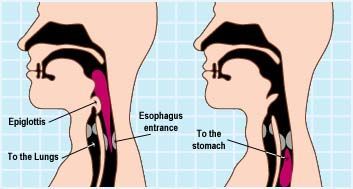
- 46—
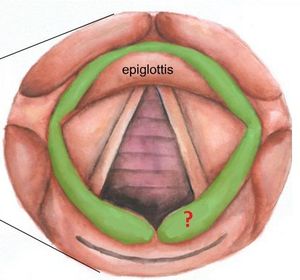
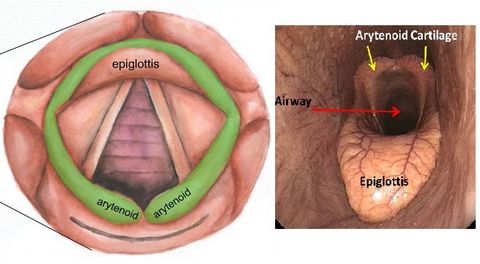
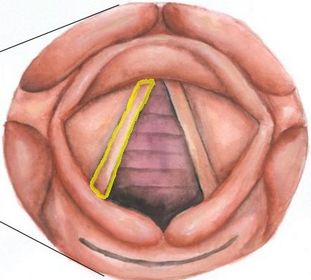
- 47—vestibular fold
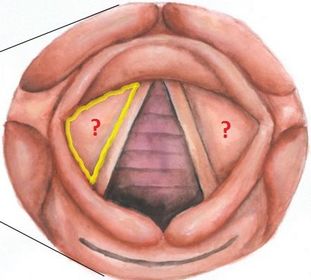
- 48—vocal fold
- 49—epiglottis
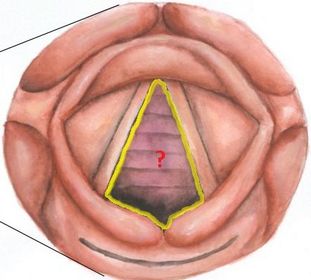
- 50What prevents fluid from entering the airways?Piriform fossae, sinuses on either side of the laryngeal orifice.
- 51Why are vocal fords readily identifiable with a laryngoscope?They are avascular, hence appear white.
- 52What is the glottis?The gap formed between the vocal cords and which is covered by the epiglottis on swallowing.
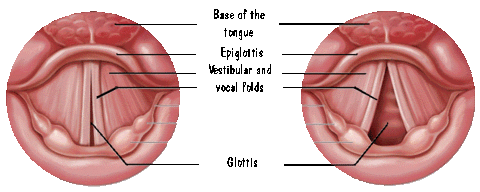
- 53Complete closure of the glottis, shown above, happens when you 1) Speak 2) Cough 3) Breathe 4) WhisperCough
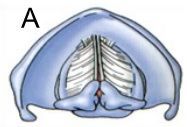
- 54The partial separation of the vocal cords and arytenoid cartilages, shown above, happens when you 1) Speak 2) Cough 3) Breathe 4) WhisperSpeak
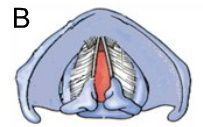
- 55Complete separation/abduction of the vocal cords and arytenoid catilages, shown above, happens when you 1) Speak 2) Cough 3) Breathe 4) WhisperBreathing
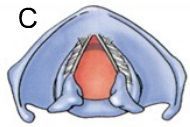
- 56Movement of the vocal cords towards the midline, and abduction/separation of the arytenoid cartilages, shown above, happens when you 1) Speak 2) Cough 3) Breathe 4) WhisperWhisper
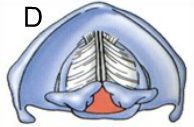
- 57In what circumstance would an emergency laryngotomy be required?Obstruction of the glottis
- 58—thyroid cartilage
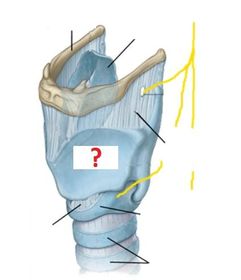
- 59—cricothyroid membrane
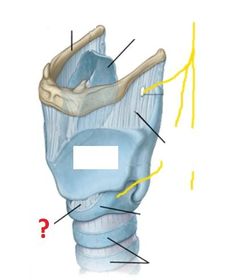
- 60—trachea
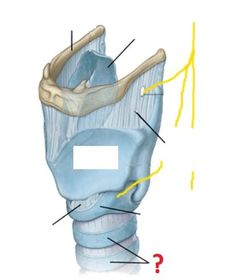
- 61—cricoid cartilage
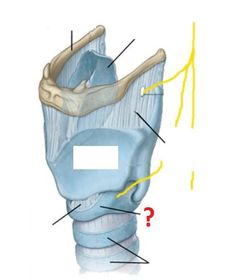
- 62—thyrohoid membrane
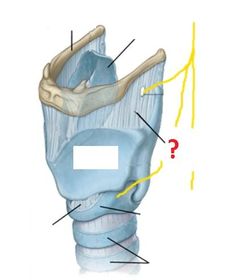
- 63—epiglottis
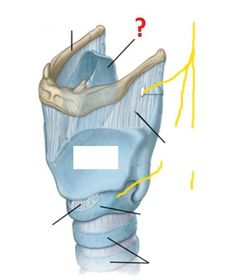
- 64—hyoid bone
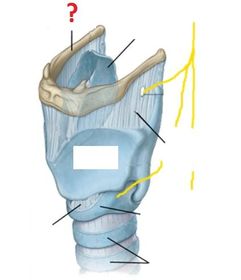
- 65—thyroid gland
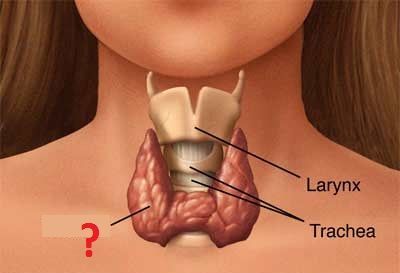
- 66What is a laryngotomy?Surgical procedure to ensure air can get into the airways.
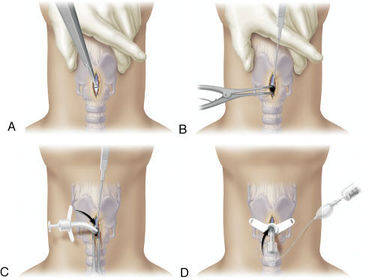
- 67How is a laryngotomy carried out?Penetration of the CRICOTHYROID MEMBRANE with a sharp object. When the blood bubbles, twist the sharp object to create an air opening and secure an empty ball point pen tube in place to maintain patency.
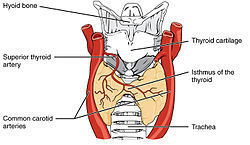
- 68Which arteries supply the larynx? (hint: same as those which supply the thyroid gland)Superior thyroid arteries
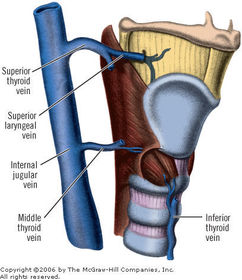
- 69Venous drainage of the larynx is into which veins?Jugular veins
- 70The mucosal lining of the larynx ABOVE the vocal cords is innervated by which nerves?Internal laryngeal branch
- 71The mucosal lining of the larynx BELOW the vocal cords is innervated by which nerves?Recurrent laryngeal branch of the vagus nerve
- 72The motor supply to the larynx (except the cricothyroid muscle) is entirely from which nerves?Recurrent laryngeal nerves
- 73The motor supply to the cricothyroid muscle is by which nerves?External laryngeal nerve; branch of vagus.
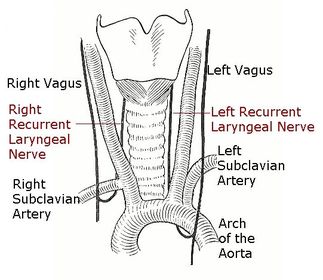
- 74Describe the course of the recurrent laryngeal nerves.Lie in the groove between oesophagus and trachea. As they approach the larynx, they lie embedded within the posterior wall of the thyroid gland.
- 75The trachea is composed of C-shapes rings of which type of cartilage?Hyaline cartilage
- 76Which muscle can modify the diameter of the trachea?Trachealis muscle
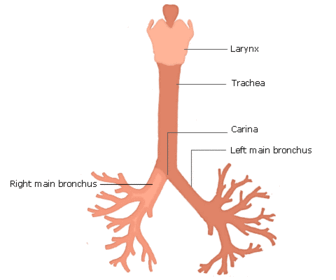
- 77Why is an inhaled objected more likely to enter the right bronchus than the left bronchus?Because the left bronchus is at more of an angle to the trachea than the right.
- 78From where on the vertebrae does the trachea extend from and to?C6-T4
Information
- Description
- Flashcards on The Thorax: Respiratory System, Upper Respiratory Tract, created by Anam Ijaaz on 21/02/2015.
- Created by
- Anam Ijaaz
- Views
- 57
- Rating