
21740104
Description

Flashcards by Marissa Alvarez, updated more than 1 year ago

|
Created by Marissa Alvarez
over 5 years ago
|
|
| Question | Answer |
| GOALS | ->Learn sites of β oxidation in cells and four repeating steps involved ->Understand how fatty acids are activated and transported to mitochondria ->Learn how oxidation is connected to the electron transport chain and citric acid cycle, and calculate yield of ATP from the oxidation of a fatty acid ->Know the differences between β oxidation of fatty acids with even and odd numbers of carbons ->Understand additional steps in the oxidation of unsaturated fatty acids ->Describe the difference between β oxidation and α oxidation |
| TUTORIAL SLIDES β oxidation: Degradation of fatty acid removing _ carbons at a time Proceeds from the ___ __ end of the fatty acid 2 carbons released as I molecule of ___ ___ Fatty acids must be removed from the lipid (break ___) Fatty acids must be activated (form ____ with COA) | 2 carboxylic acid acetyl COA ester thioester |
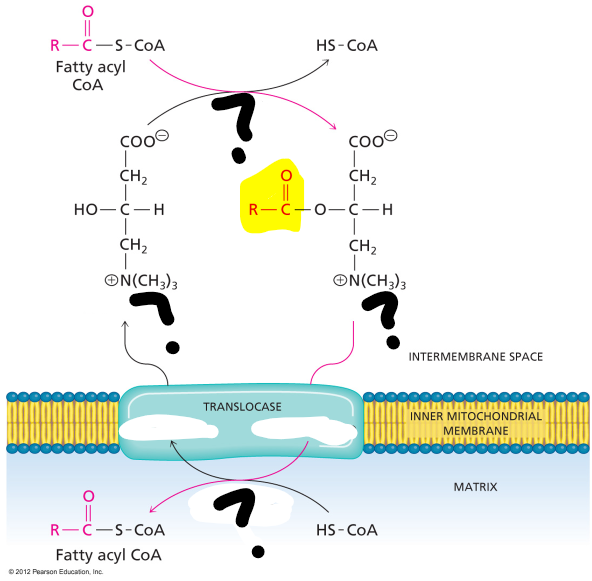
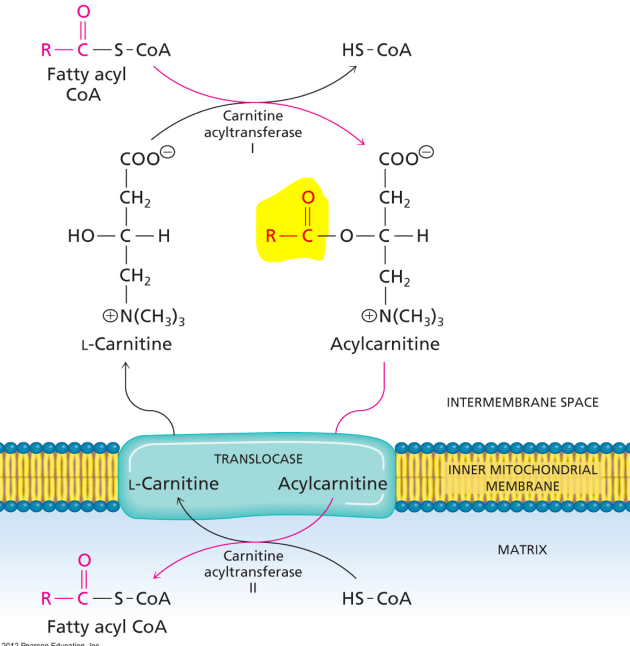
| β oxidation occurs in ____ (mostly) Must get fatty acids into mitochondria first ___ is a carrier for transport Carnitine acyltransferase I (in CYTOPLASM) transfers acyl group from acyl COA to ____ _____ is translocated into mitochondria, while carnitine is translocated out Carnitine ____ __ (in mitochondria) transfers acyl group from acylcarnitine to COA | mitochondria Carnitine carnitine Acylcarnitine acyltransferase Il |
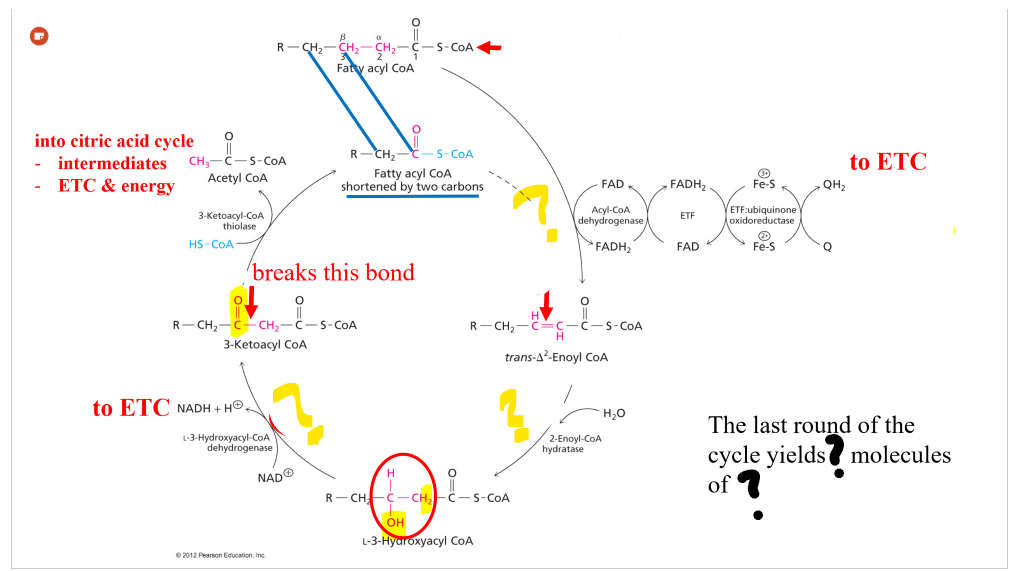
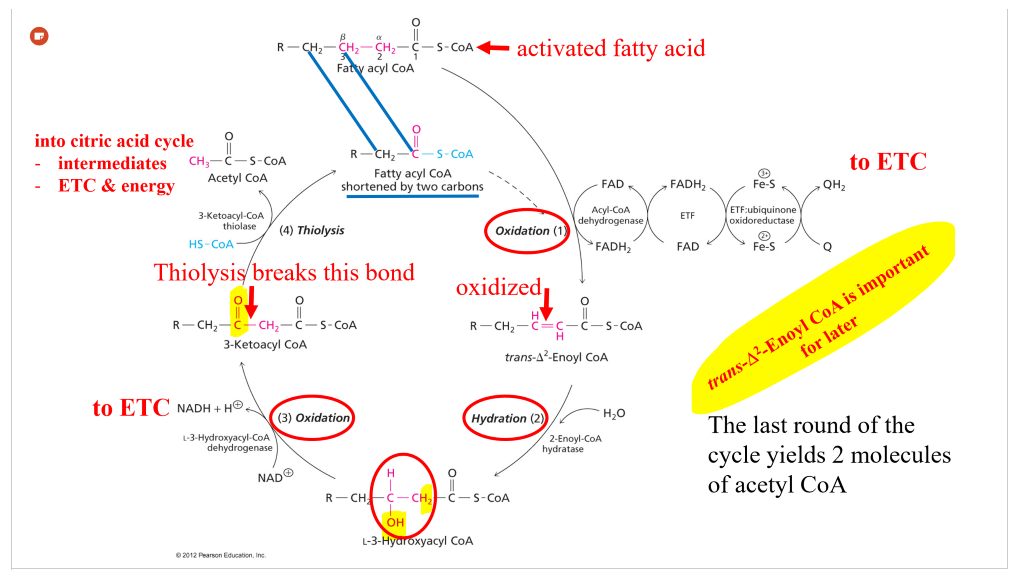
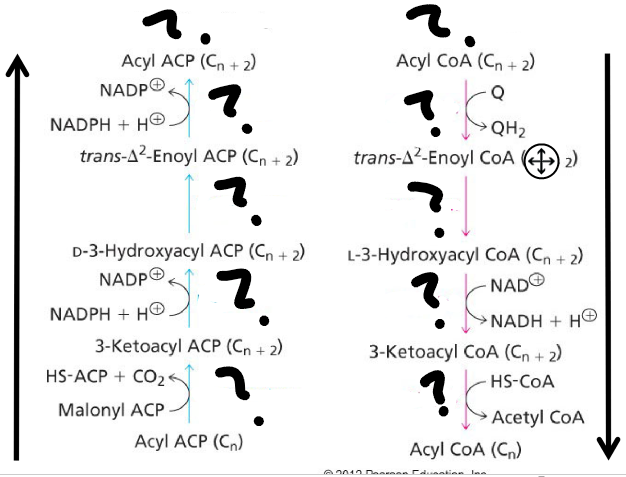
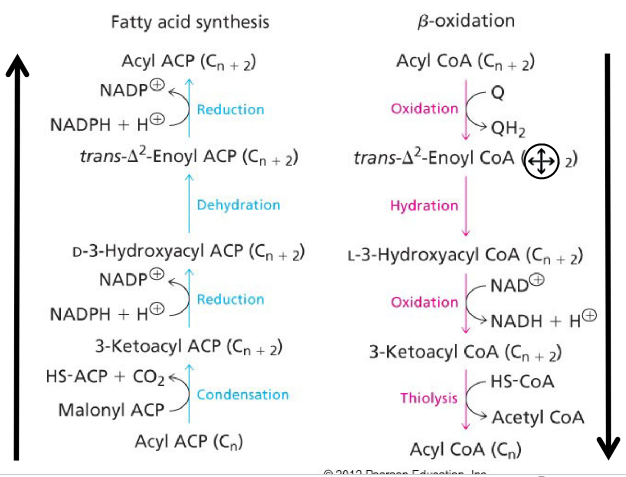
| β oxidation: Four steps l. _____ 2. _____ 3. _____ 4. _____ 1st oxidation generates ___ 2nd oxidation generates ___ FADH2 and NADH go to the __ __ __ acetyl COA goes into the __ ___ ___ | l. oxidation 2. hydration 3. oxidation 4. thiolysis FADH2 NADH electron transport chain citric acid cycle |
| Fatty acids are synthesized and degraded by adding or removing _ carbons at a time. For fatty acid oxidation Four repeating steps — ___, ___, ____, ___, then repeat FA's built and degraded at the same carbon! (at the __ carbon) | 2 oxidation, hydration, oxidation, and thiolysis Beta carbon |
| Why are fatty acids degraded? ->Turnover of membrane lipids ->Yields ___ ->Yield carbons for ___ __ synthesis | energy amino acid |
| Fatty acid oxidation Primarily occurs in ____. There are two steps: 1.) ____ 2.) ____- Four repeating steps — oxidation, hydration, oxidation and thiolysis, then repeat | mitochondria Activation Degradation |
| Ester linkage between fatty acid and carbon backbone of lipid must be hydrolyzed to yield __ ___ Free fatty acids must be ____ before they can be degraded. Forms a ___ with COA. This is the same reaction we discussed in lipid synthesis — ___ of fatty acids | fatty acid ***Most fatty acids are not free, they are incorporated into lipids SO the ester bond must be hydrolyzed (broken) to release the fatty acid activated thioester (to become activated) activation (free fatty acid becomes acyl-CoA via acyl-CoA synthetase) |
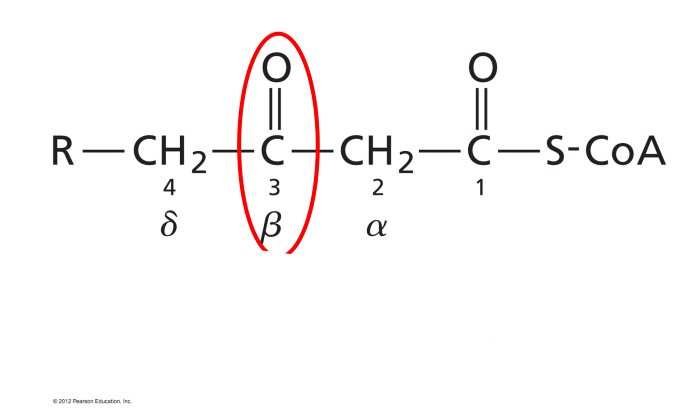
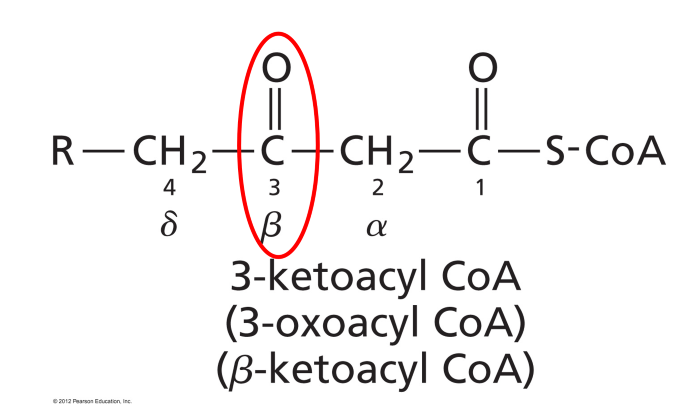
| To make a FA you need to get rid of ketone but to degrade FA you need introduce an acyl group (a ketone) so that once cleaved, a fatty acid will still remain | |
| 1 round yields = 1 acetyl CoA and 1 fatty acyl CoA LAST round = 2 molecules of acetyl CoA -so if you have a 16 carbon molecule you go through 7 times to get down to a 4 carbon molecule You need to get down to the 4 carbon molecule to generate two acetyl CoA | |
| Fatty acid oxidation also occurs in peroxisomes Very long-chain fatty acids (>C26) are oxidized in _____ When shorter, fatty acids are transported to ___ for further oxidation __ oxidation also occurs in peroxisomes | peroxisomes mitochondria α |
| Mitochondrial vs peroxisomal oxidation In mitochondria — first oxidation is catalyzed by acyl-COA ____— FAD is ___ In peroxisomes — first oxidation is catalyzed by acyl-COA ___— electrons transferred to 02 to generate ___ | dehydrogenase reduced oxidase H2O2 ***Important to reduce FAD in mitochondria because the energy can be transferred to the ETC (cannot do this in the peroxisome) |
| β oxidation and energy Consider this example — stearate = C18 fatty acid How many ATP could be made? ___ cycles of β oxidation generate: 8 QH2 12 ATP 8 NADH yields 20 ATP 9 acetyl COA yields 90 ATP Activation of stearate cost _ ATP equivalents I molecule of stearate can yield ___ ATP Oxidation of stearate = ___ ATP; oxidation of 3 glucose (CI8) = 96 ATP SHORTCUT??? (for both gross and net ATP) | Eight 2 120 120 1 cycle of oxidation produces 14 ATP and last acetyl CoA produced 10 ATP -(14 *#of cycles) + 10 ATP = GROSS amount) -(14 *#of cycles) + 10 ATP - 2ATP = NET amount) |
| Comparison of fatty acid synthesis and β oxidation Opposite processes but different: Different cofactors (COA vs ACP) Oxidation — _ carbon products Synthesis — __ carbon substrate Different compartments: cytoplasm vs mitochondria | CoA = degradation (β oxidation) ACP = synthesis (FAS) 2 3 cytoplasm = FAS mitochondria = β oxidation |
| Problem — how to get fatty acids into mitochondria? Little ones (<C12) = ___ BIGGER ones need transport Transported with ___ as a carrier | diffuse carnitine |
| Problem — how to get fatty acids into mitochondria? 1. ___ ___ _ covalently links acyl group from fatty acyl COA to carnitine — occurs at outer membrane of mitochondria 2. ____ is translocated INTO the mitochondrial matrix as carnitine is translocated OUT of the matrix 3. ___ ____ __ in matrix of the mitochondria, transfers acyl group to COA, generating acyl COA and free carnitine | Carnitine acyltransferase l ***key to regulation Acylcarnitine Carnitine acyltransferase Il |
| What happens to odd chain fatty acids? Most ANIMAL fatty acids have ___ number of carbons Odd chain fatty acids are made by other species These can be degraded by __ ___ The last step produces 1 molecule of acetyl COA (C2) and I molecule of ___ __ (C3) __ __ is converted to ___ CoA, which is used in the citric acid cycle | even β oxidation propionyl CoA Propionyl COA succinyl **Odd FA chain = stop at 5 carbons and end up with 2 carbons (acetyl CoA) and 3 carbons (propionyl CoA) |
| What happens to unsaturated fatty acids? • β oxidation occurs as normal until double bond gets in the way — occurs because l) double bond may be ___ and may be in the __ __, e.g. Δ3 position, or 2) might be a Δ2'4 diene l) If an isomerase converts to ___ and moves the double bond to the Δ2 position yielding a ___-___-___ ___ (product of first oxidation step of β oxidation — remember) and β oxidation resumes •2) If reductase reduces a double bond, generating a double bond in the wrong place: ->___ moves the double bond to the Δ2 position yielding a trans-Δ2-Enoyl COA and β oxidation resumes | cis wrong place trans trans-Δ2-Enoyl COA Isomerase ***Needs to be in TRANSconfiguration AND double bond needs to be in the right place |
| Fatty acid oxidation via other mechanisms If β carbon is methylated, e.g. in phytanic acid, β oxidation ___ occur -> Can be modified by __ oxidation Resulting product can be degraded by __ oxidation α oxidation occurs in ____ | cannot α β peroxisomes |
| Recap •Fatty acids are transported as ___ into the mitochondria, where _ oxidation occurs (transport is KEY regulatory step) •Oxidation involves 4 repeated steps of: oxidation, hydration, oxidation and thiolysis to generate __ __ (shorter by 2 C's) and __ ___ •Oxidation steps generate ___ and ___ — connect to electron transport chain — also generates __ __ which enters citric acid cycle •UNsaturated fatty acids required additional steps for degradation — either isomerization or ___/___ to generate a substrate for oxidation enzymes •BRANCHED (i.e. methylated) fatty acids must undergo _ oxidation (in peroxisome) prior to β oxidation | acylcarnitine β acyl COA acetyl COA FADH2 NADH acetyl COA reduction/isomerization α |
Want to create your own Flashcards for free with GoConqr? Learn more.