
Flashcards
IB Biology 8.2 Photosynthesis (HL)
Cards in this deck (22)
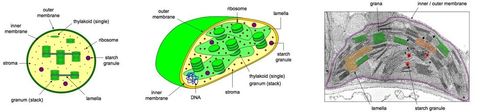
- 1Draw and label a diagram showing the structure of a chloroplast as seen in an electron micrograph
- 28.2.2 State that photosynthesis consists of the light-dependent and light-independent reactionsPhotosynthesis is a two-step process:
1. The light dependent reactions convert the light energy into chemical energy
2. The light independent reaction uses the chemical energy to make organic molecules - 3Draw a diagram of the overview of photosynthesis with LDR and LIR
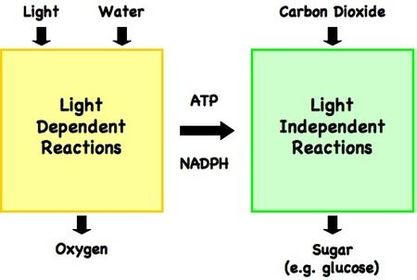
- 4Explain the light-independent reactions.The light independent reaction occurs in the stroma and uses the ATP and NADPH + H+ produced by the light dependent reaction (non-cyclic)
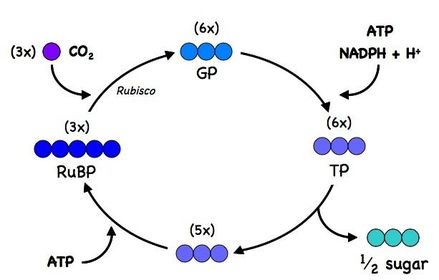
- 5What is the light-independent reaction known as and what are its main stepsThe light independent reaction is also known as the Calvin cycle and occurs via three main steps:
1. Carbon Fixation
2. Reduction
3. Regeneration of RuBP - 6Explain what occurs during Carbon Fixation.The enzyme rubisco (RuBP carboxylase) catalyses the attachment of CO2 to the 5C compound ribulose bisphosphate (RuBP)
The unstable 6C compound that is formed immediately breaks down into two 3C molecules called glycerate-3-phosphate (GP) - 7Explain what occurs during ReductionEach GP molecule is then phosphorylated by ATP and reduced by NADPH + H+
This converts each GP molecule into a triose phosphate (TP) called glyceraldehyde phosphate - 8What occurs during the regeneration of RuBPFor every six molecules of TP produced, only one may be used to form half a sugar molecule (need two cycles to form a complete glucose)
The remaining TP molecules are reorganised to regenerate stocks of RuBP in a reaction that involves ATP
With RuBP regenerated, this cycle will repeat many times and be used to construct chains of sugars (e.g. sucrose) for use by the plant - 9Draw a Diagram of the Calvin Cycle
- 108.2.6 Explain the relationship between the structure of the chloroplast and its functionThylakoids: Small lumen means small changes in proton concentration have a large effect on the proton motive force
Grana: Thylakoids arranged in stacks to greatly increase surface area available for light absorption (chlorophyll located in thylakoid membrane)
Stroma: Contains appropriate enzymes and suitable pH for the light independent reaction to occur - 118.2.7 Explain the relationship between the action spectrum and absorption spectrum of photosynthetic pigments in green plantsPigments absorb light as a source of energy for photosynthesis
The absorption spectrum indicates the wavelengths (frequency) of light absorbed by each pigment
The action spectrum indicates the rate of photosynthesis for each wavelength / frequency
There is a strong correlation between the cumulative absorption spectrum of all photosynthetic pigments and the action spectrum
Both display two main peaks - a larger peak at ~450 nm (blue) and a smaller peak at ~670 nm (red) with a decrease in between (green) - 128.2.8 Explain the concept of limiting factors in photosynthesisThe law of limiting factors states that when a chemical process depends on more than one essential condition being favourable, its rate will be limited by the factor that is nearest its minimum value
Photosynthesis is dependent on a number of favourable conditions - 13What are the limiting factors of photosynthesisLight intensity, Concentration of Carbon Dixiode and Temperature
- 14Why is light intensity a limiting factor to photosynthesis?Light is required for the light dependent reactions (photoactivation of chlorophyll and photolysis of water molecules)
Low light intensities results in insufficient production of ATP and NADPH + H+ (both needed for the light independent reaction) - 15Why is temperature a limiting factor to photosynthesis?Primarily affects the light independent reaction (and to a lesser extent the light dependent reactions)
High temperatures will denature essential enzymes (e.g. rubisco), whereas insufficient thermal energy will prohibit reactions from occurring - 16Why is the concentration of Carbon Dioxide a limiting factor to photsynthesis?Carbon dioxide is required for the light independent reaction to occur (carbon fixation of RuBP by rubisco)
At low levels, carbon fixation will occur very slowly, whereas at higher levels the rate will peak as all rubsico are being used - 178.2.3 Explain the light dependent reactionsThe light dependent reactions occur on the thylakoid membrane and may occur by either cyclic or non-cyclic processes
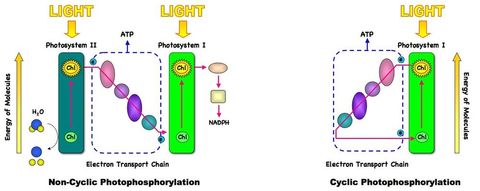
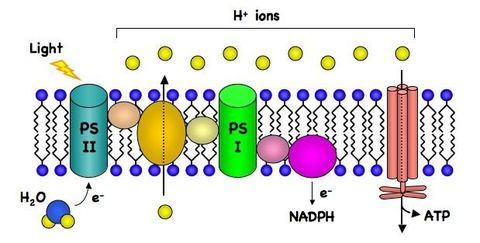
In both processes, light excites chlorophyll (clustered in photosystems) which release electrons that pass through an electron transport chain, making ATP (photophosphorylation) - 18Explain Non-cyclic PhotophosphorylationChlorophyll in photosystems I and II absorbs light, which triggers the release of high energy electrons (photoactivation)
The electrons from photosystem II pass along a series of carriers (electron transport chain), producing ATP via chemiosmosis
The electrons from photosystem I reduce NADP+ to generate NADPH + H+
Electrons lost from photosystem I are replaced by electrons from photsystem II
Electrons lost from photosystem II are replaced by electrons generated by the photolysis of water (oxygen is produced as a by-product) - 19Explain PhotophosphorylationOnly photosystem I is involved in cyclic photophosphorylation
The high energy electrons released by photoactivation pass along an electron transport chain (producing ATP) before returning to photosystem I
Cyclic photophosphorylation does not produce NADPH + H+, which is needed for the light independent reactions
Thus while cyclic photophosphorylation can make chemical energy (ATP) from light, it cannot be used to make organic molecules - 20Draw two diagrams comparing cyclic and non-cyclic photophosphorylation
- 218.2.4 Explain photophosphorylation in terms of chemiosmosisAs the electrons (released from chlorophyll) cycle through the electron transport chains located on the thylakoid membrane, they lose energy
This free energy is used to pump H+ ions from the stroma into the thylakoid
The build up of protons inside the thylakoid creates an electrochemical gradient (or proton motive force)
The H+ ions return to the stroma via the transmembrane enzyme ATP synthase, which uses the potential energy from the proton motive force to convert ADP and an inorganic phosphate (Pi) into ATP
This process is called chemiosmosis - 22Draw a diagram of photophosphorylation via chemiosmosis
Information
- Description
- Biology (Topic 8 Respiration and Photosynthesis (HL)) Flashcards on IB Biology 8.2 Photosynthesis (HL), created by robertospacey on 12/03/2015.
- Created by
- robertospacey
- Views
- 264
- Tags
- Rating