
2730333
Description

Flashcards by Afronewtzz, updated more than 1 year ago

|
Created by Afronewtzz
over 11 years ago
|
|
| Question | Answer |
| How can we trace glycolysis in Biochemistry? | By following the production of hydrogen ions, H+. |
| Write the equation for the anaerobic metabolisms of glucose. What organism metabolises most of its sugars in this way? | C6H12O6 > 2CH3CH2OH (ethanol) + 2CO2 Baker's yeast. |
| In anaerobic glycolysis when dissolved carbon dioxide is produced; how does this CO2 function in solution - write any equations necessary. | Aqueous carbon dioxide behaves as a weak acid in solution and reacts with water to produce protons and bicarbonate. Catalysed by carbonic anhydrase. CO2 + H2O < > HCO3- + H+ |
| What is a complication in using the proton production (when carbon dioxide functions as a weak acid in solution) to measure the rate of glycolysis? How do we work our way around this? | The carbonic anhydrase reaction is in equilibrium, so not all the carbon dioxide will be converted into protons and so the consequent drop in pH will not be as low. We use the Henderson-Hasselbalch equation which links pH, pKa and the conc. of conjugate acids and bases. |
| What are endogenous substrates? | Substrates that originate from within the organism, tissue or cell. |
| Why is it important that you start the experiment as soon as you can? | Because even though the yeast have been starved for 72hours, they are actively metabolising endogenous substrates and so the pH will slowly drop as protons are produced - we want the pH to be an indication of the metabolism of glucose for optimal results. |
| What will be the change in pH if you add 1e-3 moles H+ to a 1L solution starting at pH 4.0? | 10^-4 = 1e-4 mol.L^-1 (1e-4) + (1e-3) = 1.1e-3 mol.L^-1 pH = - log (1.1e-3) = 2.959 Change = 4 - 2.96 = 1.04 |
| When calculating the pH change of a solution upon addition of moles of hydrogen ions, if the solution was buffered, would you expect the observed pH change to be about the same or smaller than if they were without? Why? | Smaller - buffers have the ability to soak up pH changes to some extent. |
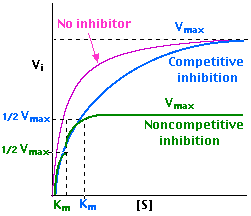
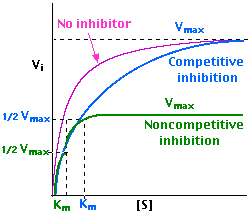
| What is the expected shape of a Michaelis-Menten plot? | Hyperbolic. |
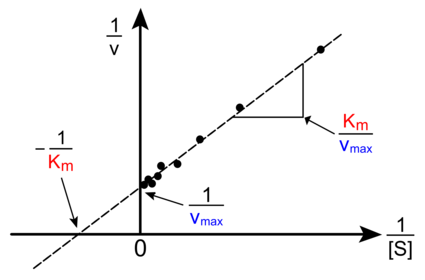
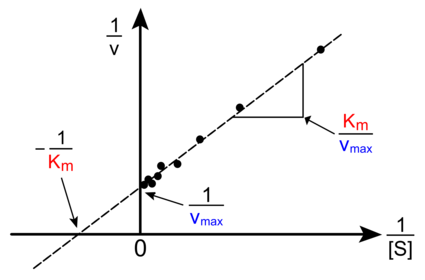
| What is the expected shape of a Lineweaver-Burk plot? | Linear |
| How do you estimate Vmax in a Michaelis-Menten plot? | Read the axis where the curve would flatten off. |
| How do you estimate Km in a Michaelis-Menten plot? | Halve the Y-axis value where the graph flattens off, read across and down to the X-axis. |
| How do you estimate Vmax in a Lineweaver-Burk plot? | -1 / Y-intercept |
| How do you estimate Km in a Lineweaver-Burk plot? | -1 / X-intercept |
| What is the gradient on a Lineweaver-Burke plot equivalent to? | Km/ Vmax |
| What pH values does the pH meter have to be calibrated between? | pH 4 and 7 |
| You need to prepare a 20mM glucose solution by adding stock glucose to buffer, making a total of 5mL. Given a 1000mM stock, how many microlitres would you need to add? | c1v1 = c2v2 5mL = 5000microlitres 1000x v1 = 20 x 5000 v1 = 100microlitres |
| You need to prepare a 20mM glucose solution by adding stock glucose to buffer, making a total of 5mL. Given a 1000mM stock, how many microlitres would you need to add? | c1v1 = c2v2 5mL = 5000microlitres 1000x v1 = 20 x 5000 v1 = 100microlitres |
| A colleague has tried to make a 20mM glucose solution by adding 400microlitres of a 250mM glucose stock to 5mL of buffer. What is the actual glucose concentration in mM? | Actual conc. of glucose = (Glucose stock conc./ Total volume) x Volume of stock = (250mM / 5400microlitres) x 400microlitres = 18.519mM |
| Assuming you calculated that the yeast produced 3.6nanomoles of H+ when you added 20microlitres of glucose... how many nanomoles of HCO3- were produced? | 3.6nanomoles (1:1 ratio) |
| Calculate the change in pH when you add 1e-3 moles of H+ to one litres of solution starting at pH 3.0. | 10^-3 = 1e-3 mol.l^-1 1e-3 + 1e-3 = 2e-3 pH = -log (2e-3) = 2.69897 Change in pH = 0.301 |
| Will the pH change be larger, smaller or the same if the amount of protons were added to an otherwise identical solution starting at pH 4.5? | The solution at pH 4.5 will have a lower starting [H+] as it is less acidic than the solution starting at pH 3.0. Therefore, addition of the same number of protons will have a greater effect on the pH of the solution (larger change) if the solution starts at pH 4.5. |
| If the initial pH = 6.8, what is the ratio of [HCO3-] / [CO2]. pKa = 6.35 | pH = pKa + log [A-] / [HA] 6.8 = 6.35 + log [HCO3-]/ [CO2] 0.45 = log [HCO3-] / [CO2] 10^0.45 = [HCO3-] / [CO2] [HCO3-] / [CO2] = 2.82 |
| Assume you have calculated that the ratio [HCO3-]/[CO2] = 7.2, and the micromoles of HCO3- = 5.0. How many micromoles of CO2 must have been produced? | 0.694 |
Want to create your own Flashcards for free with GoConqr? Learn more.