
36326787
Description

Created by Greg MacPherson

|
Created by Greg MacPherson
over 4 years ago
|
|
| Question | Answer |
| Unit Five - Module 41 Communication and Language Development | Communication and Language Development |
| language | Our spoken, written, or signed words and they ways we combine them to communicate meaning. |
| phoneme | In a language, the smallest distinctive sound unit. |
| morpheme | In a language, the smallest unit that carries meaning; may be a word or part of a word (such as a prefix) |
| grammar | In a language, a system of rules that enables us to communicate with and understand others. |
| semantics | The set of rules for deriving meaning from sounds. |
| syntax | The set of rules for combining words into grammatical sensible sentences. |
| nativist theory of language acquisition | This theory suggests that we are born with something in our genes that allows us to learn language. It proposes that there is a theoretical language acquisition device (LAD) somewhere in our brains that is responsible for learning a language |
| universal grammar | Nativist theory includes the from Noam Chomsky that humans have a built-in predisposition to learn grammar rules. This theory would help to explain why young children pick up language so easily and use grammar so well. |
| learning theory of language acquisition | The learning theory of language acquisition suggests that children learn a language much like they learn to tie their shoes or how to count; through repetition and reinforcement. |
| interactionist approach of language acquisition | The interactionist approach (sociocultural theory) combines ideas from sociology and biology to explain how language is developed. According to this theory, children learn language out of a desire to communicate with the world around them. Language emerges from, and is dependent upon, social interaction. |
| receptive language | Receptive language refers to how your child understands language. It involves understanding the words, sentences and meaning of what others say or what is read. |
| productive language | Productive language is the ability to produce words and matures in babies after their receptive language. |
| babbling stage | Beginning around 4 months, the stage of speech development in which an infant spontaneously utters various sounds at first unrelated to the household language. |
| one-word stage | The stage in speech development from about age one to two, during which a child speaks mostly in single words. |
| two-word stage | Beginning about age two, the stage in speech development during which a child speaks mostly in two-word statements. |
| telegraphic speech | Early speech stage in which a child speaks like a telegram - "go car" - using mostly nouns and verbs. |
| Broca's area | An area of the frontal lobe, usually in the left hemisphere, that helps control language expression by directing the muscle movement involved in speech. |
| Wernicke's area | An area of the left temporal lobe involved in language comprehension and expression. |
| aphasia | Impairment of language, usually caused by left hemisphere damage either to Broca's area (impairment of speaking) or Wernicke's area (impairment of understanding). |
| Sapir-Whorf Hypothesis | Sapir–Whorf hypothesis, also known as the linguistic relativity hypothesis, refers to the idea that the particular language one speaks influences the way one thinks about reality. The structure of a language determines a native speaker's perception and categorization of experience. In other words, the structure of a language affects its speakers' worldview or cognition, and thus people's perceptions are relative to their spoken language. |
| linguistic determinism | The stronger form of Sapir-Whorf hypothesis - that language DETERMINES the way we think and interpret the world around us. |
| linguistic influence | The weaker form of Sapir-Whorf hypothesis - the idea that language influences thought. The idea that our thinking and world view is relative to our cultural language. |
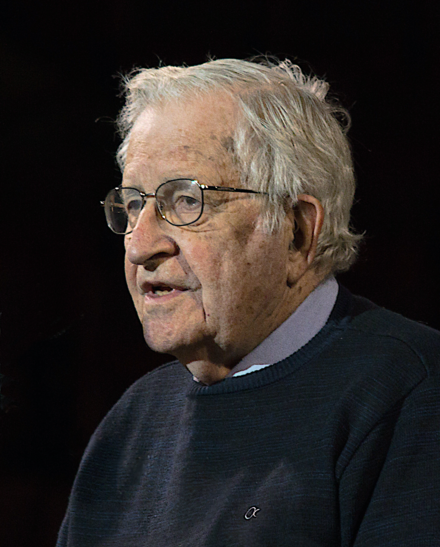
| Noam Chomsky | An important linguist who is famous for, among other things, his theory of universal grammar. |
Want to create your own Flashcards for free with GoConqr? Learn more.